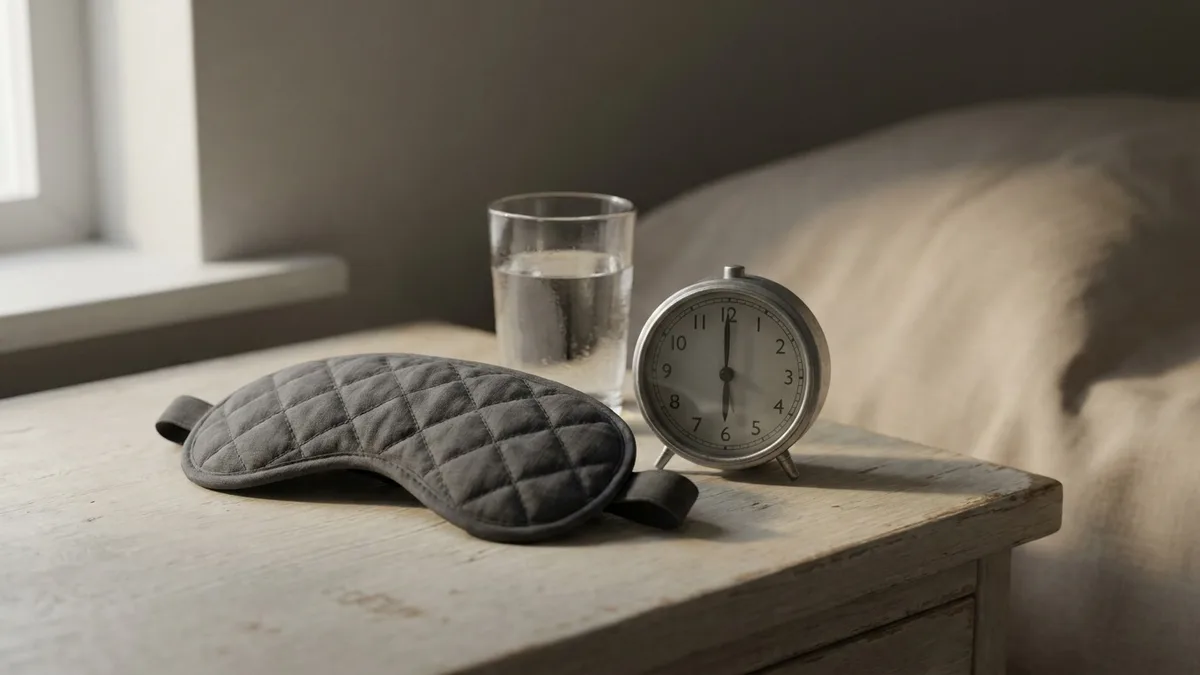
Most people assume adding years takes an overhaul. The credible research points the other way: small, repeatable actions done most days are what hold up.
A parent's stent at 58, or a peer's diagnosis at a Tuesday lunch, sends almost everyone to the same search bar, and it comes back with cold plunges, 5 a.m. protocols and a supplement stack that costs more than the gym.
None of that is where the credible version lives. The daily actions that survive scrutiny are ordinary, need no equipment beyond shoes or a wall, and each has a smallest version that still counts on a bad day.
So here are ten, each shrunk to what a working adult can manage on their worst day and hung on a moment already in their routine: at the bedroom door, at the coffee maker, after the last meal. Pick one, not ten.
Find the habit that already has a slot in your day, run only that for two weeks, and use each entry's closing line, who it fits and who should check with a clinician, to decide which one is yours.
Quick Tips Before You Start
Pick one habit
Choose the habit that already has a fixed moment in your day, not the one you think you should do.
Start with the minimum
Do the smallest version for two weeks before scaling up. Consistency beats intensity.
Set a reminder
Put a phone reminder where you will see it, or place a visual cue like shoes by the door.
Check with your clinician
If you have a medical condition, injury, or take medication, get the green light before starting a new physical habit.
1. The ten-minute walk after your last meal

Ten minutes of easy walking after you eat counts, provided you keep the pace conversational. If you can talk in full sentences without gasping, you are walking at the right speed. The American Heart Association is the place to check what the activity guidance actually says, because the answer is less dramatic than the supplement aisle implies.
The timing is the point, not the distance. You already stop when you finish eating, so nothing new has to be crammed into a day that has no room left in it.
Here is the whole setup. The plate goes in the sink. The shoes sit by the door. The phone stays behind or carries only a podcast. When it rains, hallway laps. When it does not, one loop of the block and back inside before the kitchen light goes off.
Your knees are not the problem.
On a bad day, the walk shrinks to the same ten minutes indoors – living room to hallway and back – and the anchor does not move. The plate still hits the sink, which is why this survives evenings when a gym trip would quietly evaporate.
For most people this one is gentle and near-universal. If you have balance problems, foot pain or any heart symptoms, ask your clinician about pace and surface before you start looping the block.
💡 Tip: Keep a pair of slip-on shoes right by the kitchen door so you never have to hunt for them.
| Habit | Smallest version that counts | Best anchor in the day |
|---|---|---|
| Walk after last meal | 10 minutes easy pace, indoors or out | When the plate hits the sink |
| Strength training | 2×10 minutes of sit-to-stands, wall push-ups, grip hold | Two fixed days (e.g., bin night, Sunday call) |
| Break up sitting | 1 minute standing/moving each hour | Hourly chime or phone alarm across the room |
| Beans once a day | Half cup tinned beans or lentils stirred into a meal | The meal you cook most often |
| Nuts instead of packet snack | A cupped-palm handful of unsalted nuts | Afternoon slump or the cupboard you open on autopilot |
| Fixed wake time | Same time 7 days a week, alarm set | The alarm itself |
| Morning daylight | 10 minutes outdoors within an hour of waking | First coffee or first phone check |
| Slow breathing | 2 minutes, inhale 4 / exhale 6 | When you get into bed |
| One message to one person | One text, reply, or photo to one person | Commute, kettle boiling, or queue at pickup |
| Swap one sweetened drink | One drink swapped for water or unsweetened tea | The drink you buy at a specific time |
2. Two ten-minute strength sessions a week
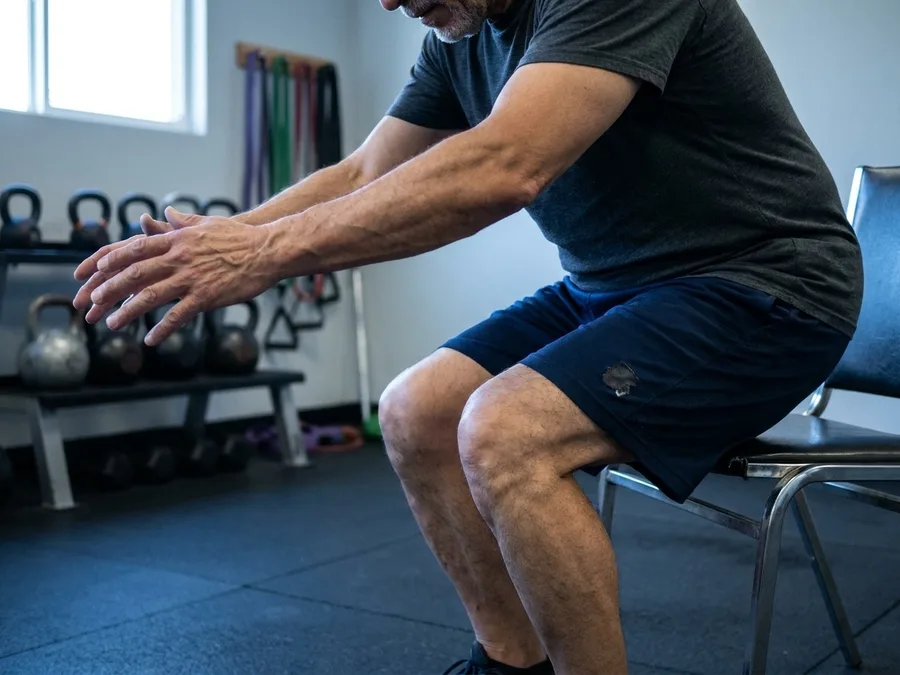
Walking is the habit that keeps a body in motion, and motion is not the same thing as strength. Ten easy minutes after dinner does almost nothing for the muscle that leaves us between 45 and 65, mostly from the legs and hips, without any obvious warning.
So the same frame gets pointed somewhere else: ten minutes, twice a week, no equipment.
A chair, a wall, a door frame. Ten sit-to-stands, standing up from the seat without using your hands. Ten wall push-ups, palms flat at shoulder height. Then a ten-second grip hold on the door frame, one hand at a time, until you feel it in the forearm. That is the session.
Whether a muscle responds at 55 is not in question. Whether you will do it is, and 'twice a week' is a vague instruction that gets negotiated with at 9 p.m. and loses. Hang the sessions on days that already carry something: bin night, the Sunday call to your sister, the morning the recycling goes out.
The day is fixed, the ten minutes are fixed, nothing has to be invented.
Progress comes before weight does. Add one repetition, or lower yourself to the chair over four slow seconds instead of two. The rule that keeps it honest: the last two reps of each set should feel like work, and if they don't, the chair just got a little lower or the count got a little slower.
Two sessions a week is an entry point, not a training plan, and the full version later might mean a gym. The question the reader asked was whether ten minutes counts. It counts if the last two reps are work and the second session actually happens.
If you have a joint replacement, a hernia, uncontrolled blood pressure or surgery in the last few months, run the specific moves past a clinician or a physiotherapist first. The list is short and the modification is usually small, but it should come from someone who knows your history.
💡 Tip: Do your strength session right before your shower. The shower is your reward and the cue.
3. One minute of standing for every hour

Two short strength sessions build something. The ten or twelve waking hours between them are where a desk day takes it back, and not for the reason most people assume.
The chair is not the problem. The problem is the unbroken stretch, hours at a time in the same position, circulation and large muscles idling while the day goes by.
Which means the fix is not furniture. A standing desk costs money, takes up space, and after two weeks most people are standing at it in exactly the same locked posture, just higher up.
What the research points at is interruption.
Stand up once an hour, for one minute. Stretch both arms overhead. Walk to the kitchen and back. No workout clothes, no sweat, no leaving the building. A minute, on the hour.
The anchor is already there: the chime your computer or phone makes on the hour, or an alarm you set and then leave on the far side of the room so that getting up is the only way to silence it. Cost: zero. Equipment: the floor you already have.
Five one-minute breaks across a day do more than a single long walk after work, because it is the continuity of the sitting that matters. A solid block of sitting, then a good walk, is still a solid block of sitting.
If your job already keeps you on your feet, skip this one, you have the opposite problem. If you get dizzy standing up quickly, or your lower back complains, keep the hourly movement but do it seated: stand slowly, hold the desk, or circle the ankles and reach overhead from the chair. The interruption is the point; the posture is negotiable.
⚠️ COMMON MISTAKE
The mistake: waiting for the perfect time
Most people try to schedule a workout but skip the small, unglamorous habits. The ten-minute walk after dinner will do more for your long-term health than the gym session you keep postponing.
4. A fistful of beans once a day

The best fiber habits are not new recipes; they are edits to the plate you already serve.
A spoonful of beans, lentils or chickpeas stirs into the pot that is already on the stove, displacing a little of the meat or the rice rather than joining it. That is the whole maneuver: less of one thing, more of another, no second meal to cook. The USDA and the NIH both publish what daily fiber intake should look like if you want the target in front of you.
Half a cup of tinned beans, rinsed under the tap, or a pre-cooked lentil pouch torn open and tipped in.
No overnight soak, no bag of dried anything, no shopping list rewritten. Your usual grocery run gains one extra tin in the basket and nothing else moves.
Hang it on the meal you cook most often. Same pan, same five minutes, same wooden spoon. Because the trigger is a dinner that was going to happen anyway, this survives the weeks when ambition does not.
Start with two or three dinners a week and build from there. Drink more water than usual alongside, because the bloating people blame on beans usually comes from jumping the fiber intake in one leap rather than from the beans themselves.
If you have IBS, a past bowel obstruction or you eat within a restricted diet, get your portions from a dietitian rather than from a magazine page.
💡 Tip: Rinse canned beans well to reduce sodium by up to 40 percent.
5. A handful of nuts instead of the packet
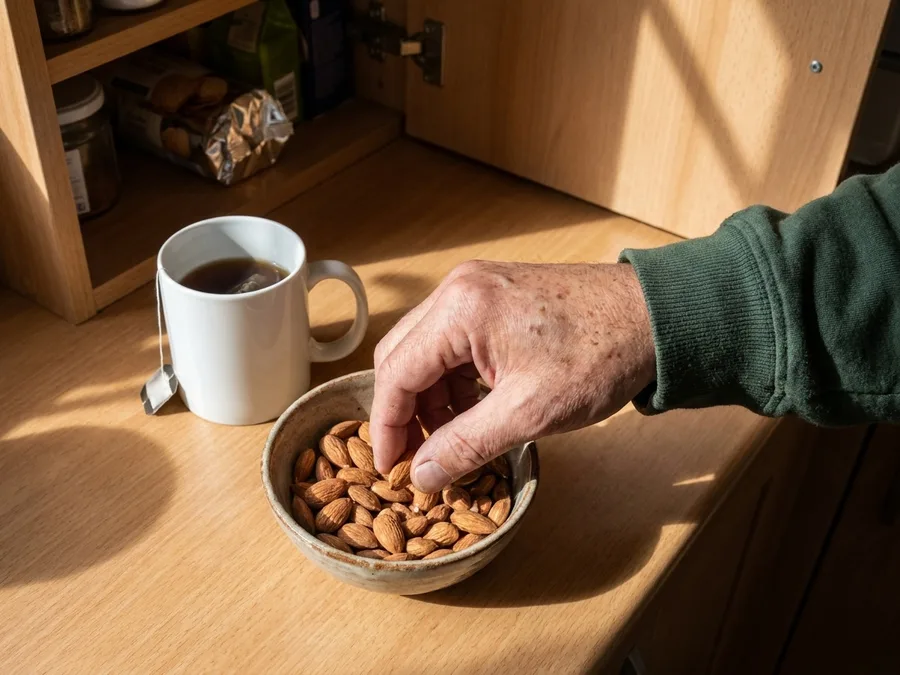
Snacking is not a test of character. It is a report on what is within arm's reach at four in the afternoon.
So treat it as a cupboard decision made in advance, not a resolve summoned at the moment of hunger. You are not going to out-argue a packet of biscuits from six inches away, and you do not have to.
One cupped palm of unsalted nuts gets tipped into a bowl on the counter, or split into small bags at the weekend so a portion is already waiting. The USDA publishes portion guidance if you want a number rather than a handful.
Then the biscuits move. Not out of the house, not into the bin, just up onto the shelf you have to stand up and reach for. The effort of a stretch is enough to turn an autopilot grab into a decision.
Notice what stays: the afternoon pause, the crunch, the something with a cup of tea. The ritual is intact. Only the bowl is different, and that is why this one lasts beyond the second week when the white-knuckle version has already collapsed.
It is worth saying plainly that a handful of nuts is dense in calories, so the palm-sized portion is the habit, not a suggestion. Anyone with a nut allergy skips this one entirely, and anyone with diverticular disease should ask their doctor whether nuts belong in their diet at all.
Nuts — At a Glance
🥜 Best types
Almonds, walnuts, pistachios
✋ Portion
Small handful (1 oz)
🧂 Choose
Unsalted, raw or dry-roasted
💰 Cost
About $0.50 per serving
⚠️ Skip if
Nut allergy
Why it works
Nuts contain healthy fats, protein, and fiber that keep you full longer than refined carbs.
6. The same wake time, weekends included

You cannot force yourself to fall asleep at a chosen hour. You can absolutely force yourself out of bed at a chosen hour.
That is why the wake time, not the bedtime, is the lever. Keep the getting-up fixed and the falling-asleep end tends to slide into place a couple of weeks later on its own. No lavender, no lecture about screens. The NIH National Institute on Aging is the source to check on how sleep timing shifts with age.
One time, seven days a week. The Sunday alarm set exactly as the Monday one is, and something you actually want to get up for, because an alarm with nothing behind it gets snoozed.
The anchor sits at the alarm itself and the first minute after it: curtains open, kettle on. Notice what this is not. It is not a rule you have to enforce at ten at night while lying wide awake and resentful, which is the version that never holds.
Here is the bill. A fixed wake time costs you the weekend lie-in for two or three weeks, and those weeks are uncomfortable enough that most people quit right before the payoff, which is the quiet point where the alarm stops being a fight.
Shift workers, new parents, and anyone with insomnia or suspected sleep apnoea need a clinician's plan. A steady alarm is the wrong tool for a body whose clock is already being pulled in several directions.
💡 Tip: Put your alarm across the room so you have to get out of bed to silence it.
7. Ten minutes of daylight before your first screen
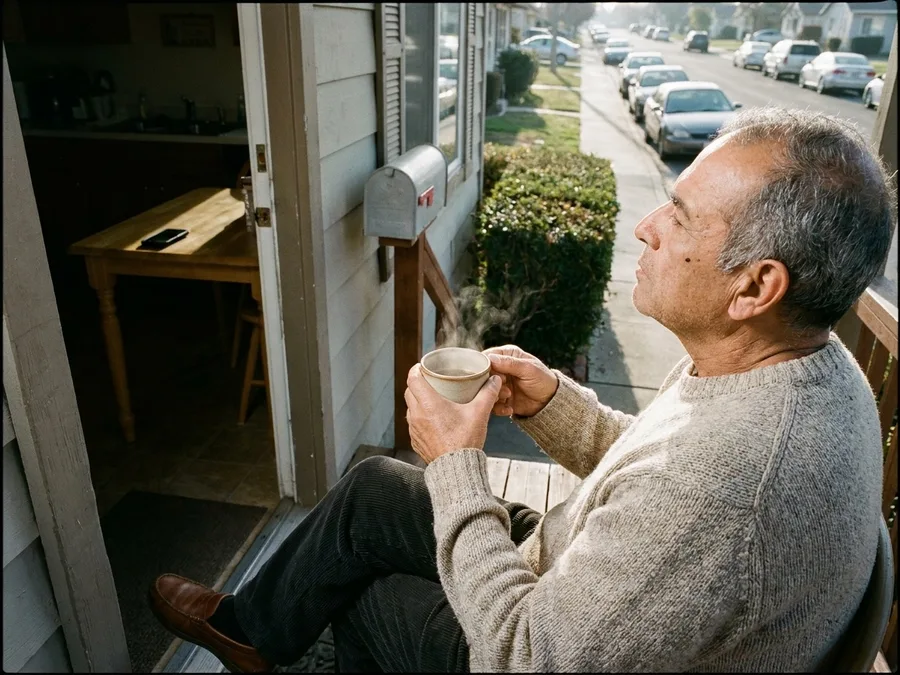
A fixed wake time only holds if there is a reason to get up, and the strongest one available is daylight. Light is the signal that sets the body's internal clock, and that clock is the very thing a steady wake time is trying to keep in place.
This is why the morning light matters more than all the light that follows it. By afternoon, your clock has already taken its reading for the day.
The smallest version: ten minutes outdoors, at any point in the first hour after waking. The back garden, the front step, the walk to the bus stop. No sunglasses, no trying.
Attach it to the first coffee or the first phone check. The rule is simple: the drink or the scroll happens outside, or by an open door with you facing it. Ten minutes, then back to the morning you already had.
A bright office does not count.
Sitting behind glass filters out exactly what the clock is reading, which is why this habit is written as going out rather than as getting light. A sunny desk is not the same input as a doorstep.
Readers on photosensitising medication, with a history of skin cancer or with an eye condition should ask a clinician about sun exposure and keep the session brief. Ten minutes is a small ask, but it is still your skin and your eyes, and a doctor should weigh in on how much is right.
The 10-minute light session: the fine print
Do this
- Count the 10 minutes from the moment you cross the threshold, not from when you wake
- Face the sky directly – a covered porch blocks most of the signal
- Go out first, coffee second, if the two compete
- Cloud cover is fine; standby on a bright grey morning still reads
Skip this
- The 10 minutes can be split – five out, five later, still counts
- If you wake before sunrise, get the light at first opportunity instead
- Photosensitising drugs or a skin-cancer history: shorten to a few minutes and ask your clinician
8. Two minutes of slow breathing before bed

Morning light anchors one end of the body's clock, and the same clock gets wound down at the other end. The cheapest lever for that is an exhale longer than the inhale.
Two minutes of paced breathing is easier to start than meditation because there is nothing to learn but one thing. Make the out-breath longer than the in-breath. No app, nothing to subscribe to, no cushion required.
The smallest version: inhale for a count of four, exhale for a count of six, sitting on the edge of the bed. Two minutes, timed by your own counting.
Hang it on the moment you get into bed or plug in the phone. That moment already happens every night without fail, which is what makes it a reliable anchor. The breathing borrows it rather than inventing a slot.
Be honest about what this is. It is a wind-down cue, a signal to the body that the day is closing, and it sits alongside the other sleep basics rather than replacing them. What controlled breathing does and does not do is best read at the source, not from a figure in a magazine.
Readers with panic disorder, asthma or a trauma history sometimes find breath focus uncomfortable rather than soothing. If that is you, pick a different wind-down, a book, a stretch, quiet music, and do not force the counting.
💡 Tip: Try it lying in bed with one hand on your belly. Feel the rise and fall.
🌙 A two-minute wind-down sequence
Sit on the bed
Place both feet flat on the floor and rest your hands on your thighs.
Inhale for 4
Breathe in through your nose, counting to four slowly.
Exhale for 6
Breathe out through your mouth, counting to six.
Repeat
Continue the cycle for two minutes, or about ten breaths.
Lie down
When you finish, lie down and let your body settle.
9. One message to one person, every day

Breathing is the habit you do alone in a dark room. The ones that follow involve other people and, in the next case, the glass in your hand. Connection has the lowest entry price on the whole list.
It also happens to be a health habit, not a nicety. Loneliness carries real physical weight, and the smallest version costs one text rather than a revived social life.
One message a day to one person. A reply, a photo of the dog, a plain thinking-of-you. No calls, no scheduling, no tallying who owes whom a reply. That is the whole bar.
Hang it on the commute, the kettle boiling or the queue at school pick-up, and keep a short list of three names. Choosing from scratch at the moment the phone is in hand is how this one dies.
The counterweight is worth naming. This fails the moment it becomes a performance, streaks, or a duty to reply to everyone. The rule is one, then stop.
Readers who are isolated, recently bereaved or caring for someone at home may need a real-world group far more than a daily text. For them, the honest version is a room with other people in it, not a message thread.
The three highest-return daily connections
10. Water in place of one sweetened drink
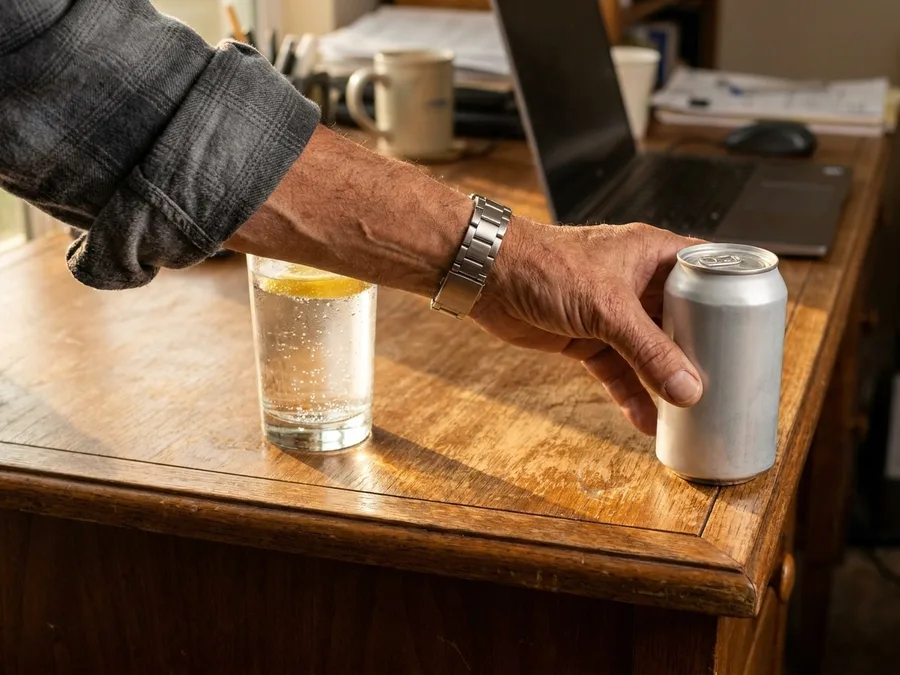
Most habits on this list ask you to add something. This one asks you to take something out, once, and then do nothing else.
Subtraction is easier to keep than addition, because there is no new routine to build, no equipment to buy, no extra stop on the way home. You are not adding a glass of water to your day; you are replacing one drink you already reach for with a drink that costs nothing and takes no thought. One swap, repeated, is the whole mechanism.
The smallest version that survives a bad day: exactly one drink, switched. The can of soda you buy at the vending machine around three in the afternoon, or the second glass of orange juice with breakfast. That one becomes water, sparkling water, or unsweetened tea. Everything else in the day stays exactly where it is. The coffee, the wine with dinner, the sports drink after a long walk — none of it gets touched. A total ban is what makes people quit by the second week, because the rebound is real: you cut everything at once, feel deprived, and by Friday you are back to two sodas and a juice. Swap one, keep the rest, and there is nothing to rebound from.
The anchor has to be a specific drink at a specific moment, not a general purge of the kitchen. The 3 p.m. vending machine run is an anchor: same time, same corridor, same coins in your pocket. So is the drive-through on the way home from work, when the order is automatic before you have decided anything.
Name the drink and the moment out loud, and the swap has somewhere to live. Say 'clear out the fridge of everything sweet' and you have given yourself a project with no fixed moment, which is why those resolutions last about four days.
There is one honest cost to price here. The first week, water at 3 p.m. tastes like nothing, and the ritual — the walk to the machine, the cold can, the ten minutes away from the desk — feels thinner without it. That passes in about a week, but it does not pass on day one, and knowing that is what keeps you from deciding the whole thing was pointless.
If you have diabetes, take diuretics, or have any kidney condition, your fluid advice needs to come from your doctor, not from a magazine list. For everyone else, this is about as low-risk as a habit gets.
Which brings the list to its real point. Ten habits is not a program. Pick the one that already has a slot in your day, run only that one for two weeks, then add the next. If you sit most of the day, the walk after your last meal is the place to start. If you sleep badly, the same wake time seven days a week. If you are already active and want to build something, the two ten-minute strength sessions. And if the drink is the thing you reach for without thinking, start here.
💡 Tip: Keep a filled water bottle in the fridge at eye level. Make water the easiest choice.
Frequently Asked Questions
Do I have to do all ten habits to see a benefit?
No. In fact, trying to do all ten at once is the fastest way to do none. Pick the one habit that already has a fixed moment in your day, do the smallest version for two weeks, and then add another. Consistency matters more than quantity.
How long before I notice a difference?
Some habits, like the after-meal walk, can help you feel better the same day. Others, like strength training, take four to six weeks before you notice a change in how you move or feel. The key is to keep going through the adjustment period.
What if I miss a day?
Missing one day does not undo your progress. The goal is to get back to the habit at the next anchor, not to be perfect. If you miss two days in a row, treat the next day as a fresh start and do the smallest version.
Are these habits safe for everyone?
Most are safe for most people, but check with your clinician if you have a medical condition, recent surgery, or take medications. Each entry above lists who should check first. When in doubt, ask.
Which habit should I start with if I am sedentary?
Start with the ten-minute walk after your last meal. It uses a moment you already have, requires no equipment, and is gentle enough for almost anyone. Once that feels automatic, add the two strength sessions a week.
The one-habit plan that outlasts the other nine
The ten are not a program. Take the one habit that already has a slot in your existing day, run only that for two weeks, then add the next. The other nine are not going anywhere.
If you are sedentary, start with the ten-minute walk after your last meal. If you sleep short, start with the same wake time seven days a week. If you are already active, start with the two ten-minute strength sessions.
A parent's scare sent you looking for a protocol, and the answer turned out to be a plate going in the sink and shoes by the door. The test is whether a habit survives a bad day. If it does, it stays. If it doesn't, make the smallest version smaller still.
Pick your one habit now
Choose the habit that already has a slot in your day. Do the smallest version for two weeks. Then come back and add the next.