

If a store really ran a senior day, they would put a sign up.
You have looked. The website, the app, the shelf tags, the aisle signage: no day, no age cutoff, no rules. You heard about it from a friend or a cashier's passing remark, and nothing since has confirmed it. That is because a senior day is not a national policy but a branch-level promotion, so it lives in the printed weekly circular, the loyalty app or email, and a phone call to the store. A shelf tag was never going to carry it.
The saving is real but small, and that is worth knowing before you rearrange anything.
On a $100 weekly basket, 5% off comes to about $200 a year after the standard exclusions, and the whole job is confirming four things at one branch: the day, the age cutoff, what the percentage leaves out, and whether a loyalty card is required. None of it is posted because none of it is meant to be posted.
By the end you can name all four, and decide whether the week is worth rearranging.
| Store type | Typical day | Age cutoff | Typical saving | Common exclusions | How you claim it |
|---|---|---|---|---|---|
| National supermarket chain | Tuesday or Wednesday, all day | 60 or 65 | 5% off the basket | Alcohol, tobacco, lottery, gift cards, prescriptions, fuel, stamps, clearance | Loyalty card scanned before the first item |
| Regional grocery chain | One weekday, often midweek | 55 to 62 | 3% to 10% | Same list, plus some store-brand-only limits | Say it at the register and show ID |
| Franchised or independent store | Set by the owner, can be any day | 55, 60, 62 or 65 | Varies by branch | Branch-specific, confirm in person | Ask the front-end manager |
| Warehouse club | One weekday | 60 or 65 | Around 5% | Membership items and already-reduced goods | Ask at the desk; membership rules apply |
| Pharmacy inside a grocery store | Often daily, not one day a week | Usually 60 or 65 | Set by the pharmacy, not the store | Medicare-related purchases | Ask the pharmacy counter separately |
| Online pickup or delivery | Rarely offered | Varies | Almost never carries in-store senior pricing | Separate online promotions apply | Ask whether the attendant can apply it at pickup |
The Schedule Lives in the Weekly Ad

It was never on a shelf tag because a shelf tag prices the item, not the shopper, and the senior day is a store-level promotion rather than a national policy.
That single fact explains the dead end you hit. National rules get printed, posted in aisles and loaded onto everyone's app the same way. A promotion set at the branch lasts as long as the branch wants it to, so it gets announced where that store talks to its own customers and nowhere else.
Look in three places, in this order. Start with the printed weekly ad, the paper circular that comes in the mail or sits in a stack by the front door.
The weekly ad is where a store puts its own dated promotions, and a senior day is exactly that. Second, the loyalty app or the store email, which often carries the same offer a few days ahead of the sale. Third, a phone call to the branch.
The shape is usually smaller than people expect: one weekday a week, most often Tuesday or Wednesday, running the whole day rather than a two-hour window. Confirm it before you plan the trip around it.
The last thing to hold onto is that the branch outranks the logo. Two stores under the same sign, ten miles apart, can run different days, and the one you drive past may not be the one with the Tuesday discount.
Ask the store you actually shop at which day it keeps, and write it on the calendar beside the weekly ad so the two pieces sit together.
One Chain, Different Days by Location
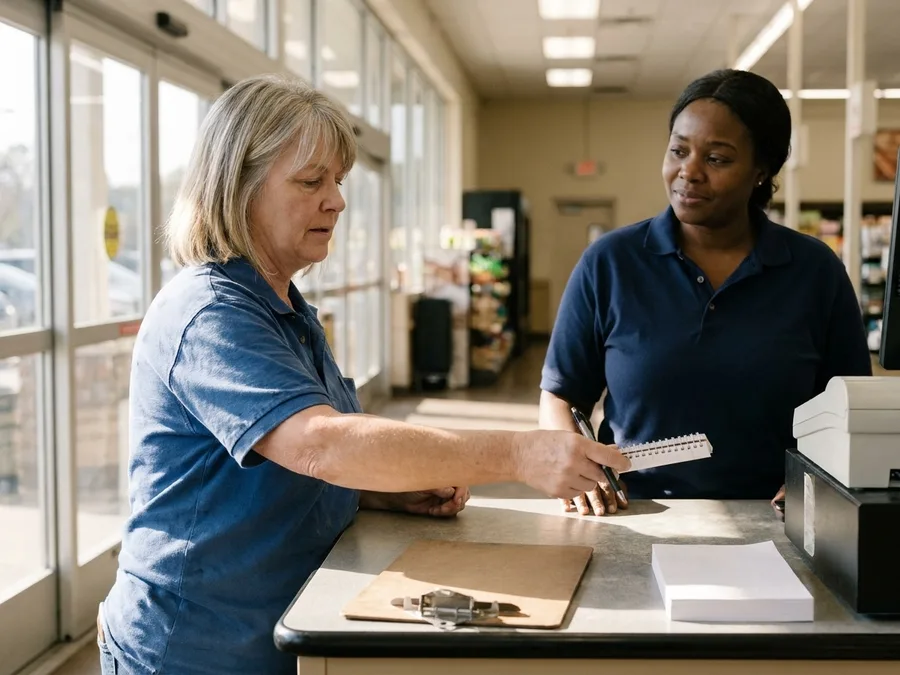
An empty page on the corporate website proves nothing about the store down the street, because individual and franchised locations set their own day, age cutoff and exclusions.
Corporate sites list national programs. A branch manager can start a senior day with a phone call to the ad department and drop it the same way, and nothing in that process touches the corporate calendar. So you can search the site for ten minutes, find a page about a rewards program and no mention of Tuesday, and still be standing in a store that has run it every week for eight years. The absence is not evidence.
Ask a person, and ask the right one: the front-end manager or the customer service desk. A website contact form routes to a queue with no branch on the other end, and the reply you get back will be a form letter about national programs, which is where this started.
Put four questions to whoever picks up. Which day is the senior discount? What age qualifies? What is excluded from the percentage? Is a loyalty card required?
Write down the day and the name of the person who confirmed it. It is small and it settles things. If a cashier later says the store doesn't do that, you have a name and a date, and the question moves to the service desk instead of turning into an argument at the register with a line behind you.
One call of four questions, one line in the calendar, one name beside it.
⚠️ COMMON MISTAKE
The website is the wrong source
An empty senior-discount page on a corporate site means nothing about your branch. Call the store, ask for the front-end manager, and get the day confirmed by a person who works there.
The Age Cutoff Is 55, 60, or 65

There is no national senior age in grocery: the cutoffs in common use are 55, 60, 62 and 65, with 60 and 65 the most frequent, and the branch or the chain's fine print is the only place yours is written down.
That is why the number you heard from a friend may not be your number. She shops a different chain, or the same chain at a different branch, and either one can set its own threshold. A cutoff is a marketing choice, not a legal category, so nothing makes the stores agree.
One wrinkle worth knowing before you ask. A few chains accept an AARP membership card from age 50, which pulls the threshold five to fifteen years earlier than the store's own rule. If you carry one, ask whether it counts here.
The threshold also moves between departments. The pharmacy counter and any in-store restaurant can run their own senior programs with their own ages, separate from the grocery one, so the number that gets you a discount on a prescription is not automatically the number that gets you 5% off the basket.
Proof is a driver's license, or the birth date already on your loyalty account. Carry the license even if you are enrolled, because the account record and the person at the register do not always agree, and the card in your wallet ends the disagreement faster than a screen does.
No Loyalty Card, No Discount
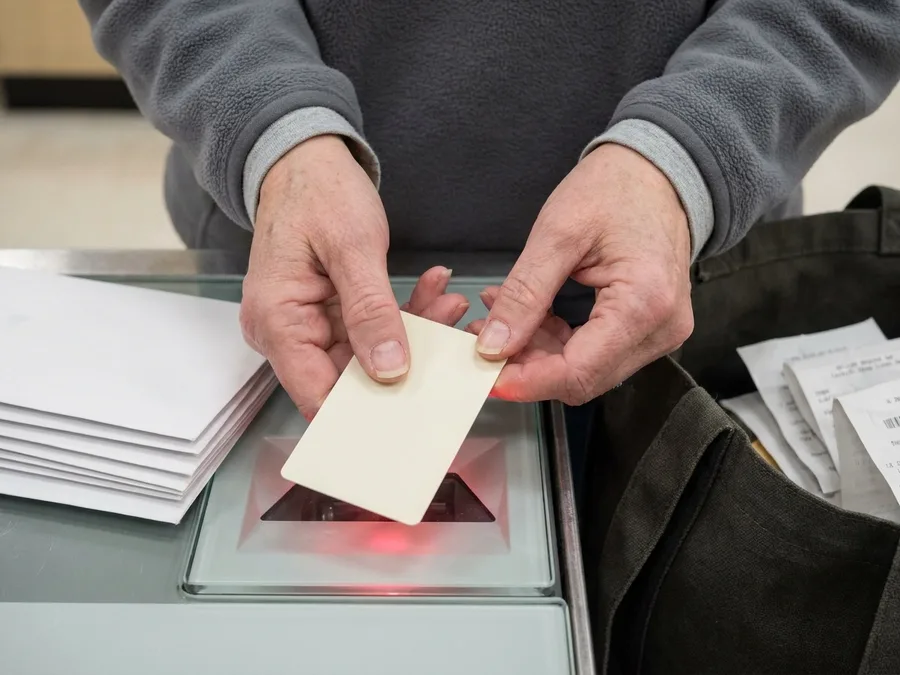
Clearing the age bar only gets you halfway; the rest depends on the account the saving is wired to. At many chains the senior percentage does not sit on the register's price file at all. It sits as a digital coupon attached to a loyalty account, which means a 68-year-old with a driver's license in hand can shop a store that is running the promotion and still pay the full shelf price, because the register is looking for a number on a card, not a birth date on a license.
The odd part is the sticker price never changes. Nothing on the shelf tells you that the same loaf of bread would ring up at 95 cents less if the coupon were live on your account. You find out at the service desk, holding a receipt, trying to work out why the total looked wrong. That is the whole gap between qualifying and being paid.
Signing up costs nothing. One visit to the customer service desk, or a few minutes in the store's phone app, and it usually asks for a phone number and a date of birth and hands back a card or a number to key in.
Some chains complicate it further: the senior coupon is not automatic even once you are enrolled. It has to be clipped each week, in the app or on the store's website, before the register will apply it. Last week's clip does nothing for this week's basket. If that is the branch's rule, the day only pays when you remember both the day and the clip.
So give the phone number or scan the card before the first item goes across the scanner. A discount tied to an account cannot be attached to a transaction that has already been closed out.
Five Percent Off Is Rarely Five Percent

The card is live, the coupon is clipped, and the percentage still lands on a smaller pile than the one in your cart. On a $100 basket, 5% reads as $5 in your head. What actually comes off, once the usual exclusions are pulled out, tends to run about $3.50 to $4.50.
The exclusions are the standard set you would expect and a few you would not: alcohol, tobacco, lottery tickets, gift cards, prescriptions, fuel, postage stamps, and anything already on clearance or marked down. Those last ones catch people. A basket full of reduced meat and yellow-sticker bakery is a cheap basket already, and the senior percentage does not reach it.
Run the arithmetic slowly. If roughly $20 of a $100 basket is excluded, 5% is working on $80, which is $4. The headline said $5. The dollar difference is small; the habit of expecting the headline is what costs you, because you plan the trip around a number the register never had.
The bigger lever is not the percentage. It is what the percentage covers. A branch that applies 5% to the whole qualifying basket and a branch that applies it only to store-brand items produce very different totals on the same cart, and the spread between those two answers can be wider than the spread between 3% and 10%. Ask for it by name at the desk: does the discount cover the whole basket, or only store brands?
Five is the typical figure, but 3% sits at one end of the range and 10% at the other. That number is a branch question too, right alongside the day.
What the Senior Day Actually Returns
A $100 weekly basket, worked out in dollars
Store Brands Count; Manufacturer Coupons Don't Stack

A coupon, a buy-one-get-one offer or a clearance sticker on the same item does not layer under the senior percentage. Something has to give, and it is almost always the senior cut.
Put the two side by side and the reason is plain. A $2 manufacturer coupon on a $4 item takes 50% off. The senior percentage on that same item takes 5%, or 20 cents. The store applies the better offer for the customer as a rule, but the two do not add, so the 20 cents quietly disappears and the coupon takes its place. You still win on the coupon. You just do not win twice.
What sits inside the discount, typically, is the ordinary centre of the basket. Store brands, fresh produce, meat, dairy. That is where a weekly shop actually spends its money, and it is why the percentage is worth having even after everything else is stripped out.
What sits outside is where the surprises live. Buy-one-get-one deals and clearance prices are the ones shoppers most often find out about at the register, after the total has already been rung and the bag is full. Nothing on the shelf tag warns you that the reduced item lost the senior cut.
How much this matters depends on where your branch sits in the range. At 3%, a dropped item costs pennies and arguing at the desk is not worth the walk. At 10%, the same dropped item is real money on a full cart, and a stop at the service desk to ask is the sensible move.
💡 PRO TIP
Clip it the night before
If the discount lives as a digital coupon, clip it the evening before you shop, with your wallet open in front of you. A week-old clip does nothing for this week's basket, and the register will not remind you.
Pharmacy and Fuel Run Separate Programs

The pharmacy counter and the gas pump run their own senior schedules, and the grocery percentage usually stops at the register. So the Tuesday rule needs re-asking at each of them, and the answers can be different from the one you already wrote on the calendar.
Ask the pharmacy separately, and ask plainly whether the senior discount works on prescriptions or only on front-of-store items. Some pharmacies run a daily senior discount instead of one day a week, which means a Tuesday-only habit built at the front register can quietly cost money at the counter behind it. Prescription copays, Medicare-related purchases and gift cards sit outside the grocery basket discount entirely, so the 5% you earned on the weekly shop does not follow the prescription slip.
Fuel is its own program too, and it helps to separate the two things people blend in their heads. Fuel points earned on the grocery bill are a points balance that cuts the price per gallon after a threshold; a senior percentage at the pump is a price cut on the posted number. One is earned in the store, the other is claimed at the pump, and neither one is the basket discount. At a 5% chain the grocery saving on a $100 basket is about $3.50 to $4.50 after exclusions, and that is the figure that stays inside the store.
What to do with this: when you call about the grocery senior day, add one question about the pharmacy and one about the pump. Write each answer on its own line, because a household filling two prescriptions a week is asking about a bigger dollar figure than the grocery basket was ever going to save.
Ask For It, Then Check the Receipt
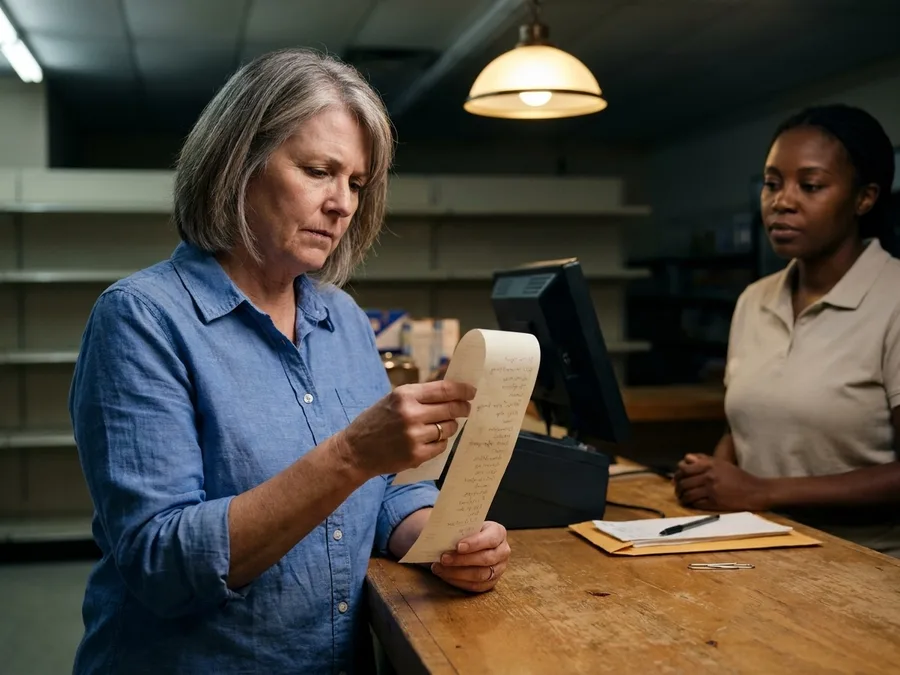
The discount almost never comes off on its own, so if it doesn't, the fix happens at the register before the first item is scanned or at the service desk before you leave the store. The cashier has to key it in, and a cashier working a basket mid-rush is not watching for a birth date on the screen. Waiting for the store to offer it is how a 5% saving turns into a full-price receipt.
So say the words "senior discount" before anything is rung, and hand over the ID without being asked. The claim is yours to make, not the store's to offer. If you usually pay with a loyalty account, say that too, since at some chains the discount loads as a digital coupon on the account and the register will not apply it if it was never clipped that week.
Then read the receipt before you get to the car. The discount should print as its own line near the bottom, separate from any coupons or markdowns. If the line isn't there and the basket was $100, you are looking at roughly $3.50 to $4.50 you paid that the store was ready to take off. The service desk can adjust a transaction on the spot while it is still open, which is the easiest version of this problem there is.
One more question for the desk, and ask it on a day when nothing has gone wrong: how long do I have to correct a missed discount? Same-day is always the simplest answer to work with, but knowing the window before you need it means a missed Tuesday is a phone call, not a write-off.
Claiming It at the Register
A Year of Tuesdays Saves About $250

Once the discount lands reliably, the year comes into view: a 5% senior day on a $100 basket is $5 a week, about $260 across 52 shops before exclusions pull it down to roughly $200. That $200 is the real headline, not the $260, because a typical basket has enough excluded items to shave it.
The line that decides everything is whether this is already the main weekly shop. If the store is where the groceries were going anyway, the saving is pure; the day merely shifts the trip by two or three days and costs nothing but a calendar entry. If it means a second stop, the math turns against you fast. A special trip burns gas and forty minutes, and both cost more than the $5 the discount returns.
Scale matters too. A household spending $40 a week sees under $100 a year, and that is the number to weigh the trip against, not the $200 headline. A two-person older household running $85 to $120 a week lands between roughly $170 and $240 a year, which is real money, but only if the drive is one you were making.
So the question is not whether $200 is worth having. It is whether the confirmed day sits on a trip you already take. If it does, plan the week around it; if it does not, a smaller regular shop at the store you already use will likely beat the discount.
📞 Confirm the Day in Five Steps
Check the weekly ad
Start with the printed ad from the store entrance — the senior day is usually in small print near the hours.
Search the loyalty app
The discount often shows as a digital coupon with its own clip button and expiry.
Call the branch
Ask for the front-end manager, not a website contact form, and put the four questions to them.
Write it down
Note the day, the age cutoff, the exclusions and the loyalty requirement, plus the name of the person.
Put it on the calendar
Mark the confirmed day against your usual shop so the discount lands on a trip you were making anyway.
Discount Day Means Crowds and Empty Shelves

The quiet Tuesday in that arithmetic is not the Tuesday you will walk into. The same confirmed day that pays the 5% draws every senior in the area to the same aisles at the same hour, and the crowd changes what is left on the shelf before you get to it. Markdown meat and the bakery clearance rack go first, because the discount applies only to what is still there when you reach it.
So the window matters as much as the day. Mid-morning, after the first rush has cleared the front lot, is usually the calmer stretch; the last two hours before close is the other one worth trying.
The trade-off is real: shop at opening and you stand in a long line behind carts stacked high, with the best markdowns already gone to whoever arrived twenty minutes earlier. Shop late and the aisles are clear but the clearance shelf is picked over. Neither window gives you both.
One more thing to confirm when you make that call: some branches limit the discount to certain hours rather than running it all day.
Ask, in the same conversation, what time on the day the discount starts and stops, because a store that runs it from 8 a.m. to noon has a very different best-arrival time than one that honors it until close. Write the hours on the calendar next to the day, the cutoff and the name of whoever confirmed it. Then plan the shop around the window rather than the window around the shop.
If the day is the only one that fits your week and the window does not, the saving still applies to whatever is in the cart when you get there. You just may not get the markdowns on top of it, and that is worth knowing before you drive over expecting them.
Delivery and Pickup Almost Never Qualify
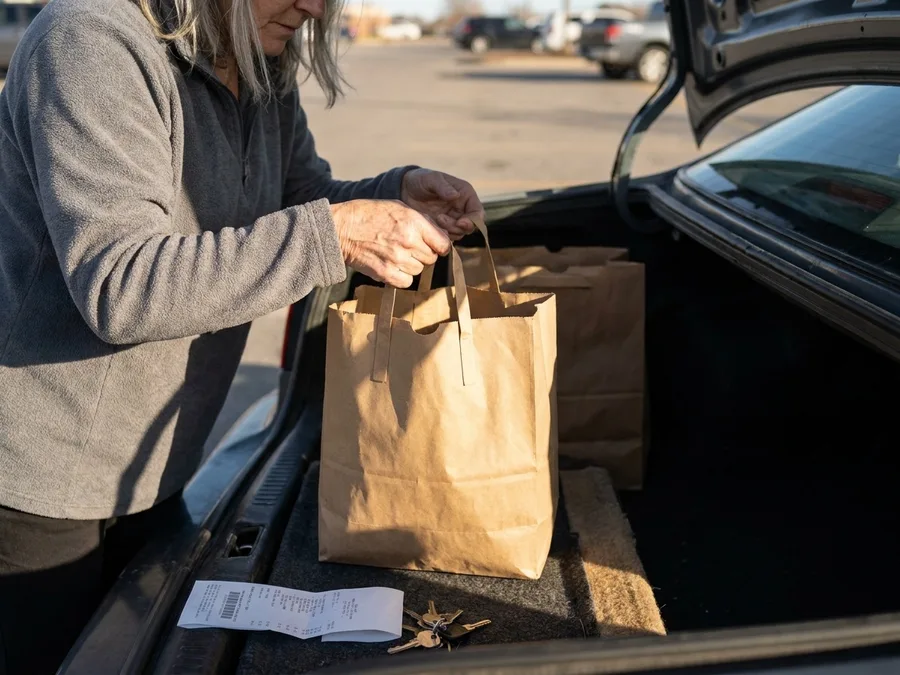
The app will ring up the same crackers at full price on the same Tuesday the register would have taken 5% off them.
That is the plainest way to see it: the senior percentage lives at the in-store register and almost never crosses over into the order-ahead system. Online orders run on a separate pricing schedule with their own promotions, built for delivery costs and pickup logistics, and the branch-level senior day is not usually loaded into it. So the day you confirmed on the phone and the week you shop from the couch are two different price lists, and the discount does not follow you to the second one.
Now run the fee against the saving. On a $100 basket the senior percentage nets roughly $3.50 to $4.50 after exclusions, and a pickup fee of $5 to $10 wipes that out before the bags reach your trunk. You are paying to lose money on the trade.
Not every store charges, and not every store refuses.
If the app is your only realistic way to shop – no car, no long walk through the aisles, a bad knee week – ask at the pickup counter whether the attendant can key the senior discount on the order at handoff. That answer is branch-specific, handed down by whoever runs that store, and it changes nothing online. It has to come from a person, the same way the day and the age cutoff did.
Call the branch before the order window opens, not after.
Senior Grocery Day — The Short Version
📅 Typical day
Tuesday or Wednesday, all day
🎂 Age cutoff
55, 60, 62 or 65 — ask the branch
🏷️ Typical saving
5% (chains run 3% to 10%)
🚫 Biggest exclusions
Alcohol, tobacco, lottery, gift cards, prescriptions, fuel, stamps, clearance
💳 Loyalty card
Often required; coupon may need clipping
🧮 A year of Tuesdays
About $200 after exclusions
The one thing to do first
Call the store, ask the four questions (day, age, exclusions, loyalty card), and write the answers on the calendar.
Frequently Asked Questions
What day is senior discount day at my grocery store?
It is usually Tuesday or Wednesday, all day, but the day is set at the branch and sometimes by the franchise owner. Check the printed weekly ad first, then the loyalty app, then call the store and ask for the front-end manager. Two branches of the same chain can run different days.
How old do you have to be for a senior grocery discount?
Cutoffs of 55, 60, 62 and 65 are all in common use, with 60 and 65 the most frequent. Some chains accept an AARP card from age 50. There is no national standard, so the store's own rule is the only one that applies at the register.
Do I need a loyalty card to get the senior discount?
Often yes, and at some chains the discount loads as a digital coupon that must be clipped each week before the register applies it. Signup is free at the service desk or in the app with a phone number and a birth date. Scan the card or give the number before the first item is rung.
Does the senior discount apply to prescriptions and gas?
Usually not. The pharmacy counter and the fuel station run their own senior programs with their own ages and their own days, and prescriptions, Medicare-related purchases and gift cards sit outside the grocery basket discount. Ask the pharmacy directly, because some run a daily rate rather than one day a week.
Is 5% off once a week worth planning around?
It is about $200 a year after the typical exclusion mix on a $100 weekly basket, so it pays if the store is already your main weekly shop. It does not pay if it means a second trip, because a second stop costs more in gas and time than $4 returns. Run the percentage against your own basket total before you rearrange the week.
Can I get the senior discount on curbside pickup or delivery?
Almost never. Online orders are priced on a separate schedule and rarely carry in-store senior pricing, and a $5 to $10 pickup fee cancels the roughly $5 saved on a $100 basket. If online is your only option, ask whether the attendant can apply it at pickup — that answer has to come from the branch.
The calendar line that pays for itself
The verdict is a real saving and a small one: about $200 a year on a $100 weekly basket after exclusions, and only if this is already your main weekly shop and the confirmed day fits your routine. A special trip costs more in gas and time than it returns.
The one thing to do first is the phone call. Ask the four questions – which day, what age, what is excluded, is a loyalty card required – and write the answers on the calendar against your usual shop.
Nothing was posted because nothing was ever going to be posted. The day lives at the branch, in the weekly ad, in the app, and in the name of the person on the phone.
So if a store really ran a senior day, they would put a sign up – and now you know why they never will. The calendar entry with the day, the cutoff and the name of whoever confirmed it is the entire system. No app, no website and no shelf tag will carry it instead.