
What actually happens to your health in the first year of early retirement? That is the question, and it has a concrete answer: the year is not a reward that arrives on its own, it is a rebuild, and the rebuild starts before the last paycheck lands.
Picture the couple who are both 58, leaving a combined $150,000 income behind, with a $1.2M portfolio, $58,000 in annual spending, and a $30,000 cash buffer. They believe year one is the payoff. Then the unglamorous numbers show up: $17,400 for pre-Medicare coverage, daily steps dropping from about 7,000 to 2,800, sleep settling at 6.5 hours, and food at about $620 a month once lunch is unplanned.
The portfolio is rarely what fails. Early retirement stumbles when the things work supplied without being asked, from health coverage and movement to a wake time, a lunch, colleagues, a title, and a reason to be relied on, are not rebuilt on purpose.
So the question is not whether the money is enough. It is which supports you install before you leave and in the first month, with a checklist for coverage, a fixed wake time, a daily walk, and a cash reserve, so the shocks land as line items instead of crises.
Quick Tips Before You Start
Pick the renewal date first
Put your plan's renewal, deductible reset and open-enrollment window on the calendar before you need them.
Track two weeks of steps
Wear the tracker for 14 days without changing anything, so the drop is a number instead of a vague ache.
Set the wake time before you resign
A fixed 6:45 a.m. wake time is easier to install while you still have somewhere to be.
Cook two lunch proteins on Sunday
Enough chicken or beans for five midday meals removes the daily takeout decision.
Hold one deductible in cash
A $4,500 deductible belongs in savings, not in a fund you would have to sell in a bad month.
Body And Health
This is where the list has to start, because coverage, sleep, food and movement constrain everything else. You cannot plan a meaningful second act on a body that is running on six and a half hours of sleep, unplanned lunches and a health plan you have not read.
The good news is that every item in this section is a setup, not a sacrifice. None of it requires a gym membership you will not use or a diet you cannot keep. It requires replacing, deliberately, four things the job used to supply without being asked.
1. Your Health Insurance Becomes a Part-Time Job

The benefits desk does not call to say goodbye.
The morning after the last paycheck, the plan that came with the job is simply gone, and what replaces it is not a benefit but a project. Choosing a pre-Medicare plan, reading the network rules, checking the drug formulary, and tracking the renewal date takes hours you used to spend on other things. The payroll deduction that made coverage invisible is now a bill you pay by hand, every month, until Medicare opens at 65.
In the example, that bill runs $1,450 a month, or $17,400 a year. Dental and vision are separate line items, about $1,200 a year on top.
Before the first appointment under the new plan, check three things: whether your doctors are in the network, whether your prescriptions are on the formulary, and what the deductible actually requires before coverage kicks in. A plan that looks affordable on the premium can strand you mid-year with out-of-network bills if your specialist is not on the list. When Medicare finally opens to you, these Medicare enrollment steps help you avoid the same kind of costly surprise.
Name a backup before you need one. Write down the insurer's appeal line, keep a paper record of every claim, and decide now where the money would come from if a claim is denied. The example couple holds a $30,000 cash buffer for exactly this kind of gap.
Put the renewal date, the next claim review, and the name of that backup contact in the same calendar you use for everything else. Work supplied a benefits desk and an automatic deduction; the calendar and the paper trail replace both.
💡 Tip: Photograph the front and back of every insurance card and keep them in a phone album named for the plan year.
The First-Year Health Bill, Line by Line
Figures describe the illustrative couple in this article, not a national average.
2. Your Body Notices the Missing Commute

Coverage handles the paperwork side of health. The movement side came free with the job, and it leaves with the badge.
A commute is a workout nobody logs. The walk to the car, the stairs between floors, the stroll to a meeting across the building, pacing while a call ran long: the example couple was logging roughly 7,000 steps on a normal workday without once putting on sneakers. Four months in, the same couple measured about 2,800. The other 4,200 steps did not get replaced by anything. They simply stopped happening.
That gap rarely announces itself. It shows up first as stiffness rising out of a chair, a flight of stairs that costs a little more breath than it used to, an afternoon energy dip that gets blamed on getting older. Age is the easy explanation and the wrong one. The knees and hips are responding to a change in load, not to the calendar.
Clip a step counter on for two weeks before drawing any conclusion. It is a boring assignment and it settles the question fast, because the daily number is either near where it was during working years or it is not. Most people are surprised by how far it fell, and more surprised by how quietly.
New pain in a back, hip, or knee after the routine changes deserves an assessment, not a pep talk. Physical therapists tend to see the same pattern in newly retired patients: a drop in daily load, then a strain when a weekend project or a grandchild's visit arrives without the base to support it. Pushing through that pain is how a small issue becomes a six-week setback. A session or two with a PT maps what to strengthen before something tears.
The schedule that replaces the incidental movement is small. A 20-minute walk in the morning, before the day's errands claim the hours, and two short strength sessions each week, 20 to 30 minutes apiece, covering a squat, a hinge, a push, a pull, and a carry. That is enough to keep muscle and bone on notice.
Strength work is the piece most people skip, and it is the one that matters most after 50, when muscle mass and bone density decline faster without a loading signal. The subtle health shifts that creep in after fifty are easier to catch early, and these concerning health challenges lay out what to watch for. Two sessions a week is not a training program. It is maintenance for the body that has to carry the next 25 years.
Expect the first two weeks to feel like a chore and the stairs to feel no different. Around week four, standing up from the couch stops requiring a small negotiation. That is not fitness in any dramatic sense. It is the baseline coming back.
| Cost item | Illustrative figure | What it changes in year one |
|---|---|---|
| Pre-Medicare premiums | $1,450/month, $17,400/year | The single largest new line in the budget, paid whether or not you use care |
| Deductible | $4,500 per person | You pay the first $4,500 of most care yourself before the plan shares the cost |
| Dental and vision | $1,200/year | Separate from medical, and usually excluded from the main plan |
| Primary care visit | $150 | The cost of establishing a doctor before anything goes wrong |
| Urgent care | $200 | Cheaper than the ER for the Saturday-morning problems |
| Telehealth visit | $40 | The lowest-cost first call for a rash, a refill or a stubborn cough |
| One ER visit, after insurance | $1,800 | A single bad night can outrun a month of premiums |
3. Sleep Drifts Later Without a Morning Anchor

Scheduled walks put some energy back. Sleep lost its anchor too, and that one is harder to notice because nothing hurts yet.
Work set two times a day and never called it a health program: the alarm, and the clock-in. Remove both and bedtime drifts. A show ends at 11, then a chapter at 11:40, then a phone in bed at 12:20, and nothing the next morning punishes it, so the drift compounds. The example couple averaged about 6.5 hours a night through the first months, most of it later and lighter than it needed to be.
The fix starts at the front of the day, not the end. A fixed 6:45 a.m. wake time, seven days a week including the weekends, gives the body a reference point it can work backward from. Within a week or two, sleepiness starts arriving at a sensible hour on its own.
Light is the strongest signal available. Ten to fifteen minutes outside within an hour of waking, coffee mug in hand on the porch, tells the internal clock the day has begun; gray indoor light at 8 a.m. does not. Caffeine gets a cutoff at noon, because a 2 p.m. cup is still measurably in the system at 10.
The last hour belongs to dim light and no screens, or at least a screen dimmed and set down. The bed stays reserved for sleep rather than laptops, phones, or the 9 p.m. news. And the extra hours in bed that retirement makes possible are not the same as better sleep; stretched time in bed often produces lighter, more broken rest, not more of the deep kind.
Loud snoring that a partner mentions, or a daytime sleepiness that has the reader nodding off during a 3 p.m. movie, is not a personality quirk to shrug at. It is worth asking a primary-care doctor about a sleep study. Sleep apnea becomes more common with age and goes undiagnosed for years because the symptom, tiredness, gets filed under normal.
Work supplied a fixed morning for decades without anyone having to think about it. Now it gets built on purpose: one wake time, daylight early, coffee done by noon, screens off before bed.
4. Lunch Becomes Whatever Is In Reach

A fixed wake time and a morning walk give the day a frame. They do nothing for the hour when the cafeteria used to hand you lunch.
At work the midday meal arrived on rails. A packed lunch sat in the fridge, or a tray was forty feet from the desk, and the choice was made before hunger had a vote. Retire, and that default vanishes without a sound. Midday becomes whatever is nearest: the pantry, the deli counter, the drive-through on the way back from an errand.
The example couple's food budget tells you what an unplanned midday costs. It ran about $620 a month without a plan, and about $480 with a single weekly prep session. That gap is roughly $1,700 a year, and it buys worse food, not better.
The quiet cost is salt and sugar. Convenience foods built for shelf life carry both in amounts a home lunch rarely matches, and after 50 the same sodium load pushes blood pressure harder than it did at 35. The grazing pattern matters too. Four small unplanned hits across an afternoon are harder to see, and harder to count, than one lunch.
The fix is one session and one list. Sunday, cook two lunch proteins and cut one tray of vegetables, enough to carry four or five midweek lunches. Then write the grocery list against the week's lunches instead of the pantry.
That last part is where most plans leak. A pantry-based list buys what you already own; a lunch-based list buys what the week will actually eat. Same store, same cart size, different result.
And keep the prep session short. Forty minutes on a Sunday holds. A two-hour production with six containers and a sauce nobody touches lasts a fortnight before it stops happening. Two proteins, one vegetable tray, done.
The frame from the morning holds the lunch if you let it. The walk ends near the kitchen, the prepped containers are already there, and the decision is made before the hunger is.
💡 Tip: Keep five containers the same size so a week of lunches stacks in one fridge shelf.
⚠️ COMMON MISTAKE
Don't Wait for the First Bill
Most new retirees read their plan documents after the first confusing statement arrives. Read the deductible, the out-of-pocket maximum and the network rules in the first week, before anyone needs care.
5. A Health Scare Exposes Your Bare Plan
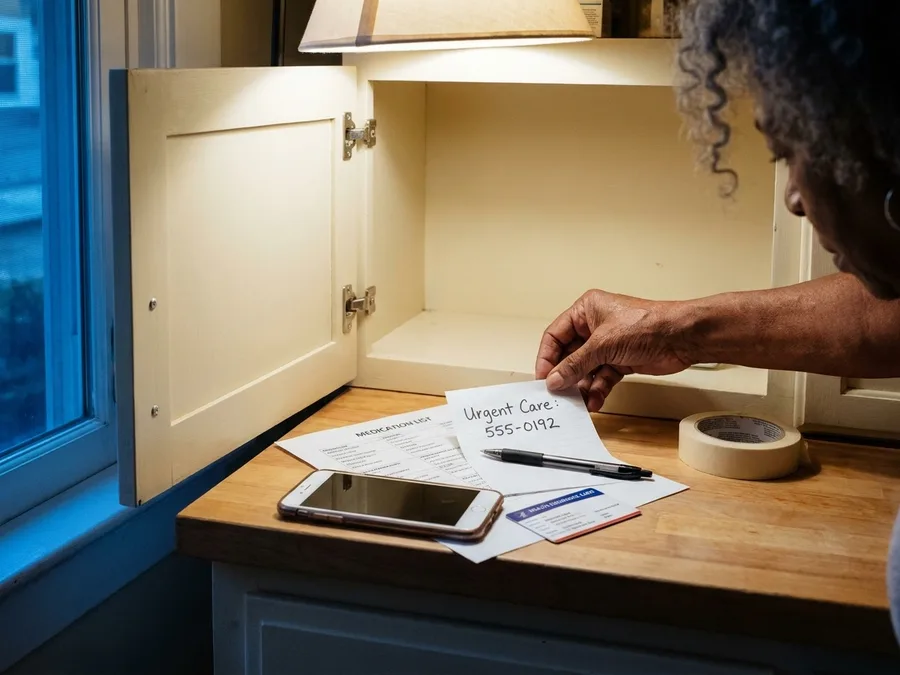
Walks and packed lunches are prevention. They do nothing the morning something actually goes wrong.
At work, the plan was invisible. HR sat one floor down, the nurse line was printed on a card in your wallet, and a sick-day script had been said out loud so many times it ran on reflex. Retirement removes the desk and keeps the symptoms.
Picture a Saturday in the second month. Chest tightness, or a fever that spikes past 102, or a cut that will not stop bleeding. In the working years a colleague would have known which urgent care took your insurance. Now the question hangs in a quiet house, and the person answering it is you, at the worst possible moment to be researching.
So write it down before the event, not after. A single sheet with four names and numbers: your primary-care doctor, the nearest urgent-care clinic, the telehealth line, and the insurance nurse line. Print it. Tape it inside a kitchen cabinet.
Know the cost side too, because a scare is also a bill. In the example, a primary-care visit runs about $150, urgent care about $200, a telehealth call about $40, and one ER visit lands near $1,800 after insurance. Those numbers are not there to scare you. They are there so a middle-of-the-night decision is made on information, not panic.
Keep the medication list and the insurance card in the same drawer as the sheet. A printed list of every drug, dose, and supplement saves ten minutes in a triage room, and the insurance card is useless in a wallet you left at home.
Then pull the deductible and out-of-pocket maximum out of the plan documents and write them on the same page. The number you can afford to spend is information you want before the ER, not a fact you discover on the statement six weeks later.
The sheet does not prevent anything. It shortens the worst hours of the year, and it turns a bare plan into one with a phone number at the top.
The Who-To-Call Card — At a Glance
🩺 Primary care
$150, book ahead
🏥 Urgent care
$200, evenings and weekends
📱 Telehealth
$40, first call for minor problems
🚑 ER, after insurance
$1,800, chest pain and worse
💊 Printed medication list
Same drawer as the cards
Why It Works
A written plan removes the three-minute panic that turns a $200 visit into a $1,800 one.
6. Mental Health Needs a Schedule, Not a Vacation

A written plan covers the sudden event. It does not cover the slow slide that arrives with no alarm at all.
The first months feel like a reward, because they are. Then around month four the novelty thins out. The calendar is empty in a way that stopped feeling freeing, the projects have stalled, and a low mood settles in that looks a lot like irritability from the inside.
That low mood is not a verdict on the decision to retire. It is a health signal, and a common one. Work quietly supplied two things the schedule did not: daily contact with other people, and a reason to get dressed and go somewhere.
The counterweight is not a vacation. It is a schedule with two entries per weekday, one social contact and one outdoor walk. A coffee with a friend counts. A twenty-minute walk in daylight counts more than it sounds like it should, because morning light and movement together do more for mood than either alone.
Know the line, too. Low mood that lasts two weeks is a reason to see a primary-care doctor and ask about screening for depression and anxiety, the same way you would for a cough that will not quit.
If the answer is therapy or medication, treat the appointments like work meetings. Put them on the calendar, keep them, and do not cancel because the day was sunny. A skipped session is a missed meeting with the person who is helping.
Time And Identity
Once the body and the coverage are stable, the harder questions show up. The hours are real, the title is gone, and both of those vacancies get filled by something whether you choose it or not.
What the job supplied here was structure and standing. Neither one can be bought back, and neither one appears on its own. Both have to be built, and this section is about building them small enough to last.
7. Time Expands Faster Than Your Plans

A rebuilt schedule protects mental health only if the calendar underneath it gets rebuilt too. Time is the part of early retirement nobody prepares for, and it expands faster than most people's plans for it.
The first month feels like a gift. By the second, days that looked gloriously empty are full of errands, phone calls, and screens, and the project you meant to start is still sitting there untouched.
Good intentions are not a schedule.
Projects need calendar blocks the same way work meetings did. Put the project on the calendar before the errands begin, two hours, and treat that block as immovable. The errands have a way of expanding to fill whatever space you leave them.
A paper week plan works better than an app for most people, but only if it holds three must-do items. Not a wish list of twelve. Three. The rest is bonus, and the week survives even if one of the three slips.
Protect one afternoon with nothing on it. Every gap filled is a week that runs the reader, not the other way around.
work supplied the deadlines, and nobody handed out a replacement. The Friday review does that job now. Fifteen minutes, one question, which commitment this week did not matter, and then cut it. That single habit keeps the calendar honest, and it is the one part of the structure most first-year retirees skip.
The First-Year Calendar
Build This In
- A fixed 6:45 a.m. wake time, every day
- A 20-minute morning walk
- Two short strength sessions per week
- One social contact each weekday
- One weekly class or recurring meetup
- One protected unscheduled afternoon
Let This Slip
- Bedtime that drifts an hour later each week
- Step count falling toward 2,800 a day
- Lunch decided at the fridge door
- Whole weeks with no one but your partner
- Errands filling every open hour
- A calendar so full it needs a project manager
8. Your Job Title Stops Explaining Who You Are

A calendar full of blocks restores output, but output is not the same as identity. The blocks sit inside a role, and for most of a working life that role came with a title attached.
That title was doing quiet work. It answered the question before anyone asked it.
The feeling arrives at a specific moment, and it is rarely the one people expect. Not the first Monday morning, which still feels like a holiday. It hits at the first professional event or the college reunion, at the moment someone asks what you do, and the sentence stalls.
reaching for a new label before reaching for a role. Calling yourself retired, or a consultant, or a writer, does not create the thing the title used to do. Only action in the world does that.
So choose one activity that hands you a real function, not just a pastime. A volunteer shift where you are expected on a set day. A class where you help run the room. A seat on a small board. The test is simple: does somebody notice if you do not show up?
Practice the plain answer out loud, too. What you do now, said without apology and without a job description attached. A short, direct sentence does more for a stalled conversation than a clever one.
Give the new identity a season to settle. A weekend is not enough, and expecting it to feel real in one is how people talk themselves into thinking something is wrong. Work supplied a title on day one. The role is the setup, and it takes a while to fit.
Built from the first-year recovery plan in this article.
9. Purpose Is Not a Hobby You Can Schedule

A title tells other people who you were. Purpose tells you why Tuesday matters, and it only arrives when someone is counting on you.
Those are different problems, and early retirees tend to solve the first one and assume the second followed. A volunteer shift gets you a badge and a role. What turns it into purpose is the woman at the food pantry who texts you Thursday to confirm Friday, or the student who cannot do the math homework without your Tuesday hour.
Hobbies fill time, and they are worth having. But a tenth of the tee time and the woodworking bench says nothing about why the day mattered – because nobody was waiting, and nobody missed you when you skipped.
Leisure and contribution split on exactly that line. A hobby you enjoy on your own terms is one thing; a role someone relies on is another. Work supplied the second one quietly for decades – someone needed your answer by 10 a.m. and noticed when it did not come.
So test one recurring commitment for eight weeks before you use the word purpose. One weekly shift at the same place, one tutoring hour, one call to the same person – long enough to see whether you show up on the bad week, when you are tired and not missing it.
Here is the detail that matters more than the mission. Look for a place that needs reliability, not a resume. A hospital that wants the same face on Tuesdays will take you with no fancy credentials. A board seat that needs your old title is a different hire, and a weaker one.
Keep the commitment small enough to survive an off week. Two hours a week at a place that expects you, week after week, does more than a grand plan you will abandon by March. That weekly line on the calendar is the same kind of setup as a fixed wake time or a morning walk, and it does the same job the office did – it puts a person in your week who is counting on you.
💡 Tip: If you dread it two weeks in a row, that is data, not failure. Cut it and try one different eight-week test.
💡 PRO TIP
Say Yes to the Small Job
The fastest route into a new role is the unglamorous one nobody else wants: the setup crew, the Tuesday shift, the treasurer's seat. Small dependable jobs turn into identity, and identity is what the title used to give you.
Money And People
Health costs land on a shared bank account, and a changed schedule lands on a shared house. This is the part of year one that tests the household rather than the individual.
The premiums, the deductibles and the dental bills arrive years before Medicare, and the partnership absorbs the extra hours at home. Handle both on purpose and the first year gets a lot quieter.
10. Couples Collide in a Shared 24-Hour Space

Purpose and identity are individual projects. The 24 hours they play out in are shared.
Retirement moves two people into the same rooms far more often than either of them has been since before the children left. The kitchen at 10 a.m., the living room at 2, the third trip to the same grocery store. Habits that were invisible when work kept you apart become negotiations when you are both there to see them.
An example couple, both 58, handled it before it became a fight. Each keeps a separate morning routine, and each holds one outside commitment a week that the other does not attend. She walks with a neighbor at 7; he reads on the porch until 8:30. That ninety minutes is not distance. It is the margin that keeps a shared day from becoming a shared every minute.
Put the rest in writing, plainly. Quiet hours, when the house is for reading and not for errands. Shared meals, which ones are fixed and which are open. Who handles which errands, named rather than assumed. The errand conversation is where most of the friction lives, because work used to assign it and now nobody does.
Not every walk or coffee is a test of togetherness. A solo errand is not a rejection.
Some couples find the first month is the easy one. You are polite, still in the shape of the old life, still saying yes to everything. The division of labor surfaces around week five, when someone notices they have been doing every grocery run and the other has been wondering why the kitchen feels crowded.
Work quietly supplied time apart. The commute, the office, the separate calendars. The setup that replaces it is separate routines, explicit agreements, and a planned conversation about the division of labor after the first month, held before the blowup rather than after it.
11. Friendships Split Into Work and Non-Work Camps

The routines you build at home can be careful and explicit. The friendships stacked on top of them will still thin on their own, because a surprising number of them were never friendships so much as proximity.
In the example couple, two weeknight work friendships faded within six months. Not with a rupture. The lunches stopped being automatic, the messages slowed to a birthday text, and eventually the contact was just a name in the phone.
Work supplied the meeting place. The setup that replaces it is a time on the calendar that does not depend on an office to make it real. One monthly meetup and one weekly class is the going baseline: something that repeats, something the reader attends whether or not anyone reminds them.
The reader is the one who puts the next date on the calendar. That is the hard part and the whole part. The work friend who used to swing by your desk no longer will. The retired friend with a loaded calendar will not think to call unless someone does.
Keep a short list of friends who knew you before the job title explained you. They are the ones who will still call when the title is gone, and they are the ones most easily lost in the first year because they never worked in the same building.
The annual budget has a line for it too. A monthly lunch and a weekly class can run to a few hundred dollars a year, and the couples who skip it because it is optional discover it was not.
12. Health Costs Arrive Before Medicare Does

Health coverage is the line item that arrives first, and the one most often underestimated. It shows up whether or not the budget was built for it, and it keeps showing up, year after year, for as long as you are under 65.
In the example couple, premiums run $17,400 a year. The deductible is $4,500 per person, on top of that. Dental and vision is about $1,200 more. These are the first items to stress-test in the bridge budget, months before you retire and long before Medicare arrives.
Most people think of Medicare as the finish line. It is not a finish line for everything. Dental, vision, and hearing costs that Medicare may not cover later still belong in the bridge budget, because the years between the last paycheck and Medicare are exactly the years those bills arrive.
One $4,500 deductible should sit in cash, not in a volatile investment. The reason is simple. You cannot choose when the deductible hits. If the year the deductible lands is also the year the market drops, cashing out a falling fund to pay a hospital is the worst of both.
In the example, a $30,000 cash buffer covers the $17,400 premium plus one $4,500 deductible and still leaves $8,100 for the next gap. That is the shape to aim for: the annual premium plus one deductible, both liquid.
Before ruling out a part-time job or COBRA for the bridge years, check the math. Work supplied subsidized group coverage for decades, and the difference is not slight. For some couples a few hours a week at an employer with a decent plan beats the open market, and it is worth seeing the numbers before dismissing the idea. A benefits counselor or the insurer's own line can run them for you.
Frequently Asked Questions
What does health coverage actually cost before Medicare at 58?
In the illustrative couple here, $1,450 a month, or $17,400 a year, with a $4,500 deductible per person and about $1,200 a year for dental and vision outside the medical plan. Your figure depends on where you live, your age and the plan tier, so price the actual plan in your county before you set a retirement date.
Why do I ache more now that I am not working?
Movement the job supplied has quietly disappeared. The example drops from about 7,000 daily steps to roughly 2,800 once the commute ends, and the stiffness that follows is usually the drop rather than your age. Track steps for two weeks, then put a 20-minute morning walk and two short strength sessions on the calendar.
Is it normal to feel low a few months into early retirement?
Common, yes, and worth taking seriously. Novelty tends to fade around month four, and the absence of daily contact and a schedule does real work on mood. Add one social contact and one outdoor walk to each weekday, and if the low mood holds for two weeks or more, screen for depression and anxiety with your primary-care doctor.
How do my partner and I stop getting on each other's nerves?
Protect separate routines on purpose. The example couple keeps separate mornings and one outside commitment each per week, and agrees on quiet hours, shared meals and who handles which errands in advance. Revisit the division of labor after the first month, before small irritations turn into a fight about dishes.
Why did my work friendships fade so fast?
Because proximity was doing most of the work. Two weeknight friendships in the example faded within six months, without a fight, simply because the shared hallway disappeared. The replacement is scheduled contact: one monthly meetup, one weekly class, and you are the one who sends the date.
How much cash should I keep for health costs in the bridge years?
At least one full deductible, held in cash rather than a volatile investment, on top of the annual premium. The example's $30,000 buffer covers $17,400 in premiums plus one $4,500 deductible and leaves $8,100 in reserve, which is what keeps a bad market from turning into a medical debt.
Twelve Truths Are a Preparation List, Not a Verdict
The twelve truths are a preparation list, not a verdict against early retirement. The first year punishes missing setups far more than it punishes the decision itself.
The couple at 58 with the $1.2M portfolio, $58,000 in spending, $30,000 buffer and $17,400 premium faces the same totals either way. What differs is whether coverage, a fixed wake time, a daily walk and a cash reserve are in place before the last workday. Boring setups beat big plans: a 6:45 a.m. wake time, a 20-minute walk and one deductible held in cash do more than a long itinerary.
So run the checklist. Lock health coverage and a primary-care appointment before your last day, because the benefits desk stops answering once you go. Set the fixed wake time and the daily walk. Then hold the annual premium plus one deductible in cash, so the first emergency stays a line item. That is how the question you arrived with gets a calmer answer by month twelve.
Three Moves Before Your Last Workday
Open your calendar now and put the coverage check, the primary-care appointment and the $17,400 premium on it. Then walk for twenty minutes.