
The surprise is not that your 26-year-old is moving back in. It is that these arrangements usually collapse a year later for the same reason they collapsed the first time: nobody wrote anything down, so the old parent-child defaults quietly took over the house again.
The lease ended, the take-home is about $2,400 a month, and the spare room is about to become a bedroom again. The instinct is to stay flexible this time.
Flexibility with no terms is exactly what produced the last round of friction. No date on the wall, no number in the budget, no named job, and no agreed place to raise a problem before it hardens into a fight.
Six lines on one page fix that: a move-out date, a rent figure, a share of the bills, a chore list, quiet hours, and a savings target. That page is what makes the stay temporary and adult rather than an open-ended rescue.
You choose the numbers, call the half-hour sit-down, and put the three-month review on the calendar before the first box comes through the door. Every rule that follows answers one question: does this keep the stay temporary and adult, or does it let the old routines back in?
Set it now, while everyone is still being polite.
Quick Tips Before You Start
Fill in the blanks first
$300 due the 1st, $80 for groceries and utilities, quiet from 11 to 7, rooms cleared by 10. Bring finished numbers to the sit-down, not questions.
Anchor the reviews
Sunday, 15 minutes, same slot weekly. At each one: the savings balance against the $4,000 target. At month three, the whole page gets reopened.
Pre-decide the four jobs
Trash and recycling, dishwasher, vacuuming common rooms, their own laundry – roughly three hours a week. Name them on the page so nobody negotiates in the moment.
Write the guest line
One partner, two nights a week max, 24 hours' notice; anyone else asks first. Deciding this before move-in is what keeps it from becoming an argument later.
1. A Move-Out Date In Writing

An open-ended stay is the default setting, and it is the one that fails. "Whenever you get on your feet" sounds generous in the driveway with a box in your arms, but it hands the whole deadline to a feeling, and feelings have no calendar.
Put a real date on the page. In the example household the target is June 30, six months out, written next to the child's name and your own. Not "sometime next year," not "when the savings look right" – a day with a month and a number that both of you can say out loud.
Why the date does the work: an open date never forces a conversation, because there is nothing yet to be late for. A written one creates a slow, quiet pressure in the right direction – a lease search starts in April instead of the week the boxes go back out.
Then set the only checkpoint before the end: a written review at the three-month mark, put on the calendar the same evening you agree to the date. One sit-down, halfway through, where the page comes back out and gets read.
On June 30 there are exactly two moves. Move out, or extend in writing – a new date, a new three-month review, both written on the same sheet. An oral "a few more months" is how the date dissolves; if it is not written, it is not an extension, it is the beginning of the old arrangement.
What no date looks like after a while: the spare room stops being a room and becomes his room again, the old routines slide back in, and the friction you remember returns on its own schedule. The date is the cheap insurance against that.
Expect the first conversation to be a little uncomfortable. It should be – you are telling an adult you love that this is a plan, not a rescue, and the discomfort is the sound of the default changing.
💡 Tip: Write the date on the same page as the rent. A move-out date without a money number is a wish; both together are a plan.
⚠️ COMMON MISTAKE
Don't wait for the 'right moment'
The biggest mistake parents make is waiting until the first argument to bring up the end date. By then it sounds like a threat. Say it before move-in day, when it still sounds like a plan.
2. A Rent Number, However Small

A date on the page sets the clock; a monthly figure beside it puts a payment inside that clock. Without one, the stay stays a favor extended in both directions, and favors have no ledger.
The number most households land on is $300, due on the 1st, written on the same sheet as the move-out date before the boxes come in. Modest is the point.
Three hundred dollars is not a token. It is a rehearsal: the 26-year-old learns to hold back a fixed sum out of $2,400 every month, on a date that does not move because the month was tight. Zero teaches the opposite – a guest with no monthly obligation, and a parent quietly absorbing the whole cost of an adult who could be paying something.
Some adult children arrive with no income at all, and rent is not the right tool. Substitute a set block of household hours – eight hours a week with the jobs named – and check it on the same monthly schedule a payment would get. The obligation is the mechanism; the form can change.
What matters more than the amount is when it is agreed. Settle it in the sit-down, before the first month, when both parties can still say what feels fair.
A figure produced after move-in carries a different meaning without anyone intending it. Arriving late, it lands either as a penalty for something or as a rescue the parent is embarrassed to name. On the page from day one, it is simply the arrangement.
| Line item | Who pays | Monthly amount |
|---|---|---|
| Rent | Adult child | $300, due on the 1st |
| Groceries and utilities share | Adult child | $80 |
| Phone, car insurance, subscriptions | Adult child | Their own accounts |
| Household supplies (detergent, toilet paper, coffee) | Adult child, from the household list | Included in the $80 |
| Savings transfer to separate account | Adult child | Toward $4,000 by June 30 |
3. What The Rent Does And Doesn't Cover

Rent is one line in the budget, not the whole of what the room costs. The line under it names what the rent leaves out, and it belongs on the same sheet.
In a working example, the adult child pays $300 in rent plus $80 toward the shared grocery and utility bills. The bottom of the page shows a single figure: $380. One number, easy to point at in month four when someone half-remembers a different conversation.
The $80 is doing quiet work. Heating a third bedroom, running a third shower, and adding one more person to the grocery run are real costs, and naming them prevents the slow drift where a parent covers them without ever deciding to.
Then there are the bills that stay firmly in the child's own name. A phone plan, car insurance, streaming subscriptions – those do not slide into the rent, and the parent does not quietly settle them from their own account. If they cannot be paid this month, that is a check-in conversation, not a withdrawal.
Household supplies need a named buyer too. Detergent, toilet paper, coffee, dish soap – one person assigned to restock them from the shared list, so the last roll does not become a recurring grievance.
The distinction is simple: shared coffee goes on the household list, personal shampoo stays personal. Writing the extras down turns rent into a visible contribution instead of an assumed full share, and no one has to guess what the room actually costs.
💡 Tip: Name the buyer for shared supplies in writing. "Someone will get it" is how the parents end up getting it every time.
4. A Named Chore List, Not "Help Out"
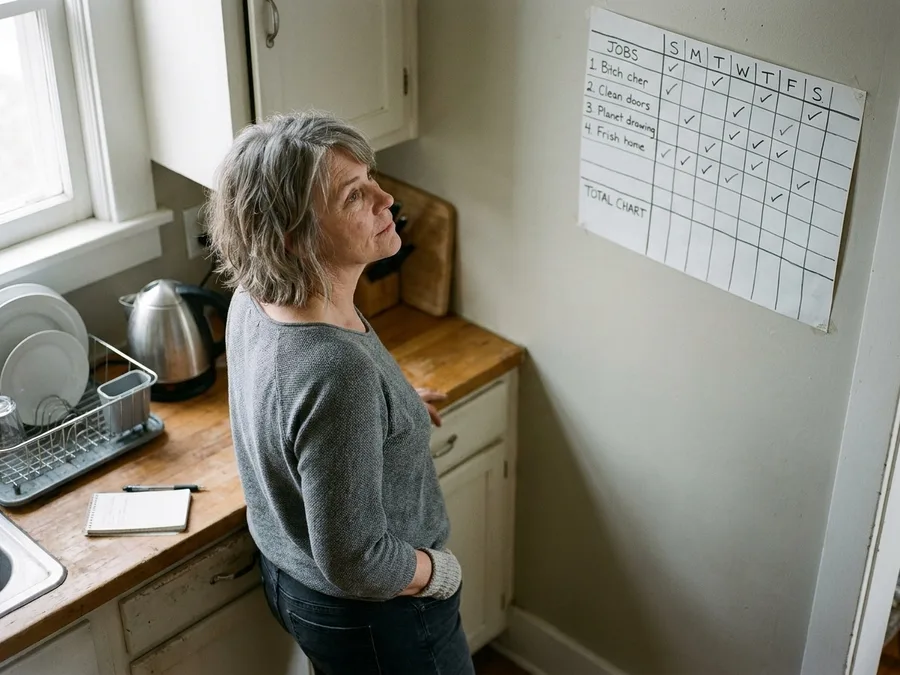
A rent check settles the money question once a month. It does nothing for the other twenty-nine days.
The phrase that sinks this arrangement is "help out around the house." It sounds generous and it means nothing. Help out is a feeling, not a task, and the parent ends up keeping the list in their head: noticing the full trash can, noticing it again, deciding whether to say it, finally emptying it alone.
Replace the phrase with four jobs, each with a name and a day. About three hours total for the week: trash and recycling, the dishwasher, vacuuming the common rooms, and the adult child's own laundry. Written where the rent number is written.
The days matter as much as the jobs. Trash and recycling go out Monday night, the dishwasher runs after dinner every day, the common rooms get vacuumed Saturday morning, their own laundry happens Sunday. A job with a day attached is a job nobody has to bring up.
Now the part parents get wrong. When Monday's trash stays in the bin on Tuesday, the rule is not a silent rescue. The parent names the missed job at the next check-in and leaves it sitting where it is. One reminder, not a nag, not a redo, and the job stays theirs.
That single move is what keeps the list from becoming the parent's second job. Tracking, reminding, and quietly resenting is the exact loop this page exists to break – the same reason the bills got their own number instead of a vague "contribute."
Three hours a week is a modest ask for a 26-year-old. It is not about the labor. It is about the difference between a guest and a member of the household, and a person who cleans the common rooms on Saturday is living there, not visiting.
Two Ways The Same Six Months Can Go
What the written page changes
5. Their Shelf, Their Dishes, Their Food

The whole house can run on a chore list and the kitchen can still be a fight by Thursday.
The kitchen is where a shared house fetches up first, because food and space collide three times a day. The fix is a couple of square feet, agreed on move-in day: one shelf in the fridge and one cupboard, and that is where everything the adult child eats lives. Not a bag of their snacks on the counter, not their leftovers on the middle shelf.
Decide the meals at the same time. Two shared dinners a week is a workable default, and the other nights are self-serve, stated plainly so neither side is guessing. A shared dinner is an appointment, not an obligation to cook for anyone.
Dishes have three lines and they cover nearly every household. Each person washes their own that night. Whoever cooked the shared pan washes it. Nobody leaves a full sink overnight.
Those three rules carve the space before the small resentments can start. A shelf, a cupboard, and a stated dinner schedule keep the kitchen shared rather than taken over – or, worse, quietly surrendered, with the parent cooking around the child's groceries and saying nothing.
💡 Tip: Tape a small label with their name on the shelf. It sounds childish; it ends the 'whose hummus is this' conversation permanently.
6. Quiet Hours And Shared-Space Hours

The schedules will not match. A 26-year-old's Thursday and a 58-year-old's Thursday look nothing alike, and no amount of goodwill fixes that.
So put the hours on the page. Quiet hours run 11 p.m. to 7 a.m. on worknights. The shared rooms clear by 10 p.m., which is the part parents tend to forget: it means the living room is the parents' again at 10, not that everyone merely lowers the volume at 11.
Late TV and late calls go through headphones. A phone conversation after 10 happens in the child's room or out on the porch, not on the living room sofa while the parents are reading two feet away.
Exceptions are fine and need a process. Either side asks at the Sunday check-in, or gives at least 24 hours' notice. An exception is one night, not the first night of a new normal, and it does not get renegotiated at 11:40 p.m. on the stairs.
Written hours settle the schedule mismatch without a nightly negotiation. A daily negotiation is what the open-ended stay felt like last time. This is the version where a parent can point at the page instead of starting a conversation about respect at the end of a long day.
And notice what the hours do to the room itself. Once the living room clears at 10, the household has staked out two private territories instead of one long shared evening that nobody gets to leave. That is what makes a three-bedroom house work again for two adults and their adult child.
💡 PRO TIP
The 24-hour rule covers everything
Apply the 24-hour rule to every exception: guests, car borrows, late nights, schedule swaps. One rule, applied everywhere, is easier to remember than five separate ones.
7. Overnight Guests, Decided Up Front

Ordinary weeknights now have their rules. The overnight guest is the exception that arrives without one unless you write it first, and it is the fastest way to turn a managed household back into a hotel.
A partner can stay over, up to two nights a week, and the request reaches the parents a full day ahead. A day of notice is enough to clear a bathroom shelf, shift a dinner, or simply not be surprised in the kitchen at 7 a.m. on a Saturday.
Notice that arrives as a text sent from the driveway, after the car is already in it, is not notice. It is an announcement, and it turns the parents into roommates who were not consulted.
Friends get a different answer. One night, asked in advance, with no standing weekend arrangement that quietly becomes four nights by the end of the month. If the child wants a friend to stay, they ask, and the answer can be no without it becoming a fight.
Some doors stay closed regardless of who is visiting. The parents' bedroom and the home office are off limits to guests; visitors use the shared bathroom and the common rooms, the same way any other adult visitor in the house would.
A step-parent or a sibling still living at home should hear the guest rule from the parent, in daylight, before the first visit. The worst version is the one where the rule gets discovered by a family member at midnight, in a hallway, from someone they did not know was staying.
The rule is what lets the visit happen without a negotiation every time. A partner's visit becomes a household plan, agreed in advance, instead of a surprise that lands on everyone at once.
8. Privacy That Runs Both Ways

You knock and wait. Yes, even now. Especially now.
The temptation is real: a room that used to be yours to tidy is now a room with a closed door, and the first instinct on a Saturday morning is to bring the vacuum in and pick up the socks. Don't. An adult child's room is not a chore on your list, and walking in without knocking reads as exactly the thing the whole page is trying to end.
So the terms carry both directions. Knock and wait before entering their room, and no tidying it, however much the clutter bothers you. Their room is not an overflow unit for the rest of the house either; the boxes of seasonal decorations and the outgrown furniture stay in the garage or the attic, not stacked in the corner behind their door.
And the same applies back to you.
Your bedroom and your office are off limits to them. The same knock-and-wait rule applies in both directions, which matters most when one of you is on a work call with the door shut and the other is looking for the stapler.
The harder half is not the door. It is the questions.
Money and job-search questions will get asked, and they will get asked more as the savings target comes up at each monthly review. Give them a place. The Sunday fifteen minutes is one, and a private walk around the block is the other.
What you want to avoid is the question through a closed door on a Tuesday night, or in front of a partner in the living room. Neither conversation goes well, and both send the message that the room is only nominally theirs. The question is fine. The timing and the doorway are what turn it into an ambush.
Privacy running both ways is how the arrangement stays adult in the small hours, not just on the signed page.
The Shared Bathroom And Laundry — At a Glance
🚿 Workday showers
6:30–7:00 and 7:00–7:30
🧺 Laundry days
Child: Wed & Sat. Parents: Tue & Fri
🕘 Washer curfew
No clothes left past 9 p.m.
🧻 Shared supplies
Child restocks from household list
🔄 Shift change
Swap in writing 24 hours ahead
Why it works
One shower and one washer only work when the slots are written down; unwritten schedules become morning fights.
9. The Bathroom And Laundry Schedule

Privacy sets the doors. A bathroom and a washing machine are shared resources, one of each, and one of each cannot absorb two adults' mornings unless the times are written somewhere both people can see them.
Two workday shower slots, 6:30 to 7:00 and 7:00 to 7:30, cover the mornings that matter. Outside those slots the bathroom is first come, first served, and nobody stands in a towel in the hallway waiting for a door to open.
Laundry gets days rather than hours. The adult child takes Wednesday and Saturday, the parents take Tuesday and Friday, and the machine empties by 9 p.m. so no load sits overnight and no one has to move wet clothes to start their own.
A towel lives on the child's hook and personal toiletries stay on their shelf. Household toilet paper and hand soap are the adult child's to restock from the shopping list, which is a small job that quietly signals this is their home to maintain, not a hotel they are passing through.
If a shift changes, the slot moves by a written swap at least a day ahead. Taking the other person's time without asking is the small discourtesy that puts an edge on the whole week; a swap in writing is the version that keeps the schedule worth having.
None of this works if it stays in your head. A verbal plan for one shower and one washer turns into a 6:45 a.m. knock fight and a load of someone else's laundry left souring in the drum, and the argument is never really about the shower.
💡 Tip: Put the schedule on the back of the bathroom door or inside the laundry cabinet. If it lives on a phone, it is not a household rule yet.
10. The Car, The Parking, And The Tank

The car keys hanging by the back door are the last piece of shared space to get sorted, and the driveway is the easiest place for a small favor to turn into a standing assumption. A written line about the car, the parking spot, and the gas tank belongs on the same page as the rest.
The shared car is available for work shifts and grocery runs, which is the whole reason the arrangement works. Weekend trips need a conversation first, not a text from the road. Say it as a rule about the car, not a verdict about the driver.
Fuel is the detail that gets skipped. Return the tank full, or leave $20 on the counter, and the rule applies from the first borrow, not after the third time the parent notices the gauge sitting on empty.
The parking spot takes one sentence too: the right side of the driveway is theirs. Blocking the driveway means the car moves before 8 a.m. or the keys go on the hook the night before.
Insurance coverage gets confirmed with the policyholder's own insurer before the first borrow. No number about premiums or coverage comes from here. One call to the agent settles it, and it is the call to make before the keys change hands.
Driveway, spare key, fuel level: all three are sorted before the first trip, which is what keeps a borrowed car from becoming a family argument that started over twelve dollars of gas.
🗓️ The First Six Months, Step By Step
Before move-in day
Sit down for 30 minutes with one sheet of paper and write the six numbers.
Move-in week
Agree the fridge shelf, the cupboard, the chore days, and the bathroom slots.
Month 1
First rent due on the 1st; first Sunday check-in; first savings transfer.
Month 2
First monthly review of the savings balance and the chore list.
Month 3
The written review: check the $4,000 target pace and decide whether June 30 still holds.
Month 5
Start the next housing search in writing so the move-out date has somewhere to land.
June 30
Move out, or extend in writing with a new date and a new review.
11. A Plan For Their Days

A borrowed car is only useful if there is somewhere to drive it. The week needs a shape on paper – so many hours earning, so many hours applying, so many hours at home on chores and shared dinners – or the stay turns into long unstructured days and the parent quietly keeping score.
Set the count in advance and keep it small enough to be true. In the example household, the standard is fifteen hours of paid work in a week, or ten applications if there is no job yet.
Both numbers are hours and counts the child can report out loud in under a minute. That brevity is the point: it removes the need for the parent to reconstruct the week from car mileage and closed doors.
The plan also names the hours at home, not just the hours away – which evenings are set aside for chores, which two dinners are shared, the standing Sunday slot. Those blocks are part of the same page, so the week reads as a whole rather than a work schedule with a household attached.
The parent learns how it went in ninety seconds, at the check-in, from a short update: hours logged, or applications sent. Not from watching the driveway, not from asking a third time at the kitchen counter. Surveillance breeds the exact defensiveness the arrangement is trying to leave behind.
If the child is enrolled in classes or raising a child of their own, class hours and study blocks – or childcare hours – fill the same role in the plan. The count changes. The written week does not.
Write the standard down before move-in and treat it as information, not a leash. A number both people agreed to is a plan. The same number applied in suspicion is a fight waiting to happen.
What Keeps The Stay Temporary
Do
- Put the end date, rent, and savings target on one page
- Name four chores with days attached
- Hold the Sunday check-in every week
- Swap slots in writing 24 hours ahead
- Ask money questions at the check-in, not the door
Don't
- Leave the end date open ('when you're on your feet')
- Say 'help out' and track the results in your head
- Cover the phone bill 'just this once'
- Enforce rules mid-argument
- Tidy their room while they are out
12. The Number They're Saving Toward

Hours worked and applications sent are only worth tracking if they turn into money for the exit. That is what the savings target is for – a single figure on the page that says how much has to be in the account, and by when, for the move-out date to be real.
In the example, the figure is $4,000 by June 30. Sit with that on a $2,400 monthly take-home: it is real money, and it is reachable across six months at roughly $650 a month once the $380 for rent and bills is out the door. Tight, not impossible – the right size for a target.
The account belongs to the child, in the child's name. Parents see the balance at the monthly review and at the Sunday fifteen minutes; they do not hold withdrawal rights, and they do not log in on a Tuesday to check.
Why not just say save what you can? Because that phrase absorbs every want. Saving what you can is the language of a person who has already decided the number will be small – and there is never a moment when the total is too low, because there is no number to compare it to.
Four thousand dollars names the gap. It forces a look at the account once a month, and a look is what turns six months into a countdown rather than a residence.
At the three-month review, look at the balance against the pace. Behind target means a written catch-up amount and a weekly transfer into the account – a specific number moving on a specific day, agreed at the table, not a general promise to try harder.
If no catch-up is agreed, the June 30 date does not move. It stays, and the next housing plan starts – which is the whole reason for setting the date in the first place. Rewarding a missed target by extending the stay is how the spare room becomes permanent.
💡 Tip: Set the transfer for the day after payday, automatic. A savings target that depends on willpower loses to a savings target that depends on a calendar.
13. The Things You Will Not Do For Them

A savings target only holds if the quiet rescues stop. Every small bailout – the phone bill paid without a word, the loan that never gets mentioned again – pulls money out of the same pocket the exit date depends on, and the target quietly stops meaning anything.
So the page names what stops, specifically. No laundry beyond their own. No cooking on the nights that are theirs. No phone bill. No new loans, no cosigning, no quiet transfer to cover a shortfall.
Say each one out loud before move-in day, not the first time it comes up at eleven at night.
The phone bill is usually the first test. It has been on your account since they were sixteen, and the paperless statement still arrives in your inbox. Move it to their name in the first week, or agree on a date when it moves, and put that date on the sheet.
Old debt needs a line of its own. Either a repayment plan with an amount and a date, or a written line that says this is settled and not coming back. What cannot happen is silence, because silence leaves the debt alive and leaves every future money conversation vague and loaded.
Genuine emergencies are a different category, and the difference is easy to state. Medical, safety, immediate transport: the answer is yes on the spot, no discussion, no paperwork. A routine shortfall – a tank of gas, a phone that broke, a night out that ran over – goes to the Sunday conversation, where it gets looked at with the numbers on the table.
The stops are not a withdrawal of love, and they need to be said that way. They are the mechanism that makes the savings number reachable and the June 30 date real. Frame them as the plan working, not the parent pulling away.
Expect the first objection within a week. It usually sounds like this is unfair, or like nobody else's parents do this. The answer is calm and short: this is what makes the date possible.
Write the four stops on the same page as the rent and the end date, so the whole arrangement reads as one agreement rather than a list of punishments.
14. A Weekly Fifteen-Minute Check-In

Written stops only hold if there is a standing place to check them. Without one, the first shortfall arrives on a Tuesday night and the only options are an argument in the kitchen or a quiet rescue that undoes the page.
The fix is fifteen minutes, Sunday evening, the same slot every week. The time matters more than the length – a fixed appointment is what turns a conversation into a habit instead of something you have to work up the nerve to start.
Three questions, asked in the same order every week. What is working. What is not. What changes this week. Nothing else, no pile-on, no rehashing of the month.
Rule changes happen here and get written on the page. Not mid-argument, not through a bedroom door, not in a text at midnight. If a quiet hour needs to move, it moves on Sunday and the sheet gets updated.
The three-month review is one of these sessions, not a separate showdown. Same fifteen minutes, same three questions, with the savings balance and the calendar in front of both of you. It reads as routine because it is.
The reason it works is timing. A missed chore caught the same week is a reminder; caught in month three it is a grievance with three months of weight behind it. Small problems stay small only if somebody names them while they are still small.
Expect the first few to feel stiff and a little formal. That is the point – the formality is what keeps the tone even when the subject is money.
Every other rule on the page stays alive through this one. Skip the Sunday slot for a month and watch how quickly the rest goes quiet.
💡 Tip: Put the check-in in both phones as a repeating event with an alarm. A calendar entry is harder to skip than a good intention.
Frequently Asked Questions
What if my adult child refuses to sign anything?
Then you have learned something before move-in day, not after. Ask what part they object to — often it is the rent number or the guest rule — and negotiate that part. A page with five agreed rules beats a page with six rules and a refusal.
Is $300 rent too much, or too little?
It is a practice number, not a market rate. The point is a monthly obligation that builds the savings habit. Scale it to your child's take-home pay, but keep it above zero so the stay does not become a free hotel.
What if they lose their job during the stay?
Use the emergency clause and the check-in. Reduce or pause the rent in writing, keep the chore list and the savings target in place, and set a date to revisit. Do not tear up the page; revise it.
Should the three-month review be a formal meeting?
No. It is one of the Sunday 15-minute sessions with two extra items: the savings balance and whether the June 30 date still holds. Formal meetings get postponed; a standing Sunday slot does not.
What if there is a step-parent or sibling in the house?
The parent delivers every rule to the adult child, and the parent delivers the guest rule to the rest of the household. Having two people enforce different versions of the page is how rules get played against each other.
One Sheet Of Paper, Thirty Minutes, Six Numbers
Start with one sheet of paper and thirty minutes before move-in day. Write six numbers on it, read them aloud, both of you sign at the bottom, and put the three-month review on the calendar that same evening.
The Sunday check-in is what keeps the other thirteen rules alive. Skip it for a month and the page becomes a document nobody opens.
Renegotiate at the review, in writing, with both people in the room. A signed agreement cannot change mid-argument, because nobody remembers what was said.
That spare room stops being a soft landing and becomes a six-month arrangement with a route out by June 30, which is the one thing the last stay never had.
Six numbers, one page, before the first box
Print the money sheet from this article and fill in the blanks with your own numbers. Then put the Sunday check-in in both phones.