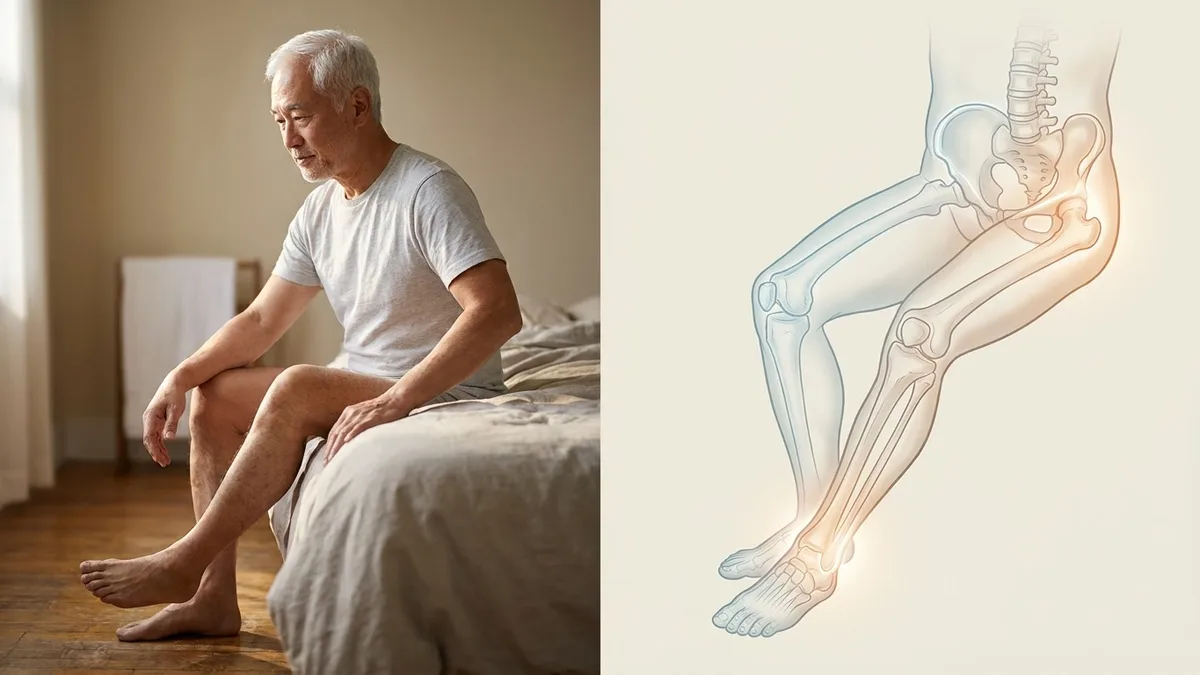
At 6:04 a.m., bare feet find a cold floor, and the walk to the bathroom is taken in short steps with one hand on the wall. No pain, no fall, just a shuffle, and by the kitchen it has faded.
That shuffle comes from seven hours of stillness, not from age. Your ankle, hip flexor, hamstring, glute and mid-back each own one part of a normal step, and every one of them is cold and shortened when you wake.
This is five stretches in walking order: three lying in bed, two standing beside it. Hold each 20 to 30 seconds twice, start within 10 minutes of waking, finish in about 8 with nothing but a bath towel, a kitchen chair and a doorframe.
Before long you can run it from memory, know which stretch to skip on a bad day, and know the pain signal that ends a stretch and the point where a clinician comes before stretching.
At a Glance
1. Ankle Circles and Pumps Before Your Feet Touch the Floor
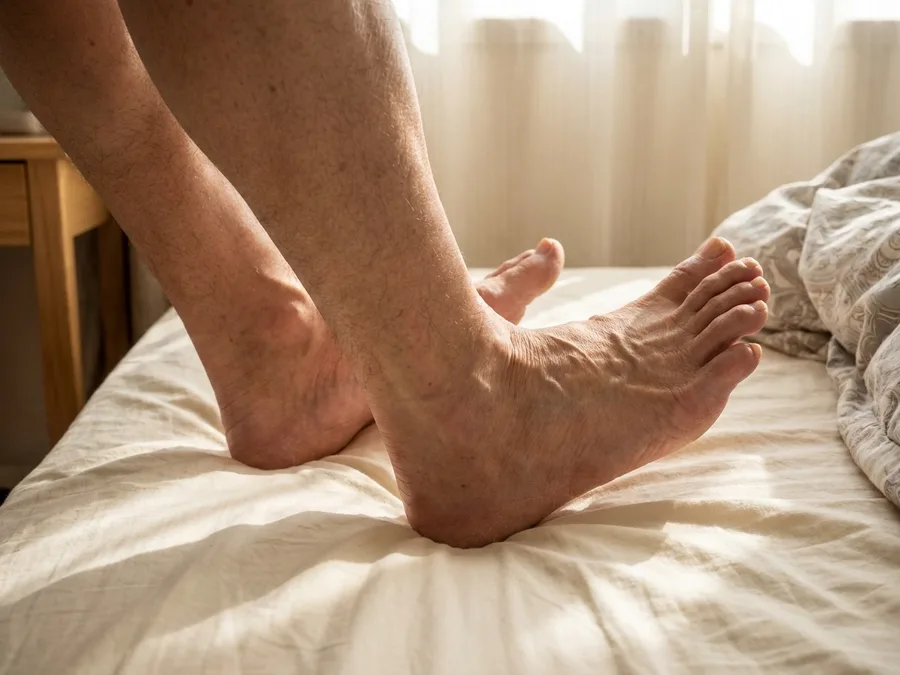
The toe that catches on the carpet is not a knee problem. It is an ankle that has spent seven hours at one angle and cannot lift the foot high enough to miss the floor.
Toe clearance is the mechanical cause of the drag. Each normal step asks the ankle to flex the foot up about twenty degrees so the toes pass over the ground, and when the joint is stiff that margin drops to almost nothing, so the front of the shoe scrapes the hallway and the body shortens the step to avoid the catch. It is why the 6 a.m. walk sounds like scuffing and not like walking.
The fix happens before your feet touch the floor, lying flat on your back with the heels on the mattress. Ten slow circles in each direction at each ankle, then fifteen pumps per foot – point the toes away, flex them back toward your shin, and count each one.
Call it a minute per foot, no prop and nothing to set up, and it is the only stretch in the whole sequence that has to happen before you stand, because the first steps come seconds after you swing out of bed.
Restoring that up-and-down range is what gives the toes the room to clear the floor on each step, and the drag goes out of the hallway. The detail that decides it: the pumps do the real work, so make them slow and full rather than fast and shallow.
A fresh ankle sprain is the exception. Skip the circles that day and do the pumps on their own, gently, and let a sore joint settle before you load it.
One rule applies to every stretch here: sharp, pinching or radiating pain ends it rather than being pushed through, and if you have had recent surgery or a diagnosed joint problem, a clinician sees you before you start.
💡 Tip: Circle from the ankle, not the whole leg — keep the knee still so the movement lands in the joint.
| Stretch | What it loosens | Hold and rounds | Prop needed | Where you do it |
|---|---|---|---|---|
| Ankle circles and pumps | Ankles and calves (toe clearance) | 10 circles each way + 15 pumps per foot | None | Lying in bed |
| Knee-to-chest | Hip flexors (stride length) | 20–30 sec, 2 per side | None | Lying in bed, at the edge |
| Towel hamstring stretch | Hamstrings (reach forward) | 20–30 sec, 2 per side | Bath towel | Lying in bed |
| Figure-four glute stretch | Glutes (push-off) | 20–30 sec + 10 squeezes, 2 per side | None | Lying in bed |
| Doorway chest opener + back extension | Mid-back and shoulders (posture, arm swing) | 20–30 sec, 2 rounds; 5 extensions | Doorframe | Standing beside the bed |
2. Knee-to-Chest Hip Flexor Stretch at the Bed Edge
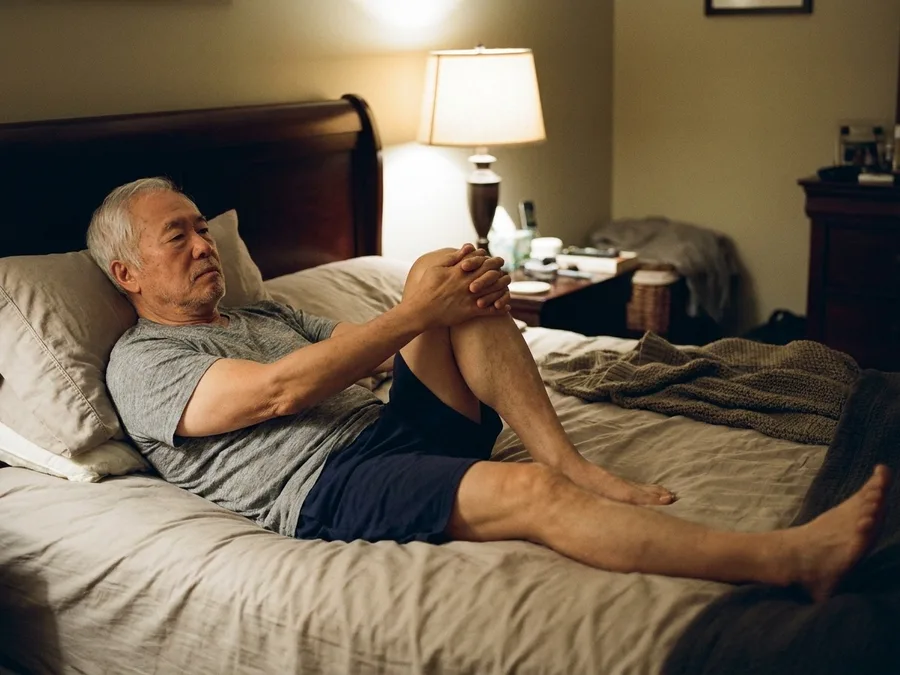
The back half of a step can be free and the stride still looks short, because the front half has a ceiling of its own.
That ceiling is the hamstring, the muscle down the back of the thigh, and it has been sitting at near-resting length since your head hit the pillow. A hamstring that will not let the leg reach means the foot comes down underneath the body instead of out in front of it. Same effort, smaller step.
Loop a bath towel around the ball of one foot, keep the knee softly bent rather than locked, and straighten the leg toward the ceiling until you feel the pull behind the thigh. Hold 20 to 30 seconds, twice per side.
The details that decide whether this one helps or hurts: the other leg stays flat on the bed, and the lower back stays pressed down into the mattress. Let the back arch and the stretch quietly moves into the spine, which is exactly what a reader with a cranky morning back does not want.
The payoff shows up on the first pass down the hallway. A hamstring with slack in it lets the leg reach far enough that the heel can land first, which is what turns a flat-footed pat into a step with a beginning.
No towel on the nightstand is not a reason to skip it. A bathrobe belt or the dog's leash works the same way, and so does a rolled sheet. Nothing here needs buying.
💡 Tip: Keep your lower back pressed into the mattress — if it arches, you are pulling from the spine, not the hip.
💡 PRO TIP
The breathing trick that doubles the stretch
Exhale as you sink into each hold and let the muscle lengthen on the out-breath. Physical therapists use this because the nervous system allows more range when you are not bracing — it is the difference between a stretch that lasts and one that snaps back the moment you let go.
3. Towel Hamstring Stretch Lying on Your Back
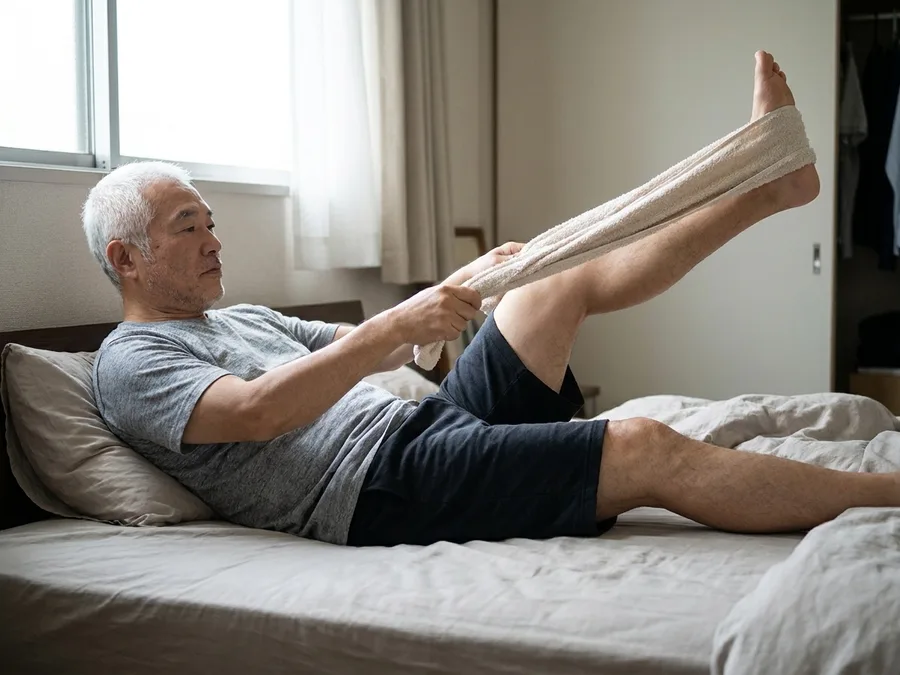
A leg that swings back has to reach forward to finish the step, and that forward reach is capped by the hamstring – the muscle down the back of the thigh that stops the knee from extending freely when it is tight.
A short hamstring keeps the foot landing underneath the body instead of out in front of it. That is the difference between a step that carries you down the hall and one that just clears the floor, and it is why stretching the back of the leg belongs in the same routine as the hip.
The move needs one prop and it is in your bathroom: loop a bath towel around the ball of one foot and lie on your back with both legs on the bed. Keep the knee softly bent, straighten the leg toward the ceiling until you feel the pull behind the thigh, and hold 20 to 30 seconds, twice per side.
The detail that decides whether this helps or hurts: the other leg stays flat on the mattress and the lower back stays pressed down into it. Do that and the stretch lands in the thigh, where you want it, rather than in the spine, where you do not.
A belt or a dog leash works as well as the towel, so there is nothing to buy for this one.
What it changes on the walk: a hamstring that lets the leg reach is what puts the heel down first. Heel first is the mark of a real stride, and it is the thing you will notice on the way to the kitchen.
💡 Tip: If you feel it in your lower back rather than your thigh, bend the knee a little more and press the back of your pelvis into the bed.
⏱️ The 8-Minute Morning Run-Through
Minute 1–2
Ankle circles and pumps, both feet, still lying in bed.
Minute 3–4
Knee-to-chest hip flexor stretch, two holds per side.
Minute 5–6
Towel hamstring stretch, two holds per side.
Minute 7
Figure-four glute stretch with 10 squeezes per side.
Minute 8
Stand beside the bed: doorway chest opener, then 5 back extensions.
4. Figure-Four Glute Stretch for a Stronger Push-Off
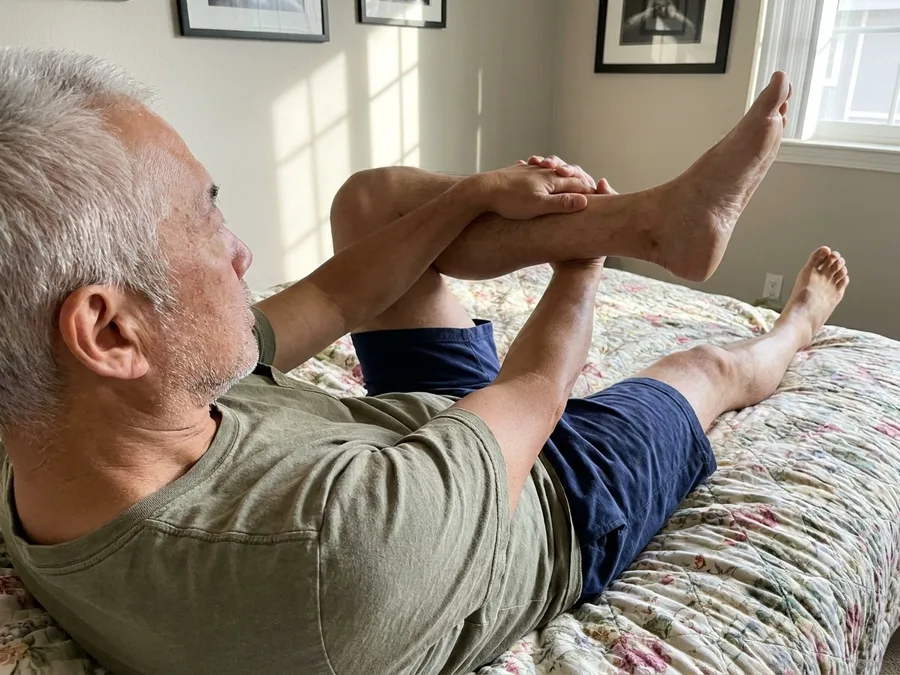
A heel that lands out in front only gives the leg somewhere to reach. The body still has to be carried over that planted foot, and the muscle that does the carrying is the one in your backside.
Push-off is the glute's job, and it is the first thing to go quiet after seven hours in bed. When the glute does not fire, the trailing leg drags behind instead of driving, and that flattened swing is what turns a stride into a shuffle.
Lie on your back and cross one ankle over the opposite knee, so the legs make a figure four. Reach both hands through the gap, take hold of the supporting thigh, and draw it toward your chest until you feel it across the back of the hip.
Hold 20 to 30 seconds, breathe slowly, and do it twice on each side. The rear foot stays flexed, not dangling, and the head and shoulders stay flat on the bed.
At the end of each hold, add 10 slow squeezes of the glute on the crossed side. That is the part most people skip: the hold lengthens the muscle, and the squeezes wake it up to do its job on the first steps.
Watch where you feel it. A stretch behind the hip is what you want; a pinch at the front of the hip joint means the angle is too deep, so ease off and stop there rather than pushing through it.
💡 Tip: Keep your head and shoulders flat on the bed — if your neck is craning, you are pulling too hard.
⚠️ COMMON MISTAKE
Don't chase the deepest stretch
The most common mistake is pushing for maximum range on the first hold of the day. Cold tissues do not lengthen that way — they guard. Take the first round at 70 percent and let the second round go deeper. You will end up with more range, not less.
5. Doorway Chest Opener and Standing Back Extension
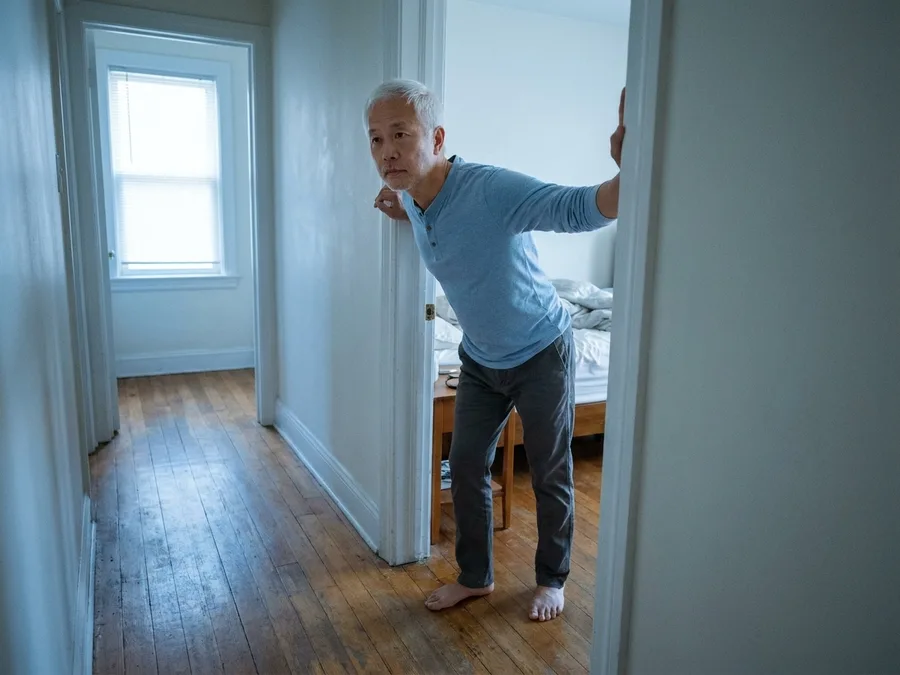
The legs can now make the stride. What decides whether that stride reads as old to anyone watching is what happens above the waist, and one rounded upper back cancels a good deal of the work already done.
Stand in a doorway with both forearms on the frame at shoulder height. Step one foot through until you feel the front of the chest and shoulders open, and hold 20 to 30 seconds. Twice.
Then take the hands to the lower back, fingertips down, and gently extend the upper back 5 times. Keep the chin tucked and do not tip the head back with it.
Here is the mechanism. When the mid-back stays rounded, the shoulders roll forward and the arms stop swinging. Arm swing is half of what makes a walk look and feel normal, so the stride reads as old even when the legs underneath it are doing fine.
This one is done last, standing beside the bed, so the first steps of the day are taken with the chest already open. Do the doorway work first and the extension after it, in that order, every morning.
If a shoulder hurts, or one has been injured recently, put the hands lower on the frame, at chest height instead of shoulder height, and take a smaller step through.
💡 Tip: Keep your chin tucked as you extend — the movement should come from the mid-back, not the neck.
Quick Tips Before You Start
Stay in bed for the first three
Do the lying stretches before your feet touch the floor — that is the whole point.
Hold 20–30 seconds, twice
One round per side is not enough; two rounds of 20–30 seconds is the dose.
Breathe slowly, don't bounce
Bouncing triggers a stretch reflex that tightens the muscle you are trying to lengthen.
Sharp pain means stop
A pull or a stretch is fine. Pinching, sharp or radiating pain down a leg is not.
Test on the first walk
After the sequence, walk to the kitchen and check that your heel lands first.
Frequently Asked Questions
How soon will I notice a difference in the morning shuffle?
Most people feel a change in the first walk down the hallway the same morning, but the effect builds over two to three weeks. The stretches restore range of motion, and the nervous system learns to use that range with repetition. Give it a month of daily practice before you judge it.
Can I do these stretches if I have arthritis in my knees or hips?
Gentle range-of-motion work is generally safe with arthritis, but the rule is the same: a stretch should feel like a pull, not a pinch. If a joint pinches, back off the range. Check with your doctor or physical therapist if you are unsure, especially if you have had a joint replacement.
What if I only have time for one or two of them?
Do the ankle circles and pumps first — toe clearance is the most direct fix for the shuffle. If you can add a second, do the doorway chest opener last so your first steps are upright. Those two bookend the sequence and give you most of the benefit.
Should I stretch before or after I get out of bed?
Three of the five are done lying in bed, before your feet hit the floor. The last two are done standing beside the bed. The order matters because you want the standing stretches to be the last thing before you walk, so the posture carries into your first steps.
When should I see a doctor instead of stretching?
If you have sharp, pinching or radiating pain — especially down a leg — stop and see a clinician. The same goes for numbness, recent surgery, or a diagnosed joint problem. Stretching is for stiffness and range of motion, not for pain that signals something else.
The First Ten Steps Are the Test
ankle circles, 10 each direction plus 15 pumps per foot, about a minute per foot. Then knee-to-chest at the bed edge, 20 to 30 seconds twice each side, with the hanging-leg version if your back is fine. Towel hamstring, 20 to 30 seconds twice per side. Figure-four glute, 20 to 30 seconds twice per side with 10 squeezes per hold. Then up: doorway chest opener twice and five upper-back extensions, straight before the walk. Eight minutes.
Same hallway, same cold floor as the 6 a.m. shuffle, now measured by longer steps instead of a hand on the wall. On that first walk, check one thing: does the heel land first on each step, and are the arms swinging? Arms hanging still means the doorway opener was rushed, so go back and hold it longer.
One stop rule stands over all of it. Sharp, pinching or radiating pain, especially down a leg, ends that stretch rather than getting pushed through, and recent surgery, a diagnosed joint problem or numbness means a clinician sees you before the sequence starts at all.
Start with the ankles tomorrow morning
Before your feet touch the floor, do ten slow circles and fifteen pumps per foot. That one minute is the difference between a shuffle and a stride.