
$5,600 a month. That figure, not the balance, is the one that quietly decides how long a retirement lasts.
Most people arrive at retirement believing the comfortable households picked better funds or caught a kinder decade, and carrying one picture: a parent's savings draining into a care facility at a monthly rate no portfolio survives. The turn is duller and more useful. The couple who retired four years ago on $840,000, house owned outright, both cars paid off, spend that $5,600 a month, and nothing about their returns is remarkable.
What separates them is timing. The numbers were settled before the bad week, which is why the twenty habits below are half health habits: a market drop and a medical bill are the only two that break a budget, and a body you can still train is the one lever against the second. Pick three to start this month.
Quick Tips Before You Start
Get twelve months of statements
Pull a full year of bank and card statements before you estimate anything – January through December, not a typical month.
Pick one review date
Put four calendar dates a year in the phone now, ninety minutes each, and hold them like appointments.
Date transfers to money-in day
Set automatic transfers for the day after Social Security lands so saving happens before any spending decision.
Price health last, not least
Treat the health line as the biggest fixed cost in the plan, not the leftover after everything else.
Write the cut list first
Agree the order you would trim things while you are calm, so nobody has to choose during a bad quarter.
1. A written monthly spending number
A retirement budget is not a guess about what life might cost. It is a receipt for what life already cost, added up.
Twelve months of bank and card statements, printed and spread across the kitchen table before retiring, produced the $5,600 figure. Not a planner's rule of thumb, not a round number picked to feel safe. What they actually spent, month by month, down to the pharmacy copays.
That distinction matters more after 60, because the years a budget most needs to survive are the years spending stops being predictable. A dental crown, a flight to a grandchild's wedding, a furnace that dies in February – none of them announce themselves in advance.
The statement exercise catches the ones that already happened, and those are the best forecast available.
Every January the number gets rebuilt from the prior year's actuals. The figure written in year one was never permitted to sit untouched through year four. It moves by a few hundred dollars either direction most years, and each move is deliberate rather than discovered in March.
Then comes the part most households skip: the number gets split in two. Insurance, property tax, utilities and groceries go in one column – the costs that arrive whether or not the month is good. Everything else goes in a second column, the trimmable parts, ranked in the order they would go if a bad year demanded it. By the time trimming is necessary, the order is already settled and nobody has to negotiate it while worried.
One honest exception. Households whose pension and Social Security already cover every dollar of spending, with a portfolio they never touch, get almost nothing from this exercise – their number is already fixed by the deposits. For everyone else drawing on investments, the number is the only thing that turns a market drop from a feeling into a figure they can plan around. Without it, a 15% decline is panic. With it, a 15% decline is arithmetic.
2. A full year of spending in savings
A spending number is only useful if paying the bills does not require selling something on a bad day. That is what the cushion is for.
$60,000 sits in a high-yield savings account – roughly a year of $5,600 months. It lives outside the rollover IRA and outside the brokerage account, so when either one drops, the cushion does not move with it. That separation is the whole design.
Here is the mechanic that keeps it working. After each portfolio withdrawal, the cushion is topped back up on a set schedule. It is never allowed to drift downward for a year and then get rescued in a scramble, which is how most cushions quietly stop being cushions.
What this costs is real: that $60,000 earns savings-account interest instead of market returns. In a good year the household gives up some growth on it. In a bad year, that same $60,000 is the reason nobody sells at the bottom.
The trade is accepted deliberately, not discovered later.
Run the scenario. The portfolio falls 20% in the spring of a year the roof also needs replacing. A household with no cash on hand sells investments at the low to cover both – locking in the loss permanently, because those shares are gone. A household with a year of spending in savings pays the roof and the groceries from cash. The portfolio is untouched until it recovers.
One year of cash does not make a long downturn painless. What it buys is time – twelve months in which the response is already written and nobody has to decide anything in a bad week.
💡 Tip: Keep this account at a different bank than your brokerage. The friction of a transfer that takes two days is exactly what stops a bad-week decision.
The Four Numbers That Run This Plan
3. Social Security claimed from their own statement
Cash buys time, but a year of it only stretches so far. Something predictable has to land underneath it every month, and that is Social Security.
Years before claiming, both spouses created accounts at SSA.gov and pulled their earnings records. The point was not curiosity. Missing or underreported years show up on that record, and correcting one is easier at 62 than at 68 – a low year from a job change or a stretch of self-employment can shrink a benefit for life if nobody catches it in time.
The claiming decision itself was uneven on purpose. The older spouse waited, because that benefit is the one that lasts longest and grows the most with patience. The younger claimed on her own work record rather than assuming some spousal figure she had never verified.
The couple's combined benefit comes to $4,150 a month. That money is the floor the entire plan rests on – the portfolio is there to cover the gap above it, not to fund the whole of a life.
Every rule, earnings limit, reduction and enrollment date belongs to SSA.gov, which states them plainly and updates them. Read them there, not from a newsletter or a neighbor who claimed early and has opinions about it. A benefits statement and a ten-minute phone call beat a confident guess every time.
This is what makes the cushion last. Twelve months of cash is a year of breathing room when it is sitting on top of a floor. Without the floor, a market drop eats the cushion in a quarter, and the selling starts early.
💡 PRO TIP
Check the record before you claim
Download your earnings record from SSA.gov and walk through the years one at a time. Correcting a missing W-2 while you are still working is a form and a phone call. Correcting it after you have claimed is a much longer road.
4. Automatic transfers on the day money lands

A benefit floor is only as good as what happens in the seventy-two hours after it hits the checking account. Money that sits there for three weeks gets quietly absorbed by groceries, a birthday, a vet bill, and nobody decides anything at all. So the transfers here are dated for the day after the Social Security deposit and the $600 pension land, which puts the saving ahead of every spending choice the month will offer.
Three destinations, three small amounts.
The cash cushion takes the largest slice, the car fund takes $250, and the home repair fund gets a modest monthly deposit that builds toward the next roof or furnace without anyone noticing it leaving. None of the three numbers is big enough to hurt in a lean month, and that is deliberate. A transfer you switch off once usually stays off, so the amounts are set low enough that a tight February never becomes the reason to pause one.
The whole system runs on a single decision made once a year.
At review time, the amounts get adjusted, the destinations get confirmed, and then the rest of the year belongs to the automatic schedule. Compare that to the alternative most households live with, where saving is a judgment call made at the checkout thirty times a month, and it is not hard to see which version survives a stressful season.
This is the habit that takes the decision out of the bad week completely. The bad week never gets a vote, because the money has already moved before the week knew it was coming.
What it costs: a small amount of flexibility. You cannot redirect a transfer mid-month to cover an unexpected dinner out, and that restriction is the feature. The transfers protect the plan from your mood, which is exactly what a market drop and a medical bill both exploit given half a chance.
💡 Tip: Automate a little less than you can afford, not a little more. A transfer that survives a tight month is worth more than a bigger one you cancel in March.
5. One paid-off car, driven twelve years

The car is the large expense you can watch approaching from three time zones away. There it is in the driveway, thirteen years old, a hundred and forty thousand miles, and the only real question is whether the replacement gets financed in whatever year it finally dies or paid for in cash because the money was already there.
The example household bought the sedan new in 2016 and pencilled it in for twelve years of service, through 2028. That means no monthly payment appears anywhere in the $5,600 spending number for a full dozen years, which is one reason the figure stays where it is. Meanwhile $250 a month leaves for the car fund every month like clockwork, so the next car arrives as a purchase rather than a loan.
Repairs get weighed against a monthly payment, and the math usually favors the repair.
Say the transmission goes in year nine and the shop quotes $1,400. A year of payments on a comparable replacement runs north of $5,000, and it does not stop after twelve months. So the transmission gets fixed from the fund, the portfolio is never touched, and the household drives another three years on a car that costs them nothing but maintenance.
Not every household can run one car. Two drivers in a rural county with no bus and a hospital forty minutes away genuinely need two vehicles, and pretending otherwise is how a plan gets abandoned. The habit worth copying there is the fund, not the single-car rule. Set aside a monthly amount for each vehicle and let both replacements arrive prepaid.
This is what a fixed cost looks like when the household chooses it in advance instead of letting the year choose for them. A car payment lands whenever it wants to land, and it lands hardest in the year something else has already gone wrong. The fund makes it a line the household wrote down, on purpose, in a good week.
6. A home repair fund kept separate

A roof is not bad luck. It is a twenty-year clock that starts the day the shingles go on, and when it finishes the bill does not care what the market is doing that spring. Households that call it bad luck end up selling investments in a down year to cover it, which turns a $19,000 repair into a permanent loss on top of the repair.
In the example household, the roof and the HVAC unit both failed in year three of retirement. The combined bill came to $19,000. It was paid out of a fund that had been quietly filling since before retirement, and the portfolio did not move a dollar. That is the entire point of keeping this money in its own account, outside the IRA and the brokerage, where a market drop cannot reach it and a contractor cannot wait for a better quarter.
The monthly funding target is the number to write down.
One to two percent of the home's value, set aside on a transfer each month, keeps the fund perpetually mid-build. On a $400,000 house that is between $4,000 and $8,000 a year, or roughly $333 to $667 a month depending on where the house sits and how old its major systems are. The fund is never quite finished, which is the correct state for it to be in.
The failure mode is specific and common. A homeowner replaces the roof in an up year, feels the pinch, sells nothing, and then the furnace goes in a down year and the only source left is the portfolio at the worst possible moment. Two expected costs, both priced, both survivable, and one of them takes a bite that never grows back.
This is a medical-bill-shaped event in housing clothing: expected, knowable, and only painful if the money was never set aside. Fund it monthly, keep it separate, and the roof becomes a date on the calendar rather than a crisis.
What People Believe About a Market Drop
7. A quarterly one-page money review

A fund that nobody looks at slowly stops being a fund. The repair money gets raided for something that felt urgent in March, the cushion drifts low because nobody wrote down where it started. The answer is not vigilance. It is a look, scheduled, four times a year.
Ninety minutes on a kitchen table, four times a year, with one printed page on it. That is the entire monitoring system for an $840,000 retirement. Not an app, not a spreadsheet with twelve tabs, not a nightly glance at the balances.
Three figures go on the sheet: what the portfolio is worth today, what is sitting in the high-yield savings account, and how much has been spent so far this year against the $5,600 monthly figure. Nothing else earns a line.
That third number is the one that makes the ninety minutes worth the trouble. In April it shows $16,400 spent through three months, and the only question is whether the year is running a few hundred ahead of the plan or on it. You are not looking for a reason to feel bad. You are looking for a trend before it has a year to become one.
Both spouses sit down for it, and the point is not moral support. If one of you were in the hospital next month, the other should be able to open the laptop and know exactly which accounts hold what, in what proportion, and how much was budgeted for the roof. Twenty minutes of shared paperwork prevents a six-month search through a filing cabinet at the worst possible time.
What they do not do is check daily, and that rule has a scar behind it. During their first year of retirement they refreshed the portfolio app most mornings, which made each 1% move feel like information, which led to two trades, which turned out to be the only entirely avoidable mistake in the whole plan. It cost less than a vacation and taught more.
The written rule now is two consecutive bad quarters, not one bad week. A rule like that only exists because the review exists: the calendar supplies the quarters, and the quarters supply the evidence, and everything in between is noise you have already agreed to ignore.
8. A gift budget agreed in January

A one-page review only works if the discretionary lines already have numbers on them, agreed before the year starts. Grandchildren's birthdays are not a surprise; they are on a calendar. The largest of those outgoing lines is gifts, and it is the one most couples leave blank, then fill from the gut in December.
These two decided their gift total in January, before the first birthday card of the year arrived. The figure was $2,400 across every birthday and holiday combined: about $200 a month held back as the year goes, distributed across the calendar however the family's dates fall. When a grandchild's birthday lands in the same month as a wedding, the month is planned, not survived.
The money comes out of monthly cash flow, never from the portfolio. That one rule means December is not a withdrawal month, which means the portfolio never sees a year-end dip that has nothing to do with the portfolio.
Then there is the request that exceeds the number. A grandchild asks for help with a $3,000 car, or a family member hints that a bigger check would make the year easier. The prepared sentence is quiet and complete: that is not in this year's budget, but here is what is. The person hears a number and a boundary, not a rejection, and the household never has to improvise an answer in the moment with the checkbook open.
It helps that the figure is written down and signed off by both spouses before the first request arrives. There is nothing left to argue about in the moment, because the decision happened in January, in a good week.
This is the habit that does not fit every family. If you are already helping to support an adult child with rent or a car payment, that is not a gift cap problem; it is a level-of-support question, and the amount needs its own line in the base budget rather than a share of the $2,400. Getting the categories straight is the job, not shrinking the generosity.
9. A part-time gig that pays for extras

Gifts go out the door each month, and there is another way to cover the extras without reaching into principal: a small income of your own. Eight to ten hours a week can pay for the parts of life that are the first to feel the squeeze when the market turns.
The consulting work here is seasonal and chosen for flexibility, not for the money. Ten hours a week in the spring and fall, a lighter schedule in between, so the workload bends its schedule around the retirement plan rather than the plan bending around the work. The rate matters less than the option to say no to a busy month and yes to a grandchild's school play.
That work brings in about $900 a month, and every dollar of it goes to the extras: travel to see the grandchildren, the gift line, a long weekend away. None of it enters the base budget. That is deliberate. If the contract dries up in October or the phone stops ringing, the household simply spends less on the extras; nothing else in the plan has to move. The $5,600 base is built to survive without it.
This is also a buffer in a way that is easy to miss. When the portfolio is down 15%, the extras are usually the first thing anyone would cut, or the first thing that would come out of the falling accounts. The gig lets the travel and the gifts keep their place without selling low to fund them. It buys time, and it buys choices, and it never has to be relied upon.
Anything about how the earnings interact with federal benefits, including how much you can earn and how the benefit is affected, belongs on SSA.gov and nowhere else. Read it there before you sign a contract.
What goes wrong is not the working. It is the work that turns out to cost as much as it pays. Gas, clothes that fit an office again, lunches out to keep the schedule, a second pharmacy run for the new stress: remove those costs from the $900 and you may find $300, which is a hobby with a commute attached. Run the honest subtraction before the second month.
💡 Tip: Route the gig money to one named purpose before it arrives. Unnamed money gets spent, and then the gig was just a job again.
The Health Line — At a Glance
💰 Monthly health cost
$1,100
🩺 Coverage
Medicare Advantage
🦷 Also budgeted
Dental and vision
💊 Blood pressure pill
$12/mo generic
📅 Review point
Fall open enrollment
Why it matters
Health is the largest single line that can move by hundreds a month without anything in the household changing – which is why it gets its own review.
10. A pharmacy conversation about generics

Extra income pays for the travel and the gifts, so the base budget never has to stretch. The largest recurring cost a household at this stage can actually lower sits behind a pharmacy counter, on a receipt most people never read closely.
The blood pressure pill is a generic and it costs $12 a month. Ask for it by name, not by the brand on the old bottle, and ask what the cash price is alongside the insurance price.
Then compare the two numbers. They are not always in the order you expect, and a plan with a copay is not automatically the cheaper route.
This is a question for two people, not one. The prescriber controls what is written on the prescription; the pharmacist controls what is dispensed and what it rings up at. Either one alone leaves half the answer on the table.
A $40 monthly difference is $480 a year. Against a $5,600 monthly spending number, that is nearly a month of groceries bought with one conversation, and it repeats every month for as long as the prescription does.
The $1,100-a-month health line has a small end and a big end. This is the small end, and it belongs first because it is the only part of that line you can move in an afternoon without changing a plan or a doctor.
⚠️ COMMON MISTAKE
Never renew a plan out of habit
A Medicare plan's formulary and network can change every January while the premium barely moves. Staying loyal for ten years without reading the annual notice of change is how people pay hundreds a month more for a plan that no longer covers their prescriptions.
11. A Medicare plan review every fall
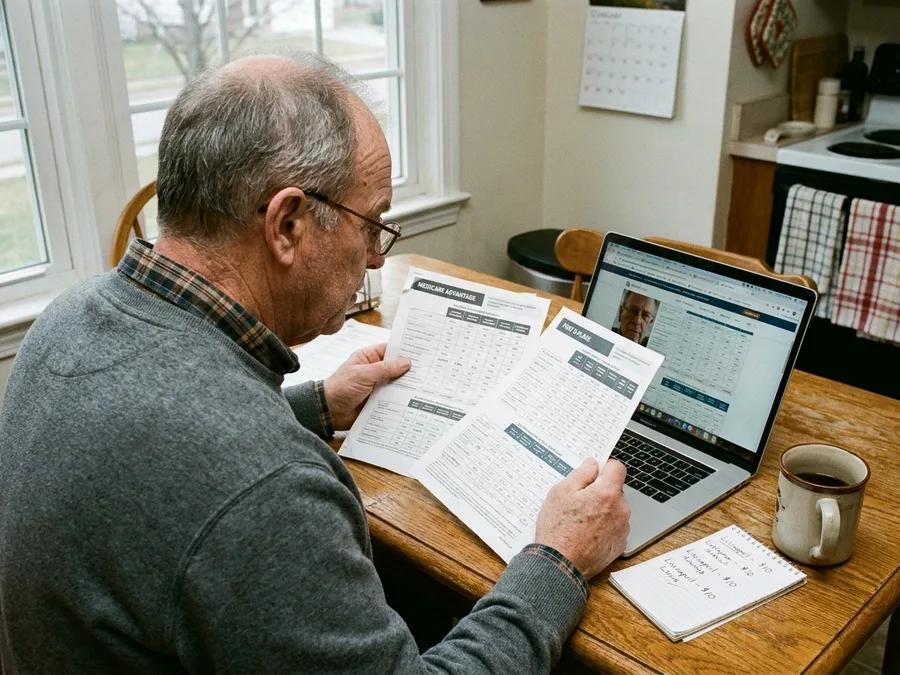
One $12 generic is the bottom of the health line. The top of it is the plan itself, and that choice is not made once at 65 and left alone.
Formularies change. Networks change. A drug that sat on tier two last year can move to tier three, and a doctor you have seen for a decade can drop out of a network without a letter that gets your attention. The annual notice of change arrives every fall and reads like junk mail, which is exactly why so many people file it without opening it.
So the plan gets re-checked during open enrollment, not renewed out of habit. Write out every prescription by name and dose. Then run each one through Medicare.gov, which is the neutral tool, rather than the plan's own brochure, which is a sales document.
The stakes are on the household's own spreadsheet. Health runs about $1,100 a month, and the plan choice is the single biggest lever on that figure. A wrong renewal can move the line by hundreds a month with nothing else in the house changing: same pills, same doctors, more money out.
Loyalty is the trap here. Ten years on the same plan without reading the fine print is not stability; it is a decision nobody has re-made since the year they first made it.
12. Dental and vision paid in cash, on schedule

A plan review settles what insurance covers. The cleanings and the eye exam are the cash side of the same ledger, and they are paid on a schedule whether or not anything hurts.
That is the part people skip. Nothing hurts, so the appointment slides, and the slide is invisible until a tooth cracks on a Tuesday and the estimate arrives with a crown on it.
The habit is two dental cleanings a year each and one eye exam a year, booked in advance, paid from the health line. Dental work gets priced before it is done, never after, so the number is known while there is still a choice about when to schedule it.
The small bills are what keep the big ones from stacking up. A bridge, a crown and an out-of-hours emergency visit have a way of landing in the same year, and that year has no spare room in a $5,600 budget.
One hard limit: if you would have to borrow for it, take the eye exam first and let the rest wait. The exam is the cheap part, and it is the one that catches a problem while the fix is still small. The goal is a $150 bill met on time instead of a $4,000 one met in a panic, and that math only works if the schedule starts before the pain does.
13. A thirty-minute walk, every single day

The checkup catches what has already started. The morning walk is what keeps most of it from starting, and it is the cheapest line on this entire list.
Thirty minutes, outside, before breakfast. Not after the news, not once the day warms up and the phone starts ringing, and not skipped because it is a holiday and the schedule has an exception built in. The time is nailed down so there is no daily negotiation with yourself.
The route matters more than the pace. A fixed, flat loop that holds up in drizzle and in a foul mood, because a bad mood and bad weather are precisely when a habit gets tested and found wanting.
One of them takes a blood pressure reading at home every few days and carries the numbers to appointments, so the stroll shows up as a chart rather than a good intention. Home monitors run $40 to $60 once, and the readings are what turn a vague sense of doing fine into something a doctor can react to.
No gym membership, no class packs, no fitness tracker subscription. Over a year this habit costs a pair of walking shoes.
What it is actually holding down is the drawer of bills that arrives when blood pressure, weight and mood all drift at once. Each one of those has its own line on the health budget, and each one gets more expensive to treat the longer it is ignored.
That is the honest case for it. Thirty minutes that cost nothing, protecting the $1,100-a-month health line from three separate directions.
14. Two strength sessions a week after 65

Walking keeps the heart and the arteries in decent shape. It does almost nothing for the thing that actually empties a retirement account in one afternoon: a fall.
A hip fracture at 68 is not a hospital bill you pay and forget. It is a rehab stay, a stretch of home care, sometimes a move nobody planned for, and the closest thing to a care-facility bill a household can trip into without warning. That is a bigger number than a bad market year, and it arrives in a single moment.
The defense costs about $60 and fits in a closet. A set of dumbbells and a sturdy chair, two half-hour sessions a week, done in the living room before the day starts. Squats to the chair, a slow sit and stand, a row with one knee braced on the seat, a press overhead. The chair is the whole gym.
Balance gets its own few minutes daily, no equipment needed. Stand on one foot at the kitchen counter while the kettle heats, switch feet when it boils. Do it every morning and it stops being an exercise and becomes a habit the body keeps without asking.
Here is the trade, stated plainly. Two sessions a week for years, most of which feel pointless, to lower the odds of the one event that can end independent living. No visible reward, no number that moves, nothing to show anyone.
It does not suit everyone. Anyone with a bad shoulder, a replaced knee, a history of back trouble starts with a physical therapist who can see how they move, not with a dumbbell bought at a big-box store. That referral is worth the copay.
Framed the way the rest of this list is framed: this is the medical bill that never gets billed, because the fall did not happen. You will never see the invoice it prevented, and that is the point.
What the Health Habits Buy You, Over Time
15. Five home-cooked dinners a week

Muscle built in the living room only pays off if the blood pressure and the waistline stay put between sessions. That is settled at the stove, five nights out of seven, and it is cheaper than any of the alternatives.
The grocery number is about $110 a week. Add one dinner out at $48 and the food line lands somewhere near $160, which against a $5,600 month is a rounding error compared with the $1,100 health line. The restaurant is in the budget, not a lapse, and that distinction is what keeps the whole thing from collapsing.
The machinery is dull on purpose. Five dinners rotate through the week, the shopping list gets written off those five, and the store trip becomes a list instead of a browse. Same five, week after week, until they are automatic and nobody has to decide what is for dinner at 6:15 on a Tuesday.
Canned beans, frozen green beans, a bag of frozen shrimp all count. The point is that you cooked, not that the produce was picked that morning. Chasing freshness is how a weeknight dinner becomes a second trip to a specialty store.
That second trip is exactly what sinks the plan. A recipe calling for one exotic ingredient three nights running means a separate shop, and a separate shop means takeout by Thursday. Keep the five recipes boring and the ingredients findable at the same store every time.
One habit, two jobs. It holds the food budget where it needs to be, and it holds the salt and the portions where the blood pressure wants them. Which is why it belongs right here, between the strength work and the bedtime.
16. A bedtime that does not move

The five dinners don't happen by willpower. They happen because the person cooking them got to bed at a decent hour the night before, which is a money decision dressed up as a bedtime.
The clock here is 10:30 lights out and 6:30 up, Saturday and Sunday included. The fixed hour is the whole apparatus. You are not aiming at eight hours, you are aiming at the same eight hours.
A regular wake time is what anchors the body clock, and a body clock that keeps getting reset every weekend is the reason a lot of people over 60 lie awake on Sunday nights, which is why bedtime routines for over-60s matter. Hold the wake time and the falling-asleep part mostly takes care of itself.
The screen goes dark by 9:30. The bedroom television left the house in the first year of retirement and nothing replaced it, because even one more reason to stay up is enough.
None of this announces itself as a budget problem. Bad sleep next morning reads as low energy, and low energy reads as takeout for dinner, a bigger grocery trip, an afternoon online order that seemed reasonable, and a Tuesday afternoon call you were too tired to handle well.
Ask anyone who tracks their own spending after a run of poor nights and you will hear the same thing: the restaurant line creeps up and the impulse line creeps up, and neither gets attributed to the four hours they actually slept.
Where the fixed hour fails: shift workers, and anyone up at night with a spouse. There the clock has to loosen into a routine, the same wind-down in the same order, even when the hours cannot be constant.
💡 PRO TIP
The habits that do three jobs
Cooking at home, the daily walk and the fixed bedtime all pull double duty: they lower the food line, the health line and the entertainment line in the same month. That is why they appear between the money items – a single habit with three savings is worth three separate habits with one each.
17. A standing weekly lunch with four friends

A mood held steady by regular sleep still needs somewhere to go, and the cheapest place to put it is a table with four friends who are already expecting you.
Tuesday, noon, same restaurant, same corner table, four people. The check gets split and runs about $18. That is the entire cost of the entertainment in this entry.
It lives in the budget as its own fixed line, not folded into some vague social fund where nobody can see the number. A labelled line can be watched and defended; a loose fund just goes.
The reason it survives is that it was scheduled instead of arranged. Nobody has to text four people on a Tuesday when everyone is tired, because Tuesday was settled months ago and showing up takes no decision.
Look at what this replaces. The concert seats at $90 a pair. The Sunday brunch at $60 a head, with the mimosas. Both were filling the same need for company, at roughly three times the price, and both happened less often than this lunch does.
this is the line that stays when the cutting begins. It costs less than a month of pay-per-view and the delivery that comes with an empty calendar, and it does more for blood pressure and mood than almost anything else on the list.
Strip it back and the standing date is cheaper than the paid entertainment that would otherwise rush in to fill the same evening.
18. A hearing test before the TV gets louder

The same Tuesday lunch is the first thing hearing loss quietly removes, one seat at a time, and no one in the group will ever call it a hearing problem.
A lot of people over 65 give it a formal check on turning 65 and then again a few years later, not because something feels wrong. The TV volume going up is a late signal. The restaurants getting louder is often the earlier one.
The pattern is well described by audiologists: first the noisy places go, because you cannot pick one voice out of four, then the meetings and the group dinners, then the phone calls. You don't notice the slide, you notice you have stayed home more.
And what fills the empty hours? Paid entertainment. The streaming subscription, the concert tickets, the brunches, the third long weekend because the house is too quiet. The social budget goes up as the social life goes down.
Start with your primary care doctor and a referral, not a kiosk in a shopping mall. The test is painless and quick, and a real audiologist is the one who can tell you whether to wait or to act.
If hearing aids are called for, price them the same way a transmission gets priced. A set can run into the low thousands, and the right move is a line in the plan, saved toward and paid in cash, not a panic withdrawal from the portfolio in a bad year.
That is the double bill nobody sends you: the health cost that arrives years later, and the entertainment cost that starts showing up the month you stop going out.
19. A garden, a workshop, or a woodshop

Fix the hearing and the eyes and you get the hours back. What you do with them decides whether those hours cost money or save it.
A garden twelve feet by twenty, four raised beds, goes in over a long weekend in May. Seed and soil run about $150 and the harvest is worth maybe $300, tomatoes, beans, enough zucchini to hand to the neighbors.
That math does not pay for a vacation.
The return that matters is the morning. Seven o'clock, coffee, walk the rows, check what came up overnight. That is two hours wearing slippers instead of driving to a store.
The tools arrive used, one at a time. A $15 spade from an estate sale in April, a cultivator in June, a wheelbarrow only when the wheel gives out on the old one. A shed full of equipment bought in one catalogue order is a four-figure purchase dressed up as a hobby, and it lands in the same year as the roof.
This is where the money quietly goes in a retirement with too much day in it. Shopping, long lunches, an extra trip because the calendar was empty, none of it asked for, all of it spent.
A hobby does not need to earn its keep. It needs to occupy the hours that were costing you before it existed.
Who it does not suit: renters without a yard, and anyone with a back that will not take kneeling in wet soil. The workshop version halves the garden and still gives you the mornings, because a workbench works at table height.
The test is not whether it saves money. It is whether it is interesting enough to show up for in February, when nothing is growing and the seed catalogues are the only thing coming in the mail.
20. A written list of what gets cut first

Every habit so far assumes an ordinary year. A retirement also has to survive a year when the portfolio is down and the household has to spend less without arguing about it on a Tuesday.
The order is written down before it is ever needed. The second trip of the year goes first. Then the weekly restaurant dinner. Then the gift budget shrinks toward its floor. Then the replacement of the twelve-year-old sedan gets delayed another year, and the car fund keeps growing in the meantime.
What is not on the list matters more than what is. The health line stays. The groceries stay. The walking shoes stay. The standing weekly lunch with friends stays. Each of those, cut to save money now, costs more later.
Both spouses signed the order, which is what makes it work. In the week a portfolio drops, nobody has to negotiate: the list already answered the question before it was asked.
The trigger is not a headline. It is two consecutive quarters of the portfolio being down, checked on the same one-page review that runs four times a year. A single rough quarter is weather, not a climate. Two in a row earns a haircut on the discretionary lines, nothing more.
That same two-quarter rule is what gives the monthly spending number its second job. Once you know what the trim list is and in which order it falls, the number stops feeling fragile. The market drop arrives, the answer is already written, and nobody has to decide anything in a bad week.
Frequently Asked Questions
Do I need an advisor to do any of this?
No. The spending number, the cash cushion and the automatic transfers are all things you can set up yourself in an afternoon. The one piece genuinely worth a paid hour is the Social Security claiming decision, and that should be with a fee-only advisor who does not sell products. Everything about rules and enrollment dates belongs to SSA.gov.
How much cash is enough outside the portfolio?
A year of spending is the target in this plan, and three to six months is a reasonable place to start while you build toward it. The point is not the exact figure – it is having enough that a market drop does not force a sale. Build it slowly and refill it on a schedule after each withdrawal.
What if my health costs are much higher than $1,100 a month?
Then the health line gets its own review and the rest of the plan scales around it. The habits stay the same: check the Medicare plan every fall, ask for generic options, price dental work before it happens, and keep the cheap prevention appointments on the calendar. Higher costs make those habits more valuable, not less.
Is it worth working a little in retirement just for the money?
Not for the money alone. The gig is worth doing when the schedule bends around your life and the income funds something specific, like travel or gifts, that can stop without breaking the plan. A job that costs as much in gas, clothes and takeout as it pays is not worth the time.
What happens if the market drops right after I retire?
That is the sequence that hurts most, and it is exactly why the cash cushion exists. Spend from cash while the portfolio recovers, follow the written cut list if the drop runs two quarters, and do not change the plan on one bad week. The order was decided in advance so nobody has to think clearly during a bad month.
Why are half of these habits health habits?
Because the largest single line that can break a retirement budget is medical. A market drop is temporary and recoverable. A hip fracture, an untreated hearing problem or a chronic condition left to drift can change the whole financial picture. The health habits are the cheapest insurance in the plan.
Start With Three, Not Twenty
Start with three, not twenty. In the next thirty days, write the monthly spending number from twelve months of statements, move one year of spending – $60,000 against a $5,600 month – into savings outside the portfolio, and put the fall Medicare plan review on the calendar.
On this list, the health habits are money habits. The health line runs $1,100 a month, the largest single line that can break a retirement budget is medical, and that is why the cut list never touches it.
The facility was not the failure. The absence of a spending number, a cushion and an annual plan review was, and all three are writable this month. The market and the medical bill will both arrive; the difference is whether the answer was already down on paper before either one showed up.
Write the number this week
Pull twelve months of statements, add up what you actually spent, and write the monthly figure on one page. Everything else on this list gets measured against it.