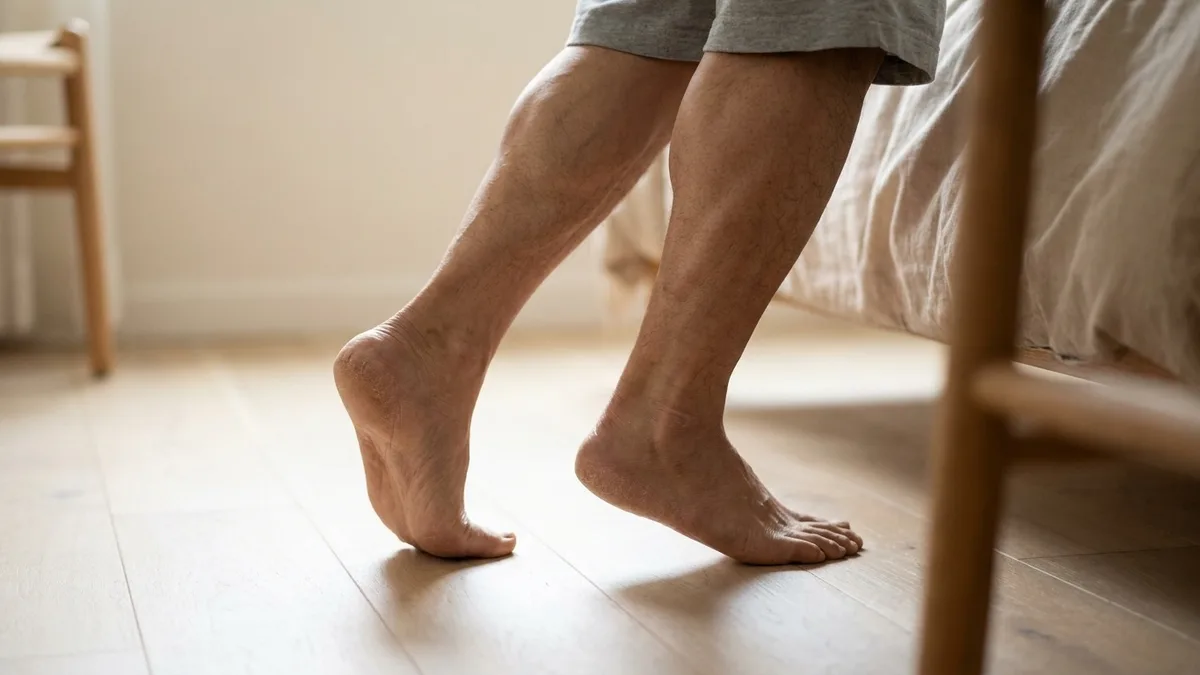
The stiffness that shortens your first walk of the morning usually is not in your knees. It is in your ankles and calves, and it built up overnight while you slept with your feet pointed.
That first walk is slow and cautious for a reason, with flat-footed steps and a hand drifting toward the wall before anything has loosened. Waiting for those first steps to warm you up simply rehearses the stiff pattern.
The ranges that let a heel land and a toe push off get restored before you stand, not during the walk itself. One round of seven moves, 20 to 30 seconds each and about seven minutes total, works the ankles, calves, hips, and glutes in order before you leave the bedroom.
You need a sturdy chair, a clear wall, and the edge of the bed. Chair support or seated versions handle balance, and sharp pain, numbness, dizziness, or a recent fall or surgery means a check with a clinician first.
Seven minutes at the bed edge loosens the ankles, calves, hips, and glutes and rehearses a taller stride, so you stand up and walk taller before you reach the door.
Quick Tips Before You Start
Use a Sturdy Chair
A dining chair with a backrest is your balance support for every standing move.
Go Barefoot or Wear Supportive Shoes
Socks on a smooth floor are a fall risk; bare feet or stable shoes give you grip.
Hold Each Move 20–30 Seconds
One round of all seven moves takes about seven minutes; no need to repeat.
Breathe Normally
Mild tension only. If you are holding your breath, you are pushing too hard.
Never Bounce
Bouncing triggers a protective reflex that makes the muscle tighter, not looser.
1. Seated Ankle Circles and Toe Pulls
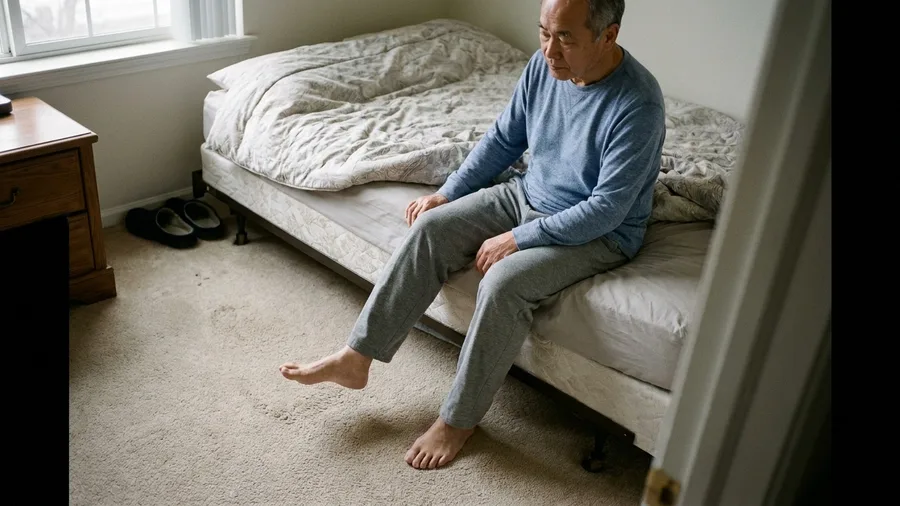
The stiffest ankles of your day are the ones you wake up with.
Before you swing your legs off the mattress, before your feet take any weight, you sit on the edge of the bed with your feet hanging free and give the ankles the two small ranges the first step depends on. This is the opening move of a seven-move sequence done in one round, about 20 to 30 seconds per move, roughly 7 minutes end to end.
Circle each ankle 10 times in one direction, then 10 times the other. Then point the foot away and pull the toes back toward you 10 times.
Those two motions cover more ground than they look like they do. A stiff ankle is what turns the first heel strike of the morning into a flat slap and leaves the push-off weak, and the seated circles and pumps hand both ranges back within mild tension, no bouncing, breathing normal, before the first step ever happens.
The bed edge does double duty here. It is your balance support the moment you stand, and the same seated position is the modification when getting down to the floor for other moves is more than you want to manage.
The honest trade-off: the first few circles feel like moving a hinge that has rusted overnight, and that is exactly the point of doing them seated. Give it 20 seconds and the hinge loosens. Skip it and you rehearse the stiff pattern on the way to the bathroom.
💡 Tip: Do the circles slowly enough that you feel the ankle joint move, not just the foot wiggle.
2. Standing Calf Raise and Hold
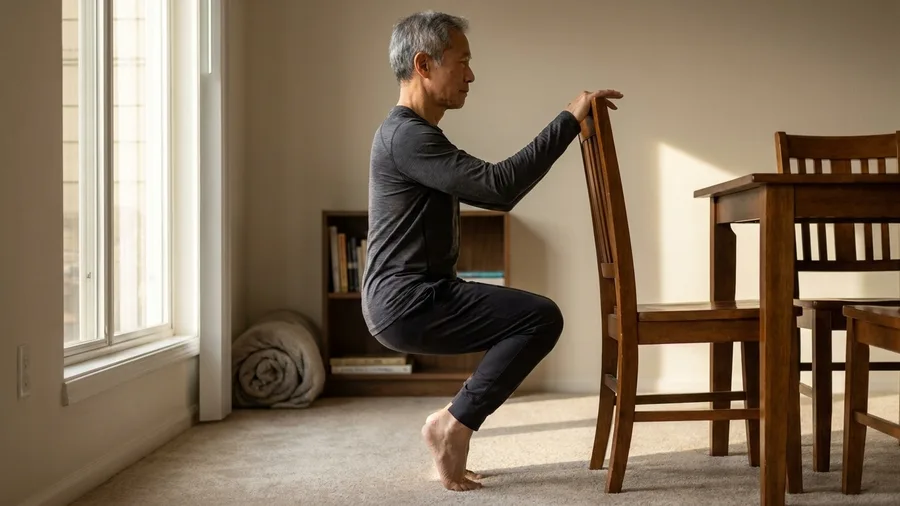
Once the ankle can point and flex, the calf is the next link in the chain, because the calf is the muscle that uses that range to push your body forward.
Stand facing a sturdy chair and rest your fingertips on the backrest. Bare feet or supportive shoes both work; the chair is the balance support for the whole move.
Rise onto the balls of your feet, hold 2 seconds at the top, and lower slowly. Ten reps.
The 2-second hold is the part people skip, and it is the part that matters. A weak toe-off is what leaves the first step of the morning short and cautious, and holding at the top teaches the calf to finish its push before you ask it to walk. You are switching on the push-off muscles without taking a stride first.
Keep the heels controlled on the way down, not bouncy. Effort is mild tension with normal breathing, nothing more.
If the calf cramps, shake it out, reduce the range, and keep your fingertips where they are on the chair. A cramped calf held at half height does more for your morning walk than a full-height rep that makes you grab for the counter.
Stiff Ankle vs. Woken Ankle
What changes after one round of ankle circles and pumps
Based on typical range of motion return after 20–30 seconds of circling and pumping.
3. Wall Calf Stretch With Heel Down
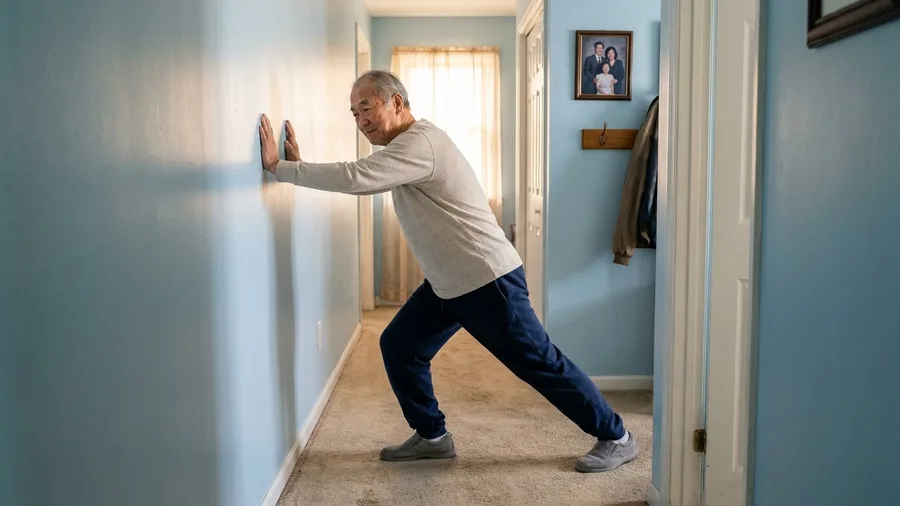
The wall is where the back of the lower leg gets its length, so the heel can stay down on the first step instead of slapping flat. Put both hands on the wall and step one foot back, heel down and back knee straight.
Point the toes forward, not turned out. Turned-out toes cheat the stretch and quietly load the knee.
Lean in to a mild stretch and hold for 20 to 30 seconds on each side. No bouncing. Breathe normally.
Bouncing feels productive and does less than a still hold. The length comes from settling in and staying there while the breath keeps moving.
If the straight-knee version is too strong, bend the back knee slightly. The wall takes the balance demand out of the stretch, so all you have to manage is the tension.
A tight lower leg is why the first steps feel flat-footed. Lengthening that line before you walk gives the heel somewhere to land.
⚠️ COMMON MISTAKE
Don't Bounce to Get Deeper
Bouncing feels like it is loosening the muscle, but it triggers a stretch reflex that tightens it. Hold still at mild tension, breathe, and let the muscle let go on its own.
4. Chair-Supported Hip Flexor Stretch
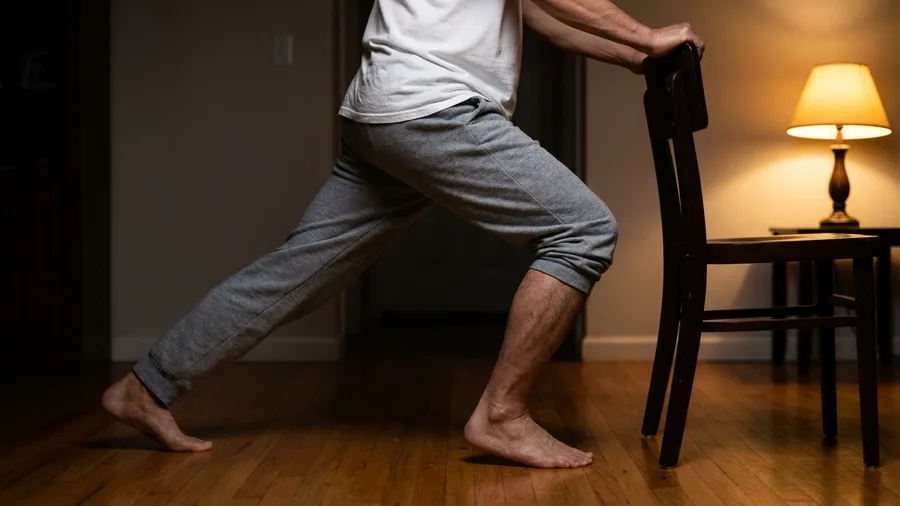
The front of the hip is where the next restriction hides. A night in bed, or an hour in a chair, leaves that line short, and the first step of the morning pays for it: the leg can't reach back, so the stride stays small.
Stand beside a sturdy chair with one hand on the backrest, then step one foot back behind you. Tuck the pelvis under so the low back flattens, and let the back heel lift off the floor if that's what the hip needs.
Hold 20 to 30 seconds on each side. The work should feel like mild tension, nothing sharp, and your breathing should stay normal the whole time.
The tuck matters more than the step. Without it, the low back arches and takes the stretch that the front of the hip was supposed to get, so if you feel it in your spine rather than your hip crease, tighten the tuck.
Balance feels unsure? Shorten the step and keep the hand planted on the chair.
That small supported lunge, done before you walk, opens the front of the hip so the leg can go back and the first step can cover more ground.
5. Seated Hamstring Stretch With Straight Leg
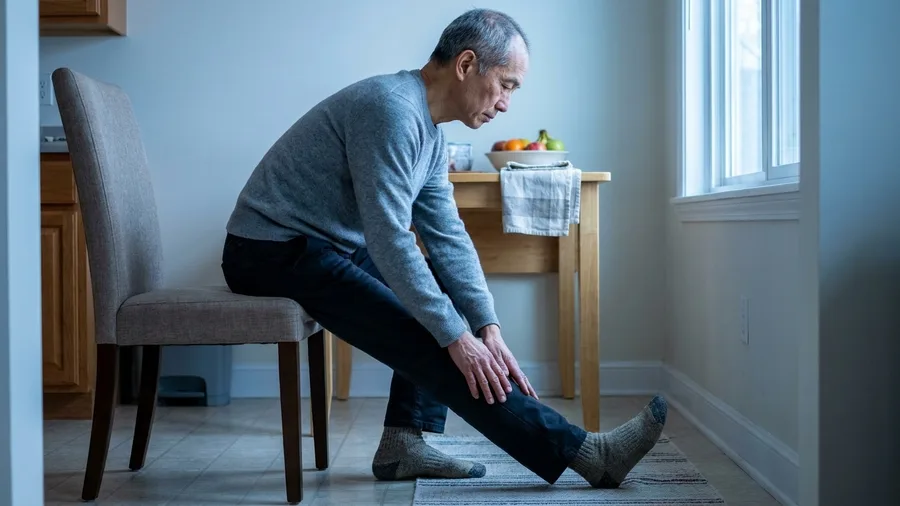
Freeing the front of the hip buys you room to reach the leg back, but the back of the thigh can still cash in that room before the step extends. That is where the stride quietly shortens.
Sit on the edge of a sturdy chair and straighten one leg in front of you, heel resting on the floor, toes up, while the other foot stays planted flat. The chair edge is what makes this a hinge instead of a floor sit, and at 60 the difference is real: no getting down, no getting up, nothing to hold onto but your own posture.
Hinge forward from the hips and keep the back long rather than curling toward the shin. Stop at mild tension behind the thigh, hold 20 to 30 seconds, then switch sides. That is one of the seven moves, and the whole round still lands around 7 minutes.
Do not round the spine to reach farther. Bending toward the floor looks like a deeper stretch and mostly buys you spinal flexion, not hamstring length, and the back of the thigh never gets the message. If the area behind the knee pinches, soften the knee a few degrees and hinge again.
The payoff shows up on the first walk. A back-of-thigh that grabs limits how far the leg swings forward, so the step lands short and the pace stays cautious. Lengthening that line seated, before you stand, gives the next step somewhere to go.
💡 Tip: Put the straight leg's heel on a low book if the floor version pulls too much.
6. Standing Glute Squeeze and Hip Extension
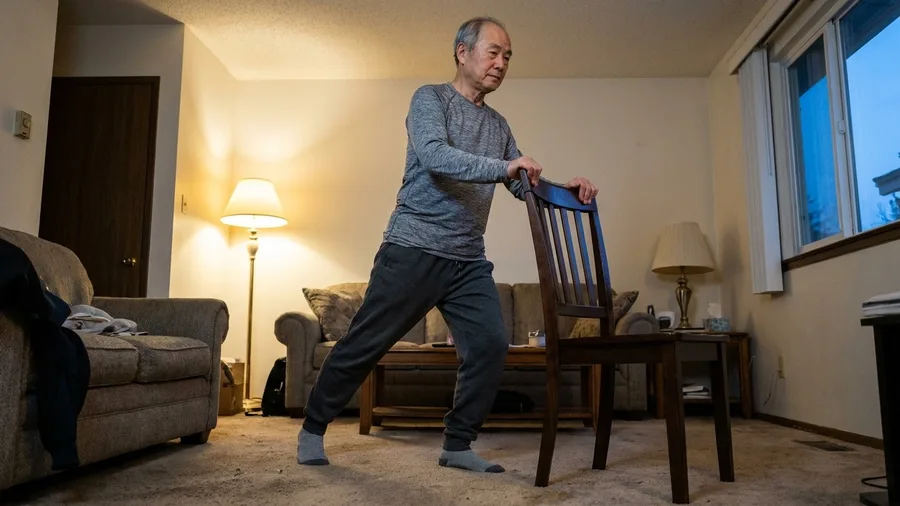
Once the back of the thigh gives length, the glute has to finish the step. A shuffle is what a step looks like when the hip never finishes moving the leg back.
Hold the chair back with both hands, stand tall, and set your feet hip-width apart. The chair is your balance support for the whole set.
Squeeze one glute and draw that leg back a few inches behind you. Hold 2 seconds, lower, and repeat 10 times on each side.
Keep the pelvis level and don't arch the low back to get more range. If you feel this in your spine more than your backside, make the movement smaller.
The chair isn't a crutch here; it lets you train the hip to drive without also managing your balance.
That's the switch that teaches the hip to finish the step, so the leg doesn't lag behind when you take the first walk of the day.
⏱️ The 7-Minute Morning Sequence
Ankle circles and toe pulls
Sit on the bed edge and circle each ankle 10 times each way, then point and flex 10 times.
Standing calf raise and hold
Face a chair, rise onto the balls of your feet, hold 2 seconds, lower slowly, 10 reps.
Wall calf stretch
Hands on the wall, one heel down, hold 20–30 seconds each side.
Hip flexor stretch
Stand beside a chair, step one foot back, tuck the pelvis, hold 20–30 seconds each side.
Seated hamstring stretch
Sit on the chair edge, one leg straight, hinge forward from the hips, hold 20–30 seconds each side.
Glute squeeze
Hold the chair back, draw one leg back a few inches, squeeze the glute, 10 reps each side.
Tall walk rehearsal
Take 10 slow heel-to-toe steps with light hand support and smooth arm swing.
7. Tall Walk Rehearsal With Heel-to-Toe Steps
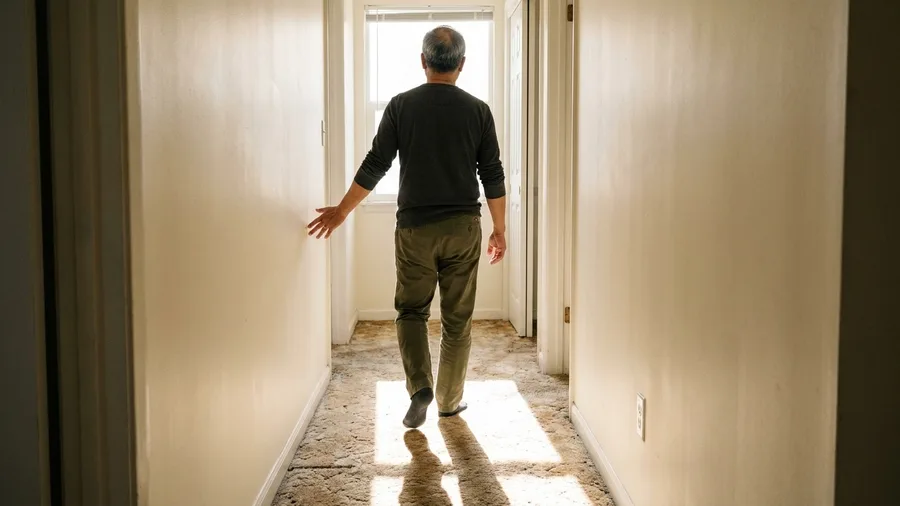
The loosening and switching-on is finished. What is left is putting those restored ranges into the actual pattern you are about to walk with.
Pick a clear stretch of hallway or counter with simple balance exercises in mind and stand tall at one end, fingertips resting lightly on the counter or wall. That light touch is balance insurance, not a crutch; if you find yourself gripping, step closer so the hand is only a guide. Tall means ears over shoulders, ribs stacked over hips, eyes level rather than down at your feet.
Now take ten slow steps, heel landing first and toe pushing off at the back, letting your arms swing naturally at your sides. Keep the steps short enough that each one stays smooth; a shorter, cleaner stride rehearses more than a long, lurching one. If the first ten feel steady, repeat them once.
Ten steps, one more round only if the first is smooth.
The arm swing matters more than it looks. Rigid arms held still tend to stiffen the whole stride, while a relaxed swing lets the spine rotate slightly and the step finish behind you. So let the hands travel, not just hang.
If the room spins or you feel light-headed, skip the rehearsal and sit down to rest; a dizzy walk is not the pattern worth rehearsing. That is the one cue to heed rather than push through.
The point of these ten steps is transfer, not fitness. By the time you reach the bedroom door, the tall spine, heel-to-toe landing, and smooth arm swing should already be set, so the first walk of the day starts with the loosened pattern instead of rehearsing the stiff one.
Stretch Smart: What Works vs. What Wastes Your Time
Do This
- Hold each stretch 20–30 seconds at mild tension
- Use a chair or wall for balance support
- Breathe normally throughout
- Do one round of all seven moves before your first walk
Skip This
- Bouncing or pulsing to get deeper
- Pushing into sharp pain
- Holding your breath during a stretch
- Skipping the walk rehearsal after the stretches
Frequently Asked Questions
How long does this morning stretch routine take?
About seven minutes for one round of all seven moves. Each move is held or performed for 20–30 seconds. You do not need to repeat the round; consistency matters more than duration.
Can I do these stretches if I have knee or hip arthritis?
Most people with mild to moderate arthritis can do these moves, but use chair support and stay within a mild stretch. If a move causes sharp pain, stop and check with your doctor or physical therapist before continuing.
What if I cannot get down to the floor?
None of these moves require floor sitting. The hamstring stretch is seated on a chair, and the hip flexor stretch is standing with chair support. If balance is a concern, keep one hand on a sturdy chair or counter for every standing move.
Should I stretch before or after I get out of bed?
Do the sequence after you sit up on the edge of the bed, before you take your first walk of the morning. The point is to restore ankle, calf, and hip range before you put weight through your first steps.
When will I notice a difference in how I walk?
Many people feel a smoother first walk the same morning. For lasting change in stiffness, give it two to three weeks of daily practice. If you have a recent fall, surgery, or sharp pain, check with a clinician first.
Seven Minutes Before Your Feet Hit
Treat this as preparation, not exercise. One round of seven moves, 20 to 30 seconds each, about seven minutes, mild tension only, no bouncing, breathing normally the whole way through. That is the entire dose.
The slower, shorter, more cautious first walk is the moment this sequence was built to change. The first walk is the test, not the warm-up. So the exact order matters: ankle circles and toe pulls, standing calf raise and hold, wall calf stretch with heel down, chair-supported hip flexor stretch, seated hamstring stretch with straight leg, standing glute squeeze and hip extension, tall walk rehearsal with heel-to-toe steps.
The one thing to do first is run that order before the first walk, using chair support for balance and seated versions when floor moves are hard. Stop and check with a clinician for sharp pain, dizziness, numbness, or after a recent fall or surgery, and skip the walk rehearsal if you feel dizzy. Then stand up and take the walk you rehearsed.
Walk Taller Tomorrow Morning
Try the full seven-move sequence before you leave the bedroom, and see how your first walk feels. Start with the ankle circles and work down the list in order.