
Thirteen years separate 62 from 75. That is roughly 680 weeks and 4,750 days, and most of them get spent doing exactly what you already do.
The arithmetic has probably already been run. A 62-year-old looks at 75 and sees a face, not a number, and the habits in between renew on their own: the $6 weekday lunch, the $35 gym membership, the $150 storage unit.
None of them ever asks permission, so the cost piles up without a single moment of choosing it.
The bill arrives in three currencies: money, legs and people. Each habit on the list is priced plainly in one of them, and each comes with the smallest swap that keeps the good part and drops the leak.
By the end, one move will name itself for this week. The other sixteen can wait their turn.
Quick Tips Before You Start
Pick One First Move
Choose the single habit that matches your biggest worry right now and leave the other sixteen for later.
Do the Thirteen-Year Math
Multiply any monthly cost by 156 — that is what it becomes across the span.
Make It a Rule
A fixed day beats a budget, because a rule survives a bad week and a budget does not.
Put the Date in the Phone
Any intention that does not get a calendar entry today is not a plan.
Check the Tread
Look at the outer heel of your walking shoes before you decide the walks are the problem.
The Quiet Leaks

These are the leaks you can check with arithmetic this afternoon. No willpower, no gym, no doctor — just a statement and a pen.
They matter first because they are the easiest to see, and because the money they free is exactly what pays for everything further down this list.
1. The daily $6 lunch is a $20,000 habit

The dressing problem is that lunch out is the most repeated purchase of the week, and the least examined: $6 at five weekdays is $30 a week, about $1,560 a year, roughly $20,000 by 75.
The swap is partial by design.
Pack two fixed days a week and about $8,000 stays in your pocket across the span, while the two lunches out that genuinely earn their place – the one with the friend, the one that is really a meeting – stay exactly as they are.
Swap: Make the two packed days rules on the calendar and not a budget – all-or-nothing lasts a fortnight, whereas Tuesday and Thursday survive a bad week because nobody has to decide them again.
Who it doesn't apply to: anyone already carrying lunch, or whose lunch out is the appointment that brings in money.
🗓️ The First Move This Week
Pick your worry
Money, body or people — choose the one that keeps you up at night.
Choose the matching habit
Money: the lunch or the storage unit. Body: the chair stands. People: the weekly call.
Write the rule
Two packed days, or two chair stands a week, or a standing call the same hour each week.
Put it in the phone
A recurring calendar entry today, before the intention cools.
Hold it for four weeks
Do not add a second habit until the first one has survived a bad week.
2. The gym you don't go to costs $5,460

Thirty-five dollars leaves the account on the same date every month, and in a good month it buys ten visits. In a bad one it buys a receipt.
Add it up and the fee comes to $420 a year, near enough $5,460 by 75, paid in full whether the turnstile ever clicks. A daily lunch tab at least leaves a sandwich behind; this leaves a card in a drawer.
The honest test takes a minute: knowing exactly what the last month held, would you walk in today and hand over the year in cash? If the answer stalls, cancel it this week.
If you are already there twice a week, it is the best value on this list, so put the sessions in the calendar like a dentist appointment and skip nothing without moving it.
Swap: the rowing machine you pass on the stairs, or two borrowed sessions a week at a pool, keeps the movement and drops the direct debit.
3. Autopay keeps charging you for a past self

That quiet monthly card charge for a streaming service you stopped watching in the first winter is the one that compounds: it renews on the version of you who signed up, not the one reading this.
One sitting a year, printout or screen, half an hour with a pen, goes down the statement line by line. Anything you cannot date to a real use gets cancelled on the spot, no trial month and no maybe.
Do it: start at the oldest page and work forward, because the charges you have stopped noticing are the ones at the back.
Where to look: the app store subscriptions, the cloud storage tier you outgrew, the magazine that followed you from an old address, the insurance on a phone you replaced.
Why it matters: the total is what counts, not any single $9.99, and this same pot funds the slower decade, so the audit is where all the quiet leaks get added into one number.
Leave it alone: if you genuinely use every line you pay for, your half hour is better spent elsewhere.
4. Short car trips cost more than the gas

Yes, and the cost is bigger than the tank of gas. A week of small drives mostly under two miles runs about $45, which works out near $2,340 a year and past $30,000 over the thirteen years.
The second charge does not appear on any statement. Every one of those trips trades a walk for a seat, and that walk was the training your legs relied on for the stairs at home.
Swap: Walk anything under a mile on days your shoes are already on. The pharmacy, the postbox, the neighbour two doors down. Nothing to buy and nothing to join.
The habit hides because each trip feels too small to question. The engine turns over, the trip is six minutes, and the walk you would have taken is invisible in the total.
Who it does not apply to: no sidewalks, real hauling, or a rural drive where anything at all is far.
The Quiet Leaks — What Thirteen Years Costs
Illustrative arithmetic, not a prediction. One habit changed moves the total.
The Body You'll Be Using at 75

The same habits that leak money also spend the body — the legs that climb the stairs, the sleep that decides your evenings, the shoes that decide whether you walk at all.
These are the ones where the cost is not on a statement. You notice it at 75 in what you can no longer do without thinking.
5. Skipping strength work is what costs you the stairs
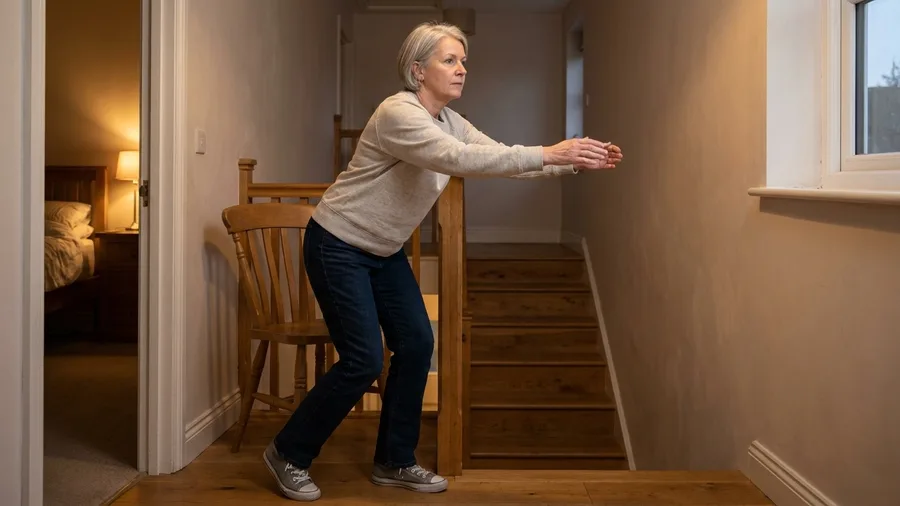
It is 6:40 on a Tuesday evening, the light is going, and the thirteen steps to the bedroom come one at a time with a hand flat on the rail. That is the hour the stairs stop being background and start being a test.
The house has been counting for you. Eight trips a day up thirteen steps is roughly 38,000 climbs across the thirteen years, and by 75 each one asks whether the leg can still push.
The minimum that counts is two moves, twice a week, at home. A chair stand with arms crossed, then a carry of a loaded shopping bag from one room to another, ten minutes in total.
Comfort: Do the set before breakfast, on the same two days each week. It is the Tuesday you do not skip that matters, not the programme designed in January.
Who it does not apply to: anyone already lifting weights, who should add a session rather than start over.
6. Worn-out shoes are why the walks stopped

Replace the shoes before the walk gets shorter.
A worn pair does not announce itself.
It shows up as a smooth tread, an outer heel worn to a slant, and a knee or hip ache that has started to feel like a normal part of a walk – the walking between the stairs is only as good as what is on your feet.
Replacement walking shoes at $120 a year come to about $1,560 across the thirteen years – the cheapest line on this list, and the one that keeps the other walks possible.
Care: put a date in the calendar, not a feeling. One pair a year, the same month, the old pair demoted to the garden.
Who it does not apply to: anyone already replacing theirs on a schedule, whose only job is to keep the date.
⚠️ COMMON MISTAKE
The Most Common Mistake
Treating a fixed wake time as optional. The bedtime follows the morning, not the reverse — set the alarm for seven days and let the evenings sort themselves out.
7. Calling five hours a night normal is the habit

The tiredness is real – but it starts at nine the night before.
Good shoes and strong legs get you out the door; what you did with the late evening decides how much you have to spend when you get there.
A bedtime that creeps twenty minutes later each night is two hours late by the end of the fortnight, and nobody decided it.
The moving parts are small and all in the same stretch of evening: the screen that stays on past the end of the programme, the second coffee at four that is still working at eleven, the lights that go off when the film does rather than when the body asked.
The one lever: fix the wake time, all seven days, before you touch anything else. The bedtime follows the morning, and it follows it far more obediently than it ever followed a resolve made at ten at night.
When it is not a habit: snoring, gasping in the night, or falling asleep in the chair mid-afternoon means a doctor's appointment, not a to-do list. And if the shifts are rotating, the problem is a schedule, not discipline, and no rule about alarm clocks fixes it.
8. One chair at 4 p.m. ends the whole evening

The chair is not the problem. The hour is.
Fixing the night gets you through the morning with something left over – and then the day still ends at four, in one particular chair, with the paper folded on your knee.
The sit begins as a rest and quietly becomes the rest of the day, and the stairs, the walk and the phone call all go in the same hour.
The swap: one standing task before you sit – the dishes, the call, the post opened and dealt with. Do it first and the chair becomes the finish line instead of the trapdoor.
How to tell a rut from tiredness: same chair, same hour, most days of the week. Genuine tiredness moves around; a rut keeps the appointment.
Who this does not apply to: anyone on their feet all day. For them the four o'clock sit is earned, and the job is to enjoy it without guilt.
9. The second drink is the one that changes tomorrow

Set the glass limit while the glass is still dry, or the glass does the choosing.
The evening chair ends your day early; a second pour ends the next morning.
What that second drink actually buys you is broken sleep and a heavier wake-up, and the walk you had pencilled in for nine gets quietly cancelled, often before you are even fully awake to notice it has gone.
So name the number aloud before the first drink is poured, not after. The version of you holding a half-empty glass is a negotiator, not a judge; the version of you at the kitchen counter at six in the evening still means what he says.
Swap: Pour the second drink as a small glass rather than a refill, and put it down half-finished. Note: How many drinks a week is safe is a question for your clinician or the NIAAA's guidance – this list prints no number and should not.
Who it does not apply to: Anyone whose drinking already worries them medically needs a doctor, not a calendar trick.
The staircase is the test. The habits are the training.
The People You'll Want There

The third currency is people. It is the one nobody checks a statement for, and the one hardest to rebuild once the standing dates have lapsed.
These four habits do not cost money at all. They cost the call you did not make and the ask you did not allow yourself.
10. Skipping the weekly call costs you 680 of them

You mean to ring her, and then the week closes and you haven't.
Someone you meant to ring stays rung less often, and the gap stops feeling like an oversight and starts feeling like distance. The usual walk with a friend gets cancelled by a heavy evening, the next one goes unbooked, and the quiet is not filled back in.
Run the arithmetic plainly, though, and the drift is smaller than it feels. One call a week across thirteen years comes to roughly 680 of them, which is a friendship kept purely by repetition rather than grand gestures.
The catch is on the other side: a call you skip is not held in reserve. Nobody rings to claim the missed one, so the count only ever falls, and the person waiting at the other end is not told why it went quiet.
Fit: A start and end time, and ten minutes, beats an open-ended hour that never gets put in the diary. What matters is that the date is fixed and the same every week, so neither of you has to raise the question of when.
Swap: Put one recurring entry in the phone before you close the app today. It takes about forty seconds, and doing it now, while the thought is warm, is the whole task.
The person on the other end may not be someone worth keeping. That is allowed. This is about setting a standing appointment, not about every name in the contacts, and skipping a draining one is not a broken habit.
11. Saying yes to every babysitting request costs you

The standing slot only works for friends you choose. The family calendar has a habit of filling itself, with the days named by whoever is asking.
Babysitting is where that pattern starts to cost. A Tuesday evening on your feet with a toddler is one workout that doesn't happen; a full Saturday on your own with two of them is the whole of Sunday gone to recovery.
Then comes the resentment, felt but never said out loud.
Swap: Say which weekdays and weekends you are free before the request arrives, so the schedule belongs to you and not the asker. Say it once, plainly, without justifying the number: two days a week is a complete answer.
Where care is already shared between households and the calendar is agreed, none of this applies.
12. Friendships that only survive at funerals are gone

The trouble is that naming your own days works both ways: it keeps the family calendar honest, and it can leave room for the friendships that quietly depend on someone else doing the asking.
A year holding more funerals than dinners is the tell. The coat comes out for services and nothing else, and the people you laughed with at the last one go back to being names in the phone.
No one decided to let that happen, and no one decided to fix it either.
Fix: Pick two people and a single date in the month that never moves. Walk, coffee, or a kitchen table with a pot of tea.
Not four or five friends in a group: a group is an event to be planned and postponed, whereas two people can meet even in a month that has gone sideways.
Swap: Text both of them the same day and hour this week, with the date already offered, so all they have to do is agree or suggest another day.
If your friendships already run on a standing date, this one is not yours to answer.
13. Never asking for help is the habit that isolates

The question in front of the phone is not whether anyone would help. It is whether you can make the call.
No is the answer that arrives first: no airport lift, no ride home from the hospital, no ladder borrowed for an afternoon. The cost is not the favour withheld.
It is the small debts that never form, the ones that run both ways and leave nobody owed anything, and the friendships that go quiet because nothing is ever asked of them.
The swap is one concrete ask a month, small enough that a yes is a single word: a lift to the airport, a ladder for the gutters, a second opinion on a quote.
Where to start: the neighbour you already nod at. Ask for something so modest they can answer in one breath, and the door is open for the next ask.
Who it skips: anyone already trading favours weekly. The ledger is open and the bench is full.
💡 PRO TIP
The Calendar Test
Ten minutes in the phone today beats an hour of good intentions in January. If the weekly call is not a recurring entry, it is not a call — it is a hope.
The Somedays and the Paperwork

The last four items are the intentions you have been deferring and the documents you have been avoiding. They are the ones with the sharpest costs, because they cannot be half-done forever.
The storage unit, the trip, the will and the empty Tuesday all share one problem: they were never given a date.
14. The storage unit is rent paid on things you left

The problem arrives as a garage door that will not close, and the answer is a second address you rented in one afternoon.
Behind that roller door sit the good chairs, two bicycles, the boxes marked Christmas, and the chest freezer from the old kitchen. They have lived there for years while you pay rent on them.
The arithmetic is plain: $150 a month is $1,800 a year and about $23,400 across the thirteen years. One signed form in a single afternoon set a thirteen-year decision running, and nothing since has asked you to agree to it again.
The test that settles it: what would you pay to have every one of those items inside the house tomorrow? If the honest answer is nothing, the unit is not storage. It is a subscription to a past address.
The ending is not a weekend. It is a date, one room, and a rule – keep only what the house holds, empty the unit, cancel it in the same week, before the cleared space refills.
Exception: a short-term unit between houses earns its keep. That one has an end date already on the calendar, and the calendar is the point.
15. Book the big trip at 62, not at 75

It's a Tuesday morning in a hotel courtyard in Lisbon, and a group of tourists in their fifties is gathering for the walking tour. At 62, that climb is still easy. At 75, it isn't.
The trip a person puts off is the one piece that anchors the whole retirement. A walking tour, a long-haul flight, a hotel with stairs and no lift – each gets harder before it gets more expensive to book.
Money freed from a storage unit can fund that first booking. Put a real date on the trip inside eighteen months and reserve the refundable part first.
Timing: Book the refundable flight or deposit first; the date becomes real the moment money moves.
Swap: If caregiving ends on a known date, put that date on the calendar instead and book after it.
🌱 GROWING TIP
Give Every Intention a Date
A storage unit, a trip, a will and a Tuesday all fail the same way: they never got a calendar entry. Pick one and put the date in the phone this week.
16. A will only you can find is not a plan

A folder only you can find is not a plan. Every settled trip, every account, every policy needs a second pair of hands that know where to look.
Start with one page, written this week. List each bank, each insurer, each pension, next to the name of the attorney and the executor, then put it where that person would reach first.
What the law says: Rules vary state to state, so check your state bar or a licensed estate attorney rather than any list, this one included.
What it does not fix: If the folder already exists and the right person can find it, this one is done. Leave it.
Avoid These Mistakes
17. Retirement without a Tuesday plan is the regret

So what will you actually do on a Tuesday when the job is gone – the answer is a calendar, not a philosophy.
The first Monday without a standing commitment is an hour-by-hour problem: coffee, the paper, lunch, and it is half past one with nowhere to be. The folder settles what happens after; the calendar settles what happens before, and they are the same piece of paper.
The fix is to name three standing commitments before the last day of work, at least one of them with other people in the room – a shop shift, a class, a standing call. They can be small: the point is the Tuesday morning has a reason to get up.
It also ties back to the money: the packed lunches, the cancelled storage unit, the short drives traded for walks are what fund the slower decade. The earlier habits are what pay for this one.
Make it casual: one shift at the charity shop and one hour at the pool, and the rest of the week can fill itself.
Frequently Asked Questions
Do I really have to do all seventeen at once?
No. The list is a menu, not a checklist. Pick the one habit that matches your biggest worry, hold it for a month, and let the other sixteen wait their turn. Doing all seventeen at once is the fastest way to do none of them.
Are the dollar figures predictions about my life?
They are illustrative arithmetic, not predictions. Six dollars a weekday really does work out to about $20,000 across thirteen years, but the point is the multiplication, not the exact number. Run your own figures on your own statement.
What if I already do most of these things?
Then you are ahead. Go straight to the four that need a date: the storage unit, the trip, the will folder and the Tuesday plan. Those are the ones most people defer, and they are the four with the sharpest costs.
Where should I start if my main worry is my health?
The stairs. A chair stand and a carry twice a week, at home, no equipment beyond a chair and a full bag of shopping. It is the move the staircase actually tests, and the staircase is in the house already.
How do I get the family to accept I cannot babysit every week?
Name the days you are available before they ask. Say it once, plainly, to your adult child. The number of days is yours to set, and it does not need justifying — but it does need to be said out loud rather than resented in silence.
Pick the Worry, Pick the First Move
Pick the worry and the first move follows. If money is the worry, the $6 lunch and the $150 storage unit are the first two. If it is the body, the stairs come first. If it is people, the standing weekly call.
The move for a 62-year-old this week is one recurring entry: a ten-minute call in the phone, same day, same hour, every week. The other sixteen wait their turn.
Those 680 weeks were never a bill. They are a schedule, and every line on it is a habit that renews itself unless someone decides otherwise. Thirteen years pass either way; the only real choice is which two of these change before they do.
One Entry in the Phone, This Week
Scroll back to the habit that matched your worry, and put its standing date in the calendar before you close the tab. That is the whole first step.