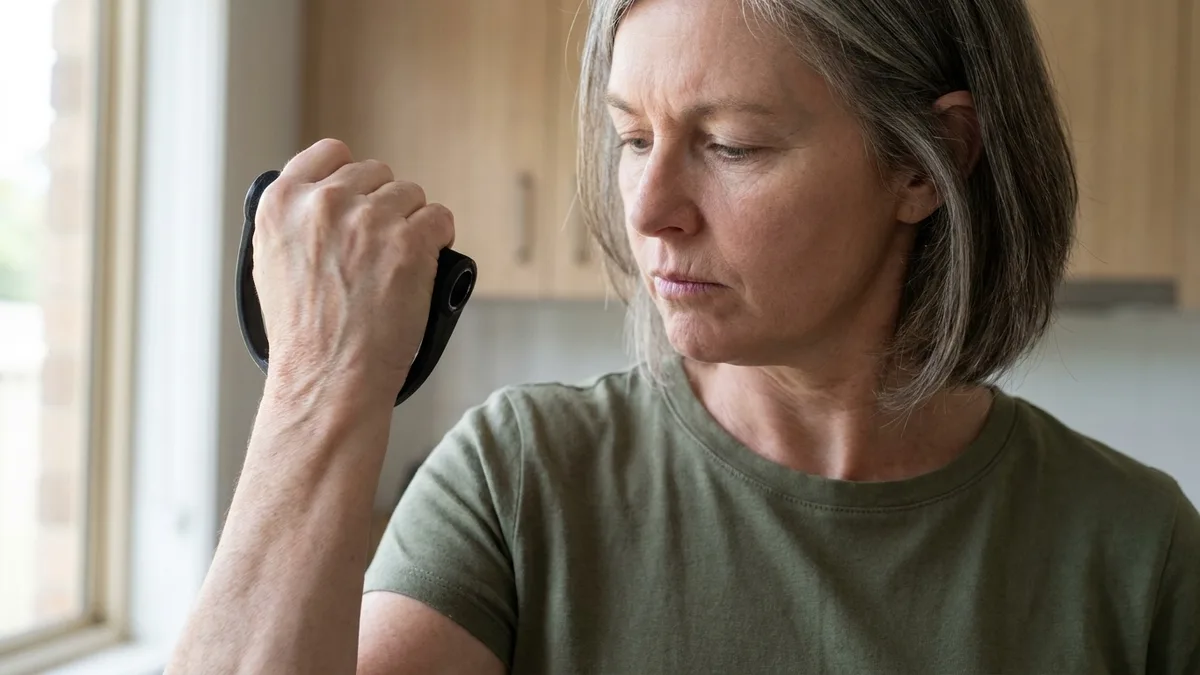
Can squeezing a handle for 30 seconds really tell you how long you will live? That is the question people type after a friend mentions a grip test or a news story links hand strength to mortality.
A firm handshake feels like a rough longevity meter, and a 30-second squeeze sounds like it might supply the reading. It measures one narrower thing: the most force each hand can produce under a fixed setup, not your overall fitness and not a clock.
What the number does give you is a signal of muscle and nerve function. Read it with your age, your sex, the device, and how it changes over time, and it stays useful. Read it alone and it misleads.
By the end you will be able to run the test, record your best score for each hand, and know whether to repeat it in six months or bring an unexpected result to a clinician.
The Grip Test at a Glance
What the 30-second grip test actually measures

It measures one thing: how hard each hand can squeeze a dynamometer under a fixed setup. Nothing more.
The tool is a hand dynamometer, a grip device with a handle that adjusts to your hand size. Clinics keep a calibrated model on the counter; home versions run $30 to $150 and work the same way when the handle fits. The full routine takes about 30 seconds: you sit down, squeeze as hard as you can twice with each hand, and the best score from each side gets written down.
What you walk away with is force in pounds or kilograms, recorded separately for the right and left hand. Not a whole-body fitness rating, not a grade for your health, just the peak force that hand produced.
That distinction matters after 40, when muscle and nerve function start changing quietly and a number you can track becomes useful precisely because it is narrow. The reading reflects the muscles in your forearm and hand, the nerves firing them, and the effort you put in on that squeeze. It does not sum up your cardio, your diet, or your habits.
So a dynamometer is a quick clinic measure of muscle and nerve function. It is not a diagnosis, and the score describes that hand's force under that setup on that day. Change the handle setting or the angle and the number moves.
Four Things to Know Before You Squeeze
Bring your recorded scores, device name, and any symptoms to your appointment.
Why doctors look at grip strength at all
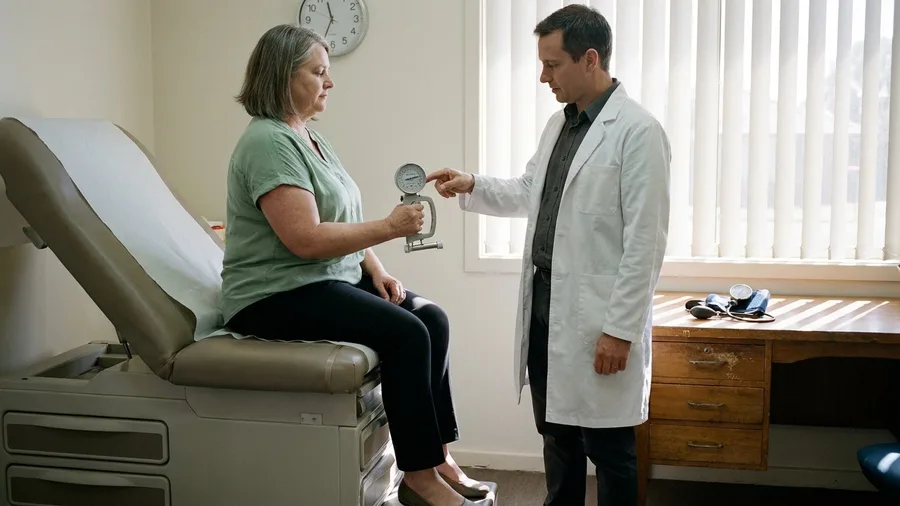
Because grip pulls on so many systems at once, a number that low can flag general decline without ever naming what is behind it. That is the point of a screening measure: it points, it does not diagnose.
Think about what a squeeze actually requires. The muscles of the forearm and hand have to contract, the nerves have to carry the signal cleanly, the joints of the wrist and fingers have to move without pain, and you have to put real effort in. Any one of those can drag the number down, which is why a weak grip can reflect trouble far from the hand itself.
That is also why grip shows up as one component of a frailty and function assessment, sitting alongside walking speed and balance rather than standing on its own. A marker is not proof of anything. Weak grip is associated with worse outcomes in study after study, but it does not establish that a weak squeeze shortens anyone's life. That is the line clinicians hold, and it is the line worth holding yourself.
There is a plainer reason it gets used at all. It is cheap, it takes 30 seconds, and it tracks well over time with the same device and the same position. For a reader in your 50s or 60s, that repeatability is the whole value: a score you can compare against your own score six months from now.
A low number is a signal, not a verdict

Not necessarily. A low reading has ordinary explanations, and most of them have nothing to do with how long you will live.
Start with the hand itself. An old injury, arthritis in the knuckles, tendon pain at the base of the thumb, a handle set too wide or too narrow for your grip, a night of poor sleep, a sloppy first attempt, or simple fatigue can all pull the force down. So can squeezing at a bad angle with your elbow braced or your wrist bent. Physical therapists see these technique errors constantly, and they alone can shave real pounds off a score.
One reading is not enough to draw anything from. Repeat the test under the same conditions, same device, same handle setting, same seated position, before you let the number mean anything. A single soft squeeze in a cold room is noise.
A trend is a different animal. If you repeat the test every few months and the score keeps dropping, that is a signal worth noticing, distinct from one low reading on one afternoon.
This is also where self-diagnosis goes wrong. The useful question is not what the number proves, but what else could explain it. That question, and the interpretation that follows, belongs with a clinician who knows your history.
⚠️ COMMON MISTAKE
Don't diagnose yourself from one squeeze
The most common mistake is treating a single low reading as a health verdict. Repeat the test calmly, record both hands, and bring the numbers to a clinician instead of chasing a diagnosis online.
Does grip strength really predict lifespan?

It cannot. A single grip score is not a forecast of how many years you have left, no matter how the headline framed it.
What a low or high reading gives you is a marker. It points at muscle and nerve function in that hand under that setup, and a marker asks for context, not a prophecy. There is a difference between a thermometer and a weather forecast: one tells you the temperature now, the other tells you next Tuesday.
You will see mortality percentages and cutoffs quoted online, usually attached to a single number for all adults. None of them belong in a personal calculation, and this article sets no cutoff of its own. Age- and sex-specific interpretation comes from your clinician or the device's official reference chart, and that is the only place it holds up.
The other direction matters just as much. A strong squeeze does not cancel the health risks that come from blood pressure, smoking, poor sleep, or skipped checkups. It is one small piece of evidence about how your muscles and nerves are behaving, not a pass. If the reading makes you want to act, a short routine for keeping moving pairs strength, balance and stretching in a manageable block.
And a weak reading does not override everything else your doctor knows about you. It sits alongside your labs, your history, your medications, and how you actually function day to day, and it gets weighed with them rather than over them.
That is the honest frame. The number is worth having, worth tracking, and worth asking about. It is not a date on a calendar.
What a Low Grip Score Could Reflect
From everyday causes to reasons for a clinician visit
- Fatigue or a bad night's sleep: Repeat the test on a normal day before reading anything into it.
- Poor technique or wrong handle size: Adjust the handle to your hand and follow the seated position exactly.
- Hand injury, arthritis or tendon pain: Pain in the hand changes the score; get the joint checked.
- A downward trend over months: A steady slide is more meaningful than one low reading.
- New weakness, numbness or pain: This warrants a clinician visit rather than a home retest.
This scale is illustrative, not a diagnostic cutoff. Interpretation belongs with your clinician.
How to do the test at home in 30 seconds
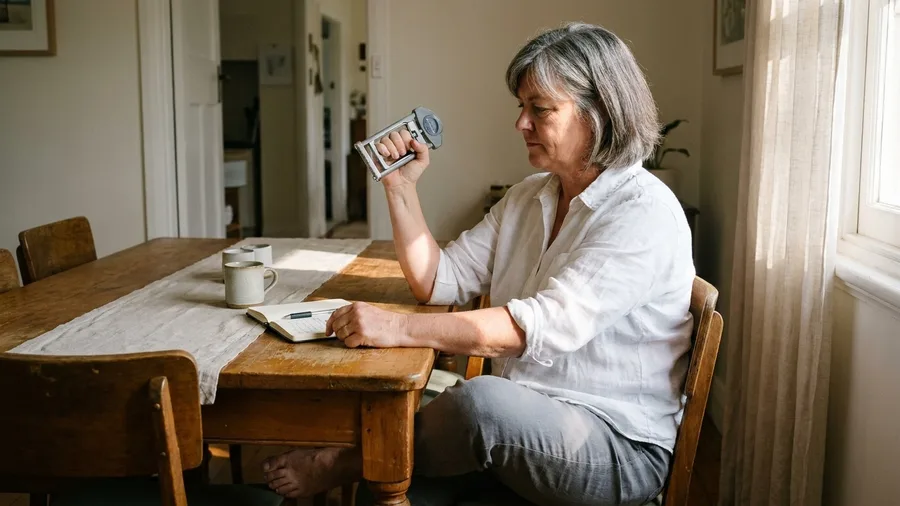
A correct home test takes 30 seconds and gives you a number you can compare with yourself later, which is the only comparison that reliably means anything.
Start with the device. A hand dynamometer, either a clinic-grade model or a home version that runs roughly $30 to $150. Before your first squeeze, adjust the handle to your hand size so the grip feels natural rather than pinched or stretched, and write down that setting so every retest starts the same way.
Now the setup, which matters more than most people expect. Sit with your back supported and your feet flat on the floor. Let your shoulder hang relaxed, bend your elbow to about 90 degrees, and keep your wrist in line with your forearm, like a handshake extended forward. Do not swing the arm or brace your elbow against your body for extra force; that turns the reading into something other than what you are trying to measure. Steady, supported movement is the same principle behind balance exercises to prevent falls, which train control rather than raw force.
Squeeze as hard as you can, two maximum efforts per hand, with a short rest between. Record the best score for each hand separately, in pounds or kilograms, and note which is your dominant side.
Keep the same device, handle setting, and seated position for every retest. Change any one of them and you are measuring the setup, not yourself.
🖐️ Your 30-Second Home Test
Know your number to beat
On a first test there is nothing to beat. The first score is the baseline. Get age and sex ranges from your clinician or the device chart; do not invent a cutoff.
Budget the full 30 seconds
Squeezes take seconds, rest between them takes seconds. Do not rush the rest to fit four squeezes in. A rushed rest undercuts the second attempt.
Pick the hand order and rest length
Finish both squeezes on one hand before switching to the other, with a short rest between attempts. Decide which hand goes first and keep that order on every retest.
Store the setup with the score
Write down the handle setting, seat height, and arm position next to the score. A retest that changes any of them cannot be compared.
Know which result to bring in
Bring a number to a clinician if one hand is clearly weaker than the other, the number keeps falling, or new weakness, numbness, or pain shows up alongside it.
What to compare your result against
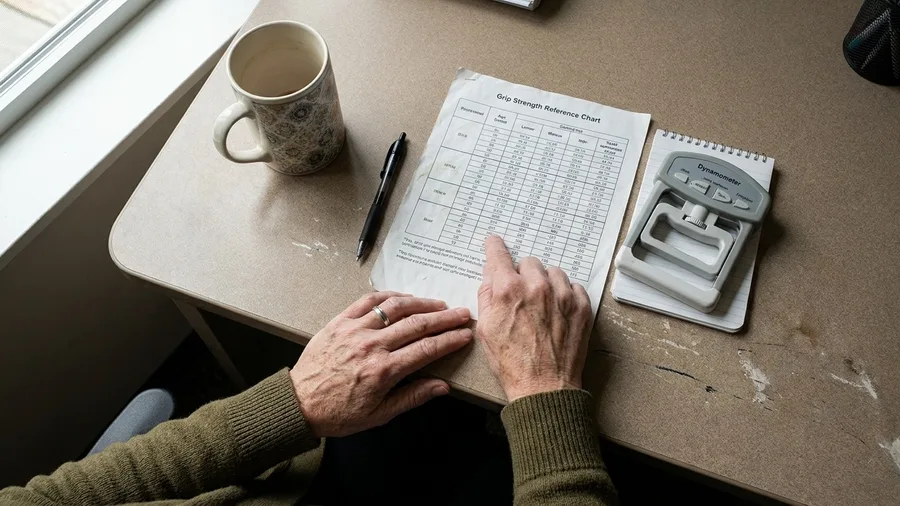
A raw number means very little on its own. Forty kilograms from a 45-year-old man's right hand and the same from an 80-year-old woman's left are not the same information, and comparing them tells you nothing useful.
The right reference is age- and sex-specific, and it comes from one of two places: your clinician or the official reference chart that ships with your device. This article deliberately sets no cutoff, because the line between normal and low shifts with both age and sex, and a number lifted from an article is not a reference range.
Compare dominant against nondominant hand within your own results. A modest gap is ordinary. A large one is worth mentioning to a clinician, because it can point at a single limb rather than a general picture.
One point that trips people up: a home device and a clinic dynamometer are not interchangeable scales. Home scores should not be compared directly with clinic scores, and if you ever get measured in an office, treat that number as a separate record rather than a target your home device has to match.
Then there is the comparison that carries the most weight of all, which is you against you. Repeat the test under identical conditions, note the dates, and watch the direction over months. A trend you can see beats a single reading every time.
Home Device vs. Clinic Test
Home Device
- Adjust the handle to your hand size before the first squeeze
- Two maximal squeezes per hand, best score kept
- Same device, same seated setup, every retest
- A big right-vs-left gap is your cue to book a visit
Clinic Test
- Ask which reference chart they use for your age and sex
- Seated, back supported, feet flat, elbow near 90 degrees
- Bring your home numbers and retest dates to the appointment
- New numbness, pain, or sudden weakness moves this up the list
Next steps for a low grip result
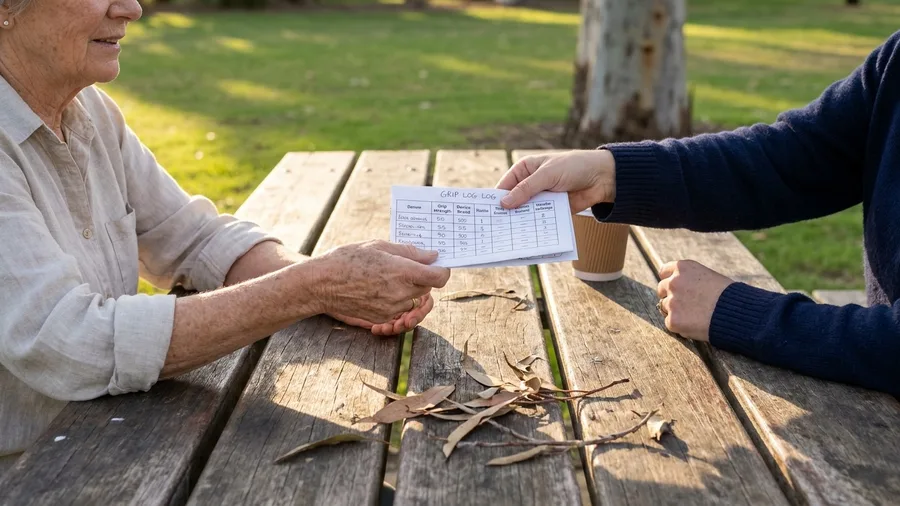
A result outside the expected range is a reason to sit down and repeat the test properly, not a reason to panic. Give it an hour. Then run it again, same chair, same handle setting, same device, two squeezes per hand, and write down the best score for each side. One low squeeze after a poor night of sleep or a stiff morning tells you almost nothing.
What the number does need is a second reading and a paper trail. Note the score, the device brand and model, the handle setting you used, and your seated position. Add symptoms while you are at it: numbness in the fingers, a thumb joint that aches, a hand that has been weaker since a fall.
Three findings earn a clinician visit. One hand is much weaker than the other. Your strength is dropping on repeat tests over months. Or the low score shows up alongside new weakness, numbness, or pain. Any one of those, and the conversation is worth having now rather than at your next routine appointment.
A clinician may look at arthritis in the thumb base, a nerve problem like carpal tunnel, an old injury, or the effects of a medication. General frailty is on that list too, and it is not an insult, just a finding with a plan attached.
Frequently Asked Questions
Can I do the grip test at home without a doctor?
Yes, with a hand dynamometer adjusted to your hand size. Follow the seated setup, squeeze twice per hand, and record the best score for each. Bring the numbers to a clinician for interpretation.
How often should I retest my grip strength?
Every few months is reasonable if you are tracking a change. Keep the same device, handle setting, and position so the comparison is fair. A single reading is not enough to draw conclusions.
Does a strong grip mean I will live longer?
Not necessarily. Grip strength is a marker of muscle and nerve function, not a forecast. A strong grip does not cancel other health risks, and a weak grip does not override other health information.
Why is one hand weaker than the other?
Some difference is normal, especially if you are right- or left-handed. A large gap, or a sudden change, is worth mentioning to a clinician, who can check for injury, nerve problems, or arthritis.
What should I bring to my appointment after a low score?
Bring your recorded scores for both hands, the device name, the handle setting, your seated position, any symptoms like numbness or pain, and any change over time. That context helps your clinician interpret the number.
The number on the gauge is a starting point, not a sentence
The number on the gauge is a starting point, not a sentence. A single grip score is a health signal that needs context, and it is not a personal lifespan forecast.
A firm squeeze is not a death clock, and a weak one is not a verdict, so do not hand either one power it has not earned.
Do the test properly once: set the handle to your hand, sit with your back supported, squeeze twice per hand, and write down both scores with the date. Then bring that number to a clinician for age- and sex-specific interpretation and next steps, which is the conversation the test is really asking you to have.
Test once, record both hands, then ask
Set up your dynamometer properly, log the date and device, and bring the numbers to your next appointment. The interpretation is the part that matters.