
By the end you will know exactly which foods to add, which to cut, how strict to be, and where the MIND evidence stops. Start with the first useful fact: MIND is a checklist of ten food groups to eat and five to limit, not a calorie plan.
Maybe a consumer DNA report handed you a line about APOE4, or you sat with a parent through an Alzheimer's diagnosis and started doing the arithmetic on your own future. The question underneath is blunt: if the odds already lean the wrong way, is changing your plate worth the effort?
The gene is a risk factor, not a diagnosis. One copy of APOE4 raises the odds and two raise them further, and no diet has been shown to cancel that. What MIND may do is lower or delay risk through vascular and inflammatory pathways. It is a real possibility, not a guarantee.
So the useful work is deciding what to add, what to cut, how closely to follow it, where the evidence runs out, and the one question to bring to a clinician. The MIND checklist is worth trying as a lever you control, because it targets those pathways without erasing your genes or standing in for medical advice.
MIND is Mediterranean and DASH, lightly edited
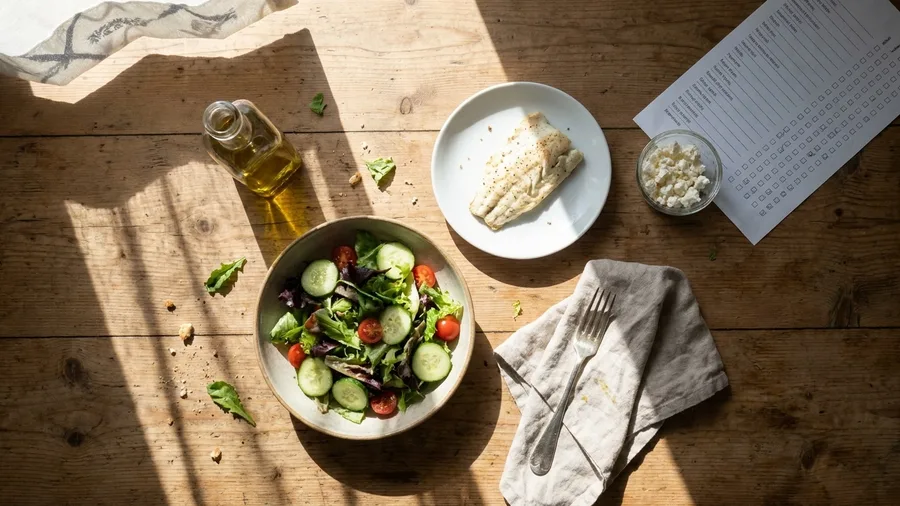
MIND is the Mediterranean and DASH patterns run through a filter built at Rush University in Chicago, where researchers wanted a single eating pattern aimed at brain aging rather than heart health alone. The letters stand for Mediterranean-DASH Intervention for Neurodegenerative Delay.
Most of the plate is unchanged from the Mediterranean pattern it borrows from.
Three edits separate it from its parent. Greens and berries no longer sit inside the general vegetable and fruit categories; each earns its own slot on the list, which pushes both toward daily or near-daily use. Cheese drops from a routine food to a rare one. Fish becomes a once-a-week box to tick rather than a general habit of eating it several times a week.
The result is a counting sheet, not a plan. Ten groups to eat and five to cut back, each with a frequency attached. Nothing about portions, nothing about calories, nothing to weigh.
Exact serving counts change with revisions, so get them from Rush's own MIND diet page rather than a blog that copied it secondhand.
This is the detail the edits hinge on: a lunch of bread, olive oil, a slice of cheese and a piece of fish reads as thoroughly Mediterranean and still lands on a limit. One meal can tick the fish box for the week and spend the cheese allowance at the same time.
| Point | MIND diet | Mediterranean diet |
|---|---|---|
| Leafy greens | Own category — most days | Included but not singled out |
| Berries | Own category — at least twice a week | Fruit generally, no berry focus |
| Cheese | Limit — less than once a week | Moderate — often daily |
| Fish | Once a week | Several times a week |
| Main added fat | Olive oil | Olive oil |
| Poultry vs red meat | Poultry preferred, red meat limited | Poultry preferred, red meat limited |
A bad gene shifts the odds, not the outcome

An APOE4 result tells you the odds have moved in the wrong direction; how far they move is not something you can rewrite by eating differently, and that was true before the first grocery list.
Of all the common variants, APOE4 carries the strongest link to Alzheimer's that begins later in life. One copy raises your risk; a second copy raises it further. Those are different numbers, not the same verdict twice.
Here is where the language has to be exact. This is a risk gene, not a gene that decides a diagnosis; it shifts probability the way a loaded coin does, and the coin still has to land. The rare inherited mutations behind early-onset disease, the kind that strike in the 40s and 50s, are a separate category handled by specialists.
So when a report puts APOE4 in front of you, the honest reading is this: a higher chance, not a diagnosis in waiting. Even two copies raise your odds without fixing your future in place.
No diet has been shown to cancel that. Not one trial has produced a food pattern that erases a genetic risk, and any article claiming otherwise is selling something. What the evidence supports, at most, is may lower or may delay.
If Alzheimer's in your family tends to arrive unusually early, or has hit several relatives across generations, take that pattern to a genetic counselor rather than a nutrition article; the questions there are medical ones.
🧭 2 quick taps · about 20 seconds
Where should you start with MIND?
Answer three quick questions to get your first move.
Start with this question
- What is your main reason for looking into MIND? I carry APOE4 or have a family history · I want a brain-healthy eating pattern · I have memory concerns
Then read the part written for you
- Talk to a doctor first — Memory concerns need a clinical evaluation, not a diet change. Make an appointment with your doctor to discuss what you are noticing. Diet can support brain health, but it cannot diagnose or treat a medical condition. 1 appointment Read: Start with oil, greens and berries this week →
- Start with three swaps — Begin with the three easiest entries: olive oil as your default cooking fat, a handful of berries at breakfast, and greens at one meal a day. These are low-effort changes that move you toward the MIND pattern without an overhaul. 3 swaps
- Go for the full checklist — You are ready to work through the 10 eat groups and 5 limit groups systematically. Focus on hitting the weekly targets for greens, berries, nuts, beans, whole grains, fish, and poultry, while cutting back on cheese, butter, red meat, sweets, and fried food. 10 + 5 groups Read: The ten foods to add, and how often →
Why food could still matter with APOE4
APOE4 is a gene for moving cholesterol and fats through the body, and cardiovascular health sits squarely inside the Alzheimer's story, which is why a diet that touches blood vessels can be relevant at all.
Picture how the gene works day to day: it codes a protein that shuttles lipids between organs, and the APOE4 version does that job less cleanly. Poorer lipid handling means more strain on arteries over decades, and damaged small vessels in the brain are part of how this disease develops.
That opens two pathways a plate can influence. Olive oil, nuts, fish and greens are tied to better vessel function and lower LDL; berries and other plant foods carry compounds studied for their effect on oxidative stress, the cell-level wear that inflammation leaves behind.
None of this proves benefit, and the gap matters. Studies showing a pathway is plausible do not show a brain spared; the trials that count measure thinking and memory over years, and their actual results belong on Rush's MIND diet page and the NIH National Institute on Aging's, not in a magazine.
The gene changes how large a lever diet might be, not whether one exists. For a reader who wants a biological reason before trading butter for olive oil, that is the trade on offer: no promise, but a mechanism worth a fair hearing.
💡 PRO TIP
The gene is not a life sentence
One APOE4 copy means elevated odds, not a diagnosis. Two copies raise the odds further but still do not fix the outcome. The rest of this article is about the lever you control.
The ten foods to add, and how often

If the biology is plausible, the practical part is a shopping list, and it starts with ten groups. Leafy greens and a second vegetable most days. Nuts most days. Berries at least twice a week, beans several times a week, whole grains at most meals, fish once a week, poultry twice a week. Olive oil becomes the main added fat. Wine is on the list too.
About that last one: nothing here suggests a non-drinker start. It sits on the checklist and stays optional, plain and simple.
Berries deserve a word of their own because they are the only fruit the pattern names. Blueberries and strawberries are listed first, and a bag of frozen berries from the freezer aisle counts exactly the same as fresh ones in July.
The frequencies above are the published targets, which is why they should come from Rush University's own frequency table rather than a half-remembered blog post. Check the source once, then post the numbers on the fridge.
Nothing about an APOE4 result adds a food to this list or removes one. What the gene leaves alone is your frequency, and frequency is the part you control, starting with the two easiest entries: frozen berries at breakfast and greens at one meal a day.
MIND diet at a glance
Source: Rush University MIND diet frequency table
The five to cut back, and what slips through

Pastries, fries, and a cheeseburger each land on the limit side of the same short list. The five groups to keep occasional rather than daily: red meat, butter and margarine, cheese, pastries and sweets, fried and fast food.
That is a small list, and it is exactly where a normal week stacks its overshoots. Cheese and butter are the pair that travel together – a slice of pizza, a turkey sandwich with a melted layer, a breakfast sandwich on the way to work can burn through both limits in one sitting without either feeling like an indulgence.
Fried and fast food means your default takeout order, not just the fries next to it. The drive-through habit is the whole meal, and the whole meal is the limit.
Three swaps do most of the work. Olive oil in place of butter on bread and in the pan. Poultry in place of beef a few nights a week. Nuts in place of chips at the desk drawer.
If you carry APOE4, nothing here asks you to eliminate any of the five; the goal is occasional, not gone. The limits are where the plate tends to overshoot, which is why tightening them pays off faster than perfecting the add side – no genotype required to start.
How closely you follow it seems to matter

Strictness cuts both ways: the people who follow the pattern most closely tend to show the best outcomes, and nobody keeps a pattern that only works at 100 percent. MIND is built to be graded, not to be pass-fail.
The evidence behind that is observational. Researchers track what people eat and how their thinking holds up over years, and the two move together – but association is not causation, and a pattern that looks protective may be a marker for people who do other protective things. Randomized trials can assign a pattern but still cannot promise a lifetime outcome.
This is why the published serving tables and trial results belong to Rush University's MIND diet page and the NIH National Institute on Aging, not to an article. Check the source before you build a week around a number you saw on a blog.
What that means practically: a plate that is roughly right most weeks is a real move, not a compromise. Aiming for ninety percent and hitting seventy is better than aiming for perfect and quitting in March.
And keep the whole picture honest. Diet is one lever beside blood pressure, exercise, quality sleep, and hearing – each pulled independently, none canceling the others. A food pattern is not a substitute for diagnosis or medical care; memory changes that worry you go to a clinician, not to a grocery list.
Start with oil, greens and berries this week

Three changes, held for two weeks, are the whole starting point: olive oil becomes the fat you reach for by default, a handful of frozen or fresh berries lands on breakfast, and greens turn up at one meal a day.
The olive oil swap costs the least effort and touches the most meals. Move the butter dish out of reach, keep a bottle of olive oil beside the stove, and roast, saute and drizzle with it instead.
Berries need no recipe. A half-cup of frozen blueberries stirred into oatmeal or yogurt thaws in the time it takes to pour coffee, and frozen costs less and lasts longer than fresh.
Greens are the one people skip, so make them automatic rather than ambitious: a handful of spinach wilted into eggs, or arugula under whatever lunch was already going to be.
Hold those three for two weeks before adding anything. The next arrivals are beans several times a week, then fish once a week.
One boundary worth stating plainly: supplements are not the pattern, and a capsule of berry extract is not the same lever as the berries. Memory concerns or a strong family history belong with a clinician; the genetic question belongs with a counselor.
These are edits to meals already in rotation, not a program with a start date and an end line. Nothing here asks about a genotype, and the gene does not move this week. Only the kitchen does.
Frequently Asked Questions
Can the MIND diet reverse Alzheimer's disease?
No. There is no evidence that any diet reverses Alzheimer's. The MIND diet is associated with lower risk or delayed onset in observational studies, but it is not a treatment for the disease. If you have memory concerns, see a doctor.
How long do I need to follow the MIND diet to see benefits?
Observational studies suggest that longer adherence is linked to greater benefit. Most research looks at patterns over years, not weeks. Start with small swaps and aim for consistency over time.
Is the MIND diet safe if I have other health conditions?
The MIND diet is generally safe and aligns with heart-healthy eating. However, if you have specific medical conditions or take medications, talk to your doctor before making significant changes, especially if you are considering alcohol or supplements.
Do I need to avoid cheese completely on the MIND diet?
No. Cheese is limited, not banned. The target is less than once a week. Occasional cheese is fine; the goal is to make it a treat rather than a daily staple.
Can I follow the MIND diet if I don't drink wine?
Yes. Wine is on the 'eat' list, but there is no recommendation for non-drinkers to start. If you do not drink, simply skip that item. The rest of the pattern stands on its own.
Does the MIND diet work for people with APOE4?
There is no guarantee, but the biological pathways the diet affects — vascular health and inflammation — are relevant even with APOE4. The diet may lower or delay risk, but it does not cancel genetic odds. Talk to your doctor about your overall risk.
The gene sets the odds, the plate is one lever you control
The verdict is narrow and clear: APOE4 and family history set the odds, the MIND pattern is one lever you genuinely control, and the evidence is promising rather than proven – no plate cancels genetic risk, but none of it is wasted either.
A DNA report or a parent's diagnosis changes the question from am I doomed to which lever do I pull this week. The answer is smaller than most guides admit: make olive oil the fat you reach for in place of butter, and hold it for a month.
Then bring one question to a doctor or genetic counselor: given my family history and my APOE4 result, what screening or risk advice should change?
The detail you started with – one copy of APOE4 on a page, or a name your parent forgot – is still true. But the gene sets odds, not a verdict, and the next meal is one input you choose.
Make the first swap tonight
Put the butter back and reach for the olive oil. Then check out the ten foods to add and the five to limit — your next grocery list is already there.